

The National Communications Commission (NCC) on Wednesday passed draft measures requiring telecoms and telecom service retailers to observe the “know your customer” principle when handling applications.
The measures were an upgrade from a set of guidelines issued last year to curb rising telephone fraud committed through local mobile phone numbers, the NCC said.
Based on the draft measures, mobile network operators would be required to verify the identities of corporate customers before assigning numbers by having a list of corporate account users, asking each user to present two identification documents and the purpose of using the numbers, verifying office locations and signing users’ affidavits, the commission said.
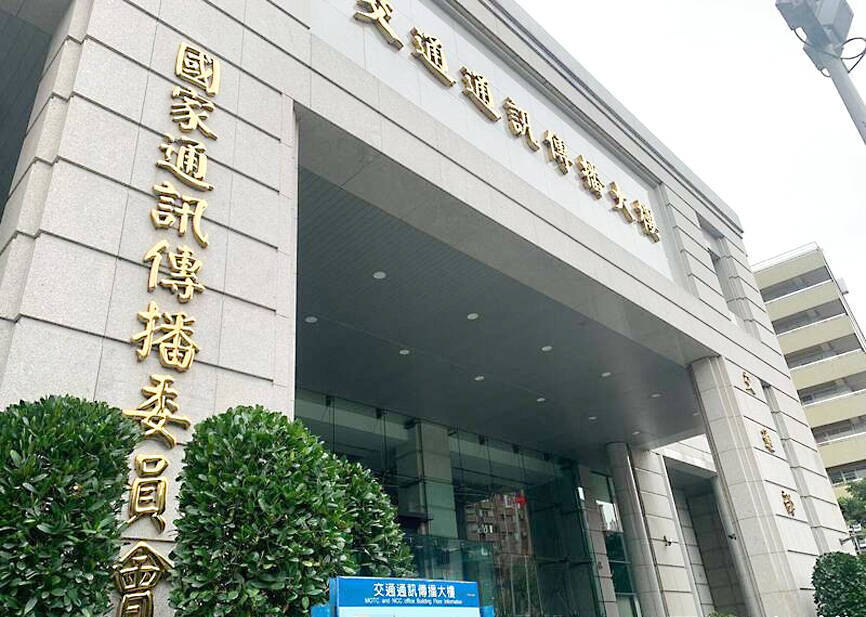
Photo: Taipei Times
Telecoms can dispatch personnel to visit their corporate customers to verify the information provided, it said.
Telecoms would be given one year after the measures take effect to correct any erroneous or incomplete information of their corporate customers, it said.
The “know your customer” principle applies to telecoms and retailers selling their services in stores or online, the commission said.
E-commerce operators are asked to jointly deter fraud by asking sellers on their platforms to prove they are certified telecom retailers. Service information they post should include their identity and a service agreement.
Telecoms should ask online platform operators to take down a telecom service or restrict view to it if the service information is false, according to the draft measures.
Meanwhile, NCC Vice Chairman and spokesman Wong Po-tsung (翁柏宗) said the draft regulations on the prevention and control of fraud proposed by the Ministry of the Interior would curb fraud committed through international roaming prepaid cards.
The problem was exposed after 25 Telecom (二五電訊) was found to have illegally sold international roaming prepaid cards, some of which were implicated in a fraud investigation conducted by the Yunlin Prosecutors’ Office.
“If you are in Taiwan, you should be using a local phone number rather than an international prepaid card,” Wong said.
“We will first announce a list of high-risk overseas telecom operators whose numbers are frequently related to fraud cases. The draft act, once passed, would allow us to work with the National Immigration Agency to check the arrival and departure database to see if people using high-risk international prepaid cards are in Taiwan or other countries,” he added.

NATURE TAKES ITS COURSE: The agency’s head said he felt a sense of loss watching red-banded snakes eat the babies, as they had decided on non-intervention The Forestry and Nature Conservation Agency yesterday released a documentary on a hundred-pace viper that had incubated 16 eggs, all of which hatched, but only a baby viper escaped after they were attacked by red-banded snakes. The agency’s Taichung branch last year launched the viper reproduction monitoring project soon after forest rangers Lin Chun-yu (林俊佑) and Chou Chia-cheng (周家成) spotted a pregnant hundred-pace viper in a grass-covered burrow near a parking lot in Tbulan Village (松鶴部落). The Atayal village, in Taichung’s Heping District (和平), is headed by Ecyang Yapu, who was positive about the project and assisted in access control and power

The Coast Guard Administration (CGA) yesterday said that it had deployed vessels to “monitor” Chinese ships operating in waters off the east coast. The CGA said it dispatched vessels in response to a China Coast Guard announcement that it had carried out another “routine law-enforcement patrol” in waters off the east coast. “The CGA firmly rejects China’s cognitive warfare campaign of ‘law enforcement in name, jurisdictional expansion in practice,’” it said on X. As of 11am yesterday, two China Coast Guard ships were “loitering and drifting” about 105 nautical miles (195km) and 74 nautical miles east of Green Island (綠島) respectively, it said. It

A sharp rise in compensation to be paid by air force officers who leave before completing their required service could indicate an increase in pilots leaving the military early, an analyst said on Friday, warning that the trend could worsen a shortage of experienced personnel. Chieh Chung (揭仲), a researcher at the Association for Strategic Foresight, issued the warning even though the number of volunteer military personnel is expected to increase next year. The planned headcount for volunteer military personnel, covering officers, noncommissioned officers (NCO) and enlisted soldiers, is 158,223 for next year, up 4,258 from 153,965 this year, Chieh said. The increase
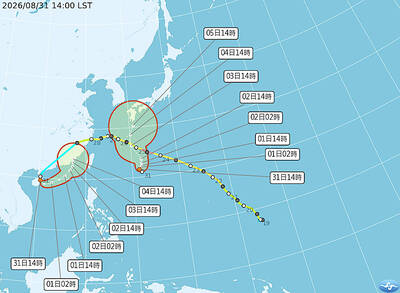
A tropical depression near Hainan that was once Typhoon Saudel may once again strengthen into a tropical storm, the Central Weather Administration (CWA) said yesterday, but a sea warning for waters around Taiwan is unlikely. CWA forecaster Huang En-hung (黃恩鴻) said that Saudel would return to being a weak tropical storm by late yesterday or early this morning. However, as the storm is to gradually weaken again and would head toward China’s Guangdong Province away from Taiwan, the chances that it would affect Taiwan enough for the CWA to issue a sea warning are relatively low,


 RSS
RSS