


The US’ repeated calls for a peaceful resolution to cross-strait differences means that it would increase arms sales to Taiwan if there is no peace across the Taiwan Strait, as arms sales and peace are linked, an academic said in Taipei yesterday.
Prospect Foundation deputy executive director Song Cheng-en (宋承恩) made the remarks at a symposium titled “The 45th Anniversary of the Taiwan Relations Act — Opportunities and Challenges in Taiwan-US Relations” held by the Taiwan New Century Foundation and the Taiwanese Society of International Law.
Song said the US’ Taiwan Relations Act (TRA) is expanding its previous framework of maintaining peace and stability in the western Pacific to the Indo-Pacific, ensuring that Taiwan has sufficient self-defense capacity and that the country’s future is determined peacefully — even making it a precondition for a US-China relationship.
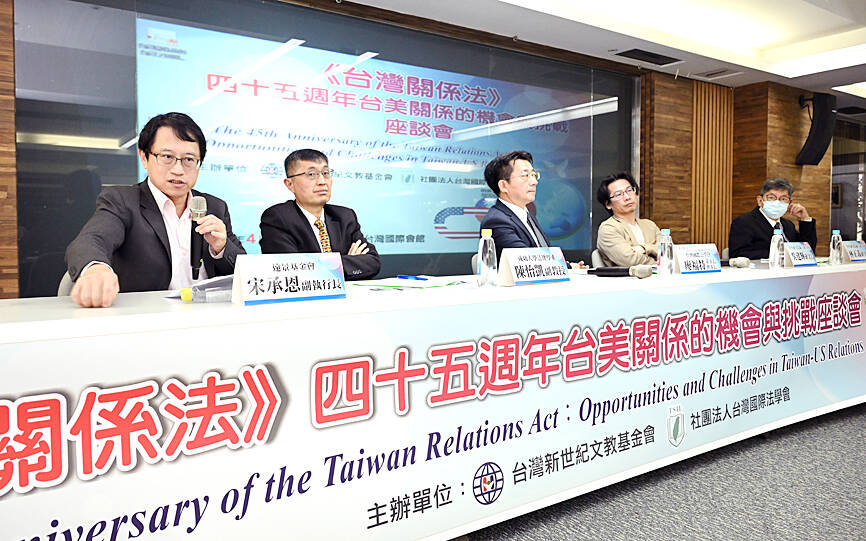
Photo: Liao Chen-huei, Taipei Times
The US has reiterated this condition more frequently in the past few years, which means that if China takes a more hostile attitude toward Taiwan, the Three Joint Communiques between the US and China might become invalid, he added.
The US’ priority is the TRA, followed by the Three Joint Communiques and the “six assurances,” so the communiques cannot override the TRA, Song said.
It also explains the dense war clouds hanging over the Taiwan Strait and why many countries are concerned over China’s use of force against Taiwan, he said.
Taiwan is a part of the US’ response to China’s aggressive efforts to change the international order, he added
The “six assurances” have been implicitly mentioned before, without written text, but US President Joe Biden’s administration has mentioned it more than once in statements, and this is “something that Beijing hates the most,” Academia Sinica research fellow Lin Cheng-yi (林正義) said.
The principles behind selling weapons to Taiwan have also changed, Lin said.
In 2022, the US Senate reviewed a draft of the Taiwan Policy Act, which proposed to allow sales of arms that are not only defensive in nature, but to also allow sales of “arms conducive to deterring acts of aggression by the People’s Liberation Army [PLA].”
Although the act has not been signed into effect, much of its content was later included in other laws or stated as policy directions, Lin said.
If the TRA needs to be amended, allowing sales of weapons that can deter PLA aggression would be one option, Lin added.
Another trend is defense cooperation and planning, Song said.
The US would do its best to arm Taiwan by allowing Taiwanese troops to be trained in the US or by sending US specialists to train Taiwanese soldiers, Song added.
The Taiwan Enhanced Resilience Act, which is built on the TRA, states that the US should enhance Taiwan’s national defense by arming the nation to become a “porcupine” and helping it to thoroughly reform its defense system.
The US would also establish multilateral partnerships in the Indo-Pacific and a US-Japan-Philippines defense cooperation could be an opportunity for Taiwan to establish links with other countries, Song said.
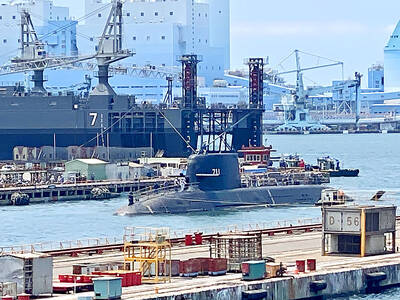
AGING: While Japan has 22 submarines, Taiwan only operates four, two of which were commissioned by the US in 1945 and 1946, and transferred to Taiwan in 1973 Taiwan would need at least 12 submarines to reach modern fleet capabilities, CSBC Corp, Taiwan chairman Chen Cheng-hung (陳政宏) said in an interview broadcast on Friday, citing a US assessment. CSBC is testing the nation’s first indigenous defense submarine, the Hai Kun (海鯤, Narwhal), which is scheduled to be delivered to the navy next month or in July. The Hai Kun has completed torpedo-firing tests and is scheduled to undergo overnight sea trials, Chen said on an SET TV military affairs program. Taiwan would require at least 12 submarines to establish a modern submarine force after assessing the nation’s operational environment and defense

A white king snake that frightened passengers and caused a stir on a Taipei MRT train on Friday evening has been claimed by its owner, who would be fined, Taipei Rapid Transit Corp (TRTC) said yesterday. A person on Threads posted that he thought he was lucky to find an empty row of seats on Friday after boarding a train on the Bannan (Blue) Line, only to spot a white snake with black stripes after sitting down. Startled, he jumped up, he wrote, describing the encounter as “terrifying.” “Taipei’s rat control plan: Release snakes on the metro,” one person wrote in reply, referring
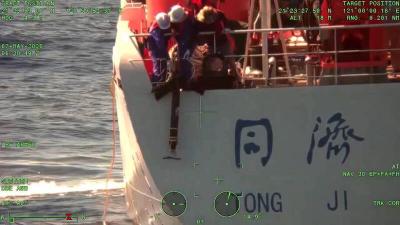
The coast guard today said that it had disrupted "illegal" operations by a Chinese research ship in waters close to the nation and driven it away, part of what Taipei sees a provocative pattern of China's stepped up maritime activities. The coast guard said that it on Thursday last week detected the Chinese ship Tongji (同濟號), which was commissioned only last year, 29 nautical miles (54km) southeast of the southern tip of Taiwan, although just outside restricted waters. The ship was observed lowering ropes into the water, suspected to be the deployment of scientific instruments for "illegal" survey operations, and the coast
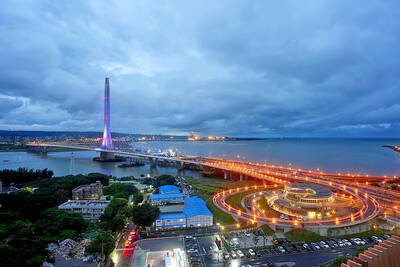
An inauguration ceremony was held yesterday for the Danjiang Bridge, the world’s longest single-mast asymmetric cable-stayed bridge, ahead of its official opening to traffic on Tuesday, marking a major milestone after nearly three decades of planning and construction. At the ceremony in New Taipei City attended by President William Lai (賴清德), Premier Cho Jung-tai (卓榮泰), Minister of Transportation and Communications Chen Shih-kai (陳世凱) and New Taipei City Mayor Hou Yu-ih (侯友宜), the bridge was hailed as both an engineering landmark and a long-awaited regional transport link connecting Tamsui (淡水) and Bali (八里)


 RSS
RSS