


Article 286 of the Criminal Code should be amended to impose the death penalty or life imprisonment on those guilty of child abuse leading to death, the Chinese Nationalist Party (KMT) caucus has proposed.
Under the current law, “a person who maltreats a minor under the age of 18, or impairs the mental or physical health or development thereof by other means” would be imprisoned for up to five years, while offenses that lead to the death of a minor could result in imprisonment for up to 10 years.
In its proposal, the KMT caucus called for the introduction of the death penalty or life sentencing for the abuse of children aged six or younger that leads to their death. For abuse that does not result in death, the minimum sentence would be raised from six months to seven years under the amendment.
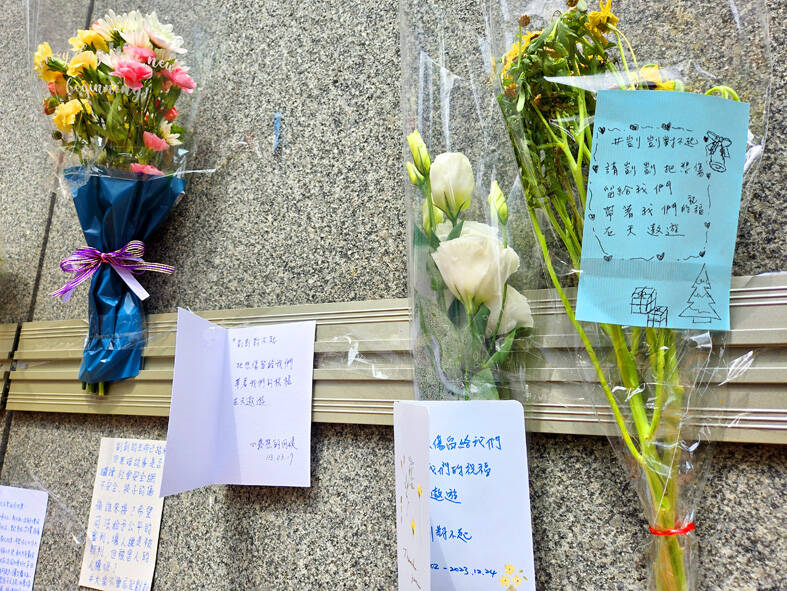
Photo: Lai Hsiao-tung, Taipei Times
The KMT caucus said the motivation for the proposal came from the public reaction to the death of a one-year-old boy, nicknamed Kai-kai (剴剴), who had allegedly been abused to death by a licensed in-home childcare provider in December last year.
The caregiver, surnamed Liu (劉), was arrested and detained in January in connection with the case.
“Article 286 of the Criminal Code was previously revised in May 2019 to increase the criminal liability for child abuse,” a statement from the caucus said.
“However, since then 25 children nationwide have died as a result of severe abuse. This shows that the previous revision has not curbed child abuse cases, and there is a need to increase criminal penalties.”
Nine proposals on the amendment were introduced by KMT legislators during the most recent legislative session. In addition to the version introduced by the caucus, one other version introduced by KMT legislators Hsu Hsin-ying (徐欣瑩) and Hung Meng-kai (洪孟楷) was also submitted for review.
In that version, stricter punishments are stipulated for the abuse of children aged three or younger. Under this version of the amendment, those abusing children up to the age of three would face imprisonment of between five and 12 years, while those whose abuse of a child aged three or younger that leads to the child’s death would face the death penalty or life imprisonment.

Yangmingshan National Park authorities yesterday urged visitors to respect public spaces and obey the law after a couple was caught on a camera livestream having sex at the park’s Qingtiangang (擎天崗) earlier in the day. The Shilin Police Precinct in Taipei said it has identified a suspect and his vehicle registration number, and would summon him for questioning. The case would be handled in accordance with public indecency charges, it added. The couple entered the park at about 11pm on Thursday and began fooling around by 1am yesterday, the police said, adding that the two were unaware of the park’s all-day live

Fast food chain McDonald's is to raise prices by up to NT$5 on some products at its restaurants across Taiwan, starting on Wednesday next week, the company announced today. The prices of all extra value meals and sharing boxes are to increase by NT$5, while breakfast combos and creamy corn soup would go up by NT$3, the company said in a statement. The price of the main items of those meals, if ordered individually, would remain the same. Meanwhile, the price of a medium-sized lemon iced tea and hot cappuccino would rise by NT$3, extra dipping sauces for chicken nuggets would go up

Yangmingshan National Park’s Qingtiangang (擎天崗) nature area has gone viral after a park livestream camera observed a couple in the throes of intimate congress, which was broadcast live on YouTube, drawing large late-night crowds and sparking a backlash over noise, bright lights and disruption to wildlife habitat. The area’s livestream footage appeared to show a couple engaging in sexual activity on a picnic table in the park on Friday last week, with the uncensored footage streamed publicly online. The footage quickly spread across social media, prompting a tide of visitors to travel to the site to “check in” and recreate the

Minister of Digital Affairs Lin Yi-ching (林宜敬) yesterday cited regulatory issues and national security concerns as an expert said that Taiwan is among the few Asian regions without Starlink. Lin made the remarks on Facebook after funP Innovation Group chief executive officer Nathan Chiu (邱繼弘) on Friday said Taiwan and four other countries in Asia — China, North Korea, Afghanistan and Syria — have no access to Starlink. Starlink has become available in 166 countries worldwide, including Ukraine, Malaysia, the Philippines and Vietnam, in the six years since it became commercial, he said. While China and North Korea block Starlink, Syria is not


 RSS
RSS