


Taiwan has been rated as the country most affected by disinformation for the 11th consecutive year in a study by the global research project Varieties of Democracy (V-Dem).
The nation continues to be a target of disinformation originating from China, and Hong Kong is increasingly being used as a base from which to disseminate that disinformation, the report said.
After Taiwan, Latvia and Palestine ranked second and third respectively, while Nicaragua, North Korea, Venezuela and China, in that order, were the countries that spread the most disinformation, the report said.
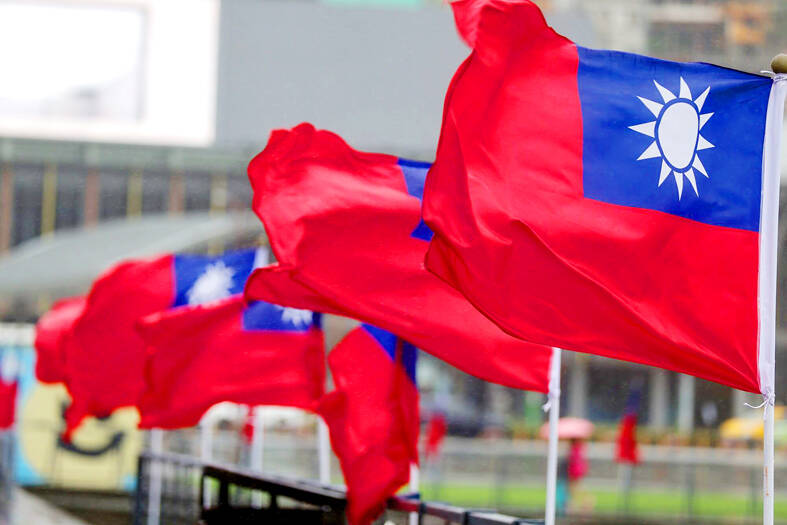
Photo: I-Hwa Cheng, Bloomberg
Each country listed in the report was given a score, and the lower the score, the greater the impact of disinformation was in that country, said National Cheng Kung University associate professor Wang Yi-ting (王奕婷), who participated in the study.
Taiwan’s score of 0.092 was the lowest among all countries listed, and was similar to its score last year, she said.
Countries such as Latvia, Belarus, Palestine and Israel also ranked high on the list of countries affected by disinformation because of the conflicts in Ukraine and the Gaza Strip, and attempts by certain actors to control the narrative on those conflicts, she said.
This year, China rose from sixth place to fourth on the list of countries that spread disinformation to the outside world, while Russia ranked ninth, placing in the top 10 for a second year in a row.
“Hong Kong has also risen on the list in recent years, particularly since 2018 when China began to tighten controls over the city,” Wang said.
National Changhua University of Education professor Liu Chao-lung (劉兆隆) said that disinformation targeting Taiwan — much like other international challenges facing the nation — originates almost exclusively in China.
“This disinformation aims to make the international community question Taiwan’s determination to resist an attack from China, which would affect the resolve of foreign powers to provide Taiwan with aid in the event of such an attack,” he said.
Taiwanese must be made aware of the threat of cognitive warfare, and be urged to refrain from spreading disinformation, he said.
Sky Fung (馮詔天), secretary-general of the Taiwan-based exile group Hong Kong Outlanders, said that the Chinese Communist Party also spreads propaganda about China’s progress and freedom, which misleads young people in Taiwan.
For example, disinformation spread in Taiwan following Hong Kong’s passage of Article 23 of the Basic Law aimed to convince Taiwanese that about 90 percent of Hong Kongers supported it, Fung said.
“At the same time there were a large number of negative remarks about Taiwan purportedly made by Hong Kong people that aimed to sow division between Hong Kong and Taiwan,” he said. “Taiwan must learn from these experiences and remain vigilant regarding such propaganda.”

FUKUOKA SITUATION: Japanese media reported that the pathogen is expected to be identified by the summer, while the CDC downplayed the idea that it was hMPV A “mysterious cold-like illness” reported in Japan’s Fukuoka Prefecture does not seem to be a new disease, but Japanese authorities have been asked about the situation, the Centers for Disease Control (CDC) said yesterday. The Fukuoka Prefectural Medical Association on Wednesday told a news conference that a “mystery cold” that has become a hot topic on social media is “highly likely to be caused by some kind of viral infection,” Japan’s KBC News reported. “Many people are experiencing symptoms starting with a sore throat, followed by a runny nose, phlegm and a severe cough,” KBC News reported, citing association officials. Health authorities are

Nvidia Corp CEO Jensen Huang (黃仁勳) arrived in Taiwan yesterday ahead of upcoming AI and technology events, saying he plans to meet with clients and Taiwan Semiconductor Manufacturing Co Chairman C.C. Wei (魏哲家) during his visit. After landing at Taipei Songshan Airport, Huang posed for photos with fans and handed out Yakult drinks to reporters and supporters waiting at the scene, saying he has “a lot to do” during the trip. Asked about reports that Nvidia’s planned headquarters site in Taipei’s Beitou Shilin Technology Park could break ground on May 27, Huang said that if the company holds an event, he would

Carrefour Taiwan is to begin using a new name from the start of July, but it cannot divulge the name until then, the chairman of the supermarket chain's parent company said today. President Chain Store Co chairman Lo Chih-hsien (羅智先) was asked by reporters after a shareholders' meeting to confirm whether the company has settled on a new name for the supermarket brand. In March, the government-registered name of two Carrefour Taiwan branches was quietly changed to "Le Chia Kang" (樂家康) in Chinese, raising speculation that has been selected as the name. Lo said that because of local regulations and contractual obligations, the

The Philippines would likely be involved in any conflict over Taiwan due to its proximity to the democracy claimed by China, President Ferdinand Marcos Jr said, reiterating a stance that risks angering Beijing. “In the Philippines, we do not have a choice because Taiwan is so close to the Philippines and we have almost 200,000 Filipino nationals living and working in Taiwan,” Marcos said in an interview with Japanese media in Manila on Monday. The Philippine leader’s comments come ahead of a state visit to Japan next week, where he is to meet with Japanese Prime Minister Sanae Takaichi to discuss security


 RSS
RSS