


Suspending group tours to China was a political decision made by national security officials, rather than by Tourism Administration officials, tourism industry representatives said at a news conference organized by the National Policy Foundation.
“The group tour ban was imposed out of political considerations and it is useless to talk about the legal basis for such a decision,” Travel Association of Chinese chairman Hsu Chin-ruey (許晉睿) said. “Tour operators only consider demand and goodwill, and whether Taiwan and China are on equal terms has never been an issue for them.”
Many Taiwanese have visited the US, but the government has never required the same number of Americans to visit Taiwan, Hsu said.
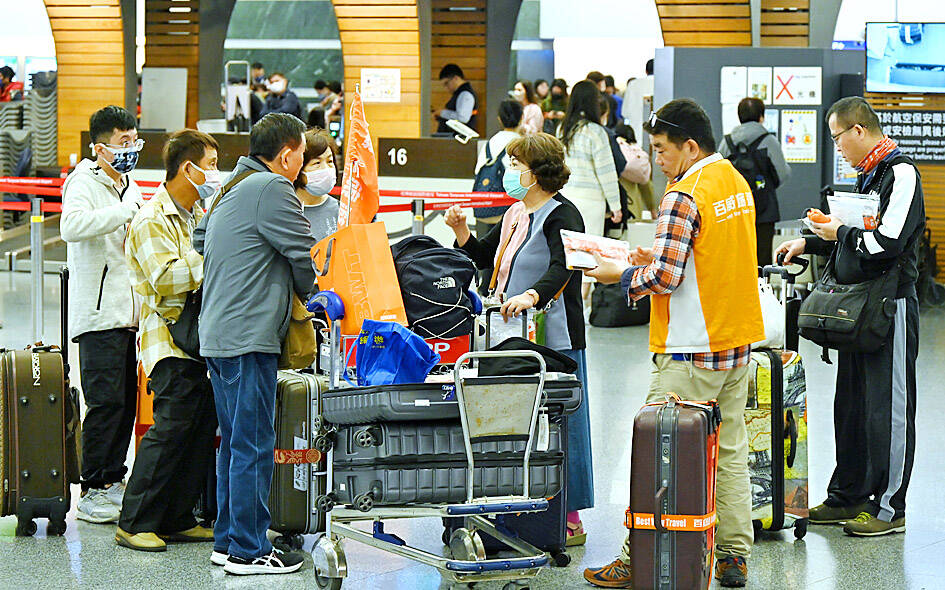
Photo: Liu Hsin-de, Taipei Times
Banning group tours to China is a political decision, and the ruling Democratic Progressive Party (DPP) wants the public to focus on statements made by the Tourism Administration, but the Mainland Affairs Council (MAC) has authority regarding cross-strait affairs, he said.
“Our interactions with officials of the Tourism Administration over the years have shown us that the agency in general respects and supports tourism operators. A day before the agency made the announcement to stop tours, I was even talking to some of them about details on resuming group tours on March 1,” Hsu said. “This shows it was the MAC officials, not the Tourism Administration, that decided to stop the tours.”
It requires effort from lawmakers and tour operators to ensure that Taiwanese travel agents can legally host tours to China, he said.
Chinese Business Association of World Culture and Travel’s vice president in Taiwan, Hsu Chuan-ping (許傳萍), said the government should tell her what the national interests really mean.
She is planning to protest on Ketagalan Boulevard on May 20 and host an international news conference saying the government is suppressing the development of the tourism industry.
Former KMT legislator Arthur Chen (陳宜民) said the government had earlier claimed the tourism industry would recover last year and it vowed to draw 6 million international visitors, of which 1 million would be from China.
Tourism Administration data showed while the nation last year attracted about 6.48 million international visitors, more than 11.79 million Taiwanese traveled overseas.
Of the international visitors, only 190,000 were from China, Chen said.
“The government has restricted exchanges between Taiwanese and Chinese by denying entry of Chinese business travelers into Taiwan and only allowing some Chinese arriving for healthcare,” Chen said. “Taiwanese are allowed to travel to China individually, but not allowed to join group tours. What happens is that these travelers form groups after arriving in China.”
KMT Legislator Weng Hsiao-ling (翁曉玲) said that the Tourism Administration previously banned group tours to China due to the implementation of the Special Act for Prevention, Relief and Revitalization Measures for Severe Pneumonia with Novel Pathogens, which was abolished last year following a significant decline of COVID-19 cases.
Everything should have returned to normal when the restrictive measures were lifted, and the Act for the Development of Tourism (觀光發展條例) does not ban travel agents from organizing group tours, Weng said.
Tourism officials, along with those from MAC and the Ministry of Transportation and Communications, simply used an administrative order to restrict people’s right to travel and form group tours, which lacks legal backing and risks contravening the principle of legal reservation, Weng said.
“The Tourism Administration has frequently cited Article 53 of the Act for the Development of Tourism as the legal basis to impose a ban on group tours to China. However, the article applies to the groups that have visited China and were found to have engaged in behaviors that tarnish Taiwan’s national dignity,” Weng said.
“How can the administration presume that these tour groups would engage in illegal behavior if they have not arrived there yet?” she asked.
“If forming tour groups to China could compromise national interests, then should we not ban direct navigation and aviation services across the Taiwan Strait?” Weng asked.
The MAC can only restrict people from traveling to China through the approval of the Executive Yuan and the legislature, a procedure that it clearly did not follow, she said.
Weng said the MAC and the Tourism Administration abused their administrative power and caused substantial damage to tour operators, adding they are entitled to seeking compensation from the government.
The Control Yuan should investigate the MAC, the ministry and the Tourism Administration for administrative irregularities, she said.

Considering that most countries issue more than five denominations of banknotes, the central bank has decided to redesign all five denominations, the bank said as it prepares for the first major overhaul of the banknotes in more than 24 years. Central bank Governor Yang Chin-lung (楊金龍) is expected to report to the Legislative Yuan today on the bank’s operations and the redesign’s progress. The bank in a report sent to the legislature ahead of today’s meeting said it had commissioned a survey on the public’s preferences. Survey results showed that NT$100 and NT$1,000 banknotes are the most commonly used, while NT$200 and NT$2,000

The Centers for Disease Control (CDC) yesterday reported the first case of a new COVID-19 subvariant — BA.3.2 — in a 10-year-old Singaporean girl who had a fever upon arrival in Taiwan and tested positive for the disease. The girl left Taiwan on March 20 and the case did not have a direct impact on the local community, it said. The WHO added the BA.3.2 strain to its list of Variants Under Monitoring in December last year, but this was the first imported case of the COVID-19 variant in Taiwan, CDC Deputy Director-General Lin Ming-cheng (林明誠) said. The girl arrived in Taiwan on

ANNUAL EVENT: Two massive Pokemon balloons are to be set up in Daan Park, with an event zone operating from 10am to 6pm This year’s Taipei Floral Picnic is to be held at Daan Park today and tomorrow, featuring an exclusive Pokemon Go event, a themed food market, a coffee rave picnic area and stage performances, the Taipei Department of Information and Tourism said yesterday. Two massive Pokemon balloons are to be set up in the park as attractions, with an exclusive event zone operating from 10am to 6pm, it said. Participants who complete designated tasks on-site would have a chance to receive limited-edition souvenirs, it added. People could also try the newly launched game Pokemon Pokopia in the trial area, the department said. Three PokeStops are

South Korea is planning to revise its controversial electronic arrival card, a step Taiwanese officials said prompted them to hold off on planned retaliatory measures, a South Korean media report said yesterday. A Yonhap News Agency report said that the South Korean Ministry of Foreign Affairs is planning to remove the “previous departure place” and “next destination” fields from its e-arrival card system. The plan, reached after interagency consultations, is under review and aims to simplify entry procedures and align the electronic form with the paper version, a South Korean ministry official said. The fields — which appeared only on the electronic form


 RSS
RSS