


The Control Yuan has issued corrective measures against the Ministry of National Defense’s Armaments Bureau and its 205th Arsenal after scandals involving abuse of authority, corruption and collusion.
The Kaohsiung-based 205th Arsenal and its supervisory agency, the Armaments Bureau, have been ordered to reassess their internal oversight and evaluation mechanisms, and to address the graft and inefficiency problems in procurement, Control Yuan members Wang Mei-yu (王美玉), Lai Ting-ming (賴鼎銘) and Kuo Wen-tung (郭文東) said in a statement yesterday.
The Control Yuan on Jan. 9 issued a report saying it had impeached three 205th Arsenal officers: chief of engineering and former army colonel Lin Lung-chi (林龍基), and Lin’s two subordinates, Lin Yi-ming (林憶明) and Lu Chien-hsun (呂建勳), who had both been master sergeants.
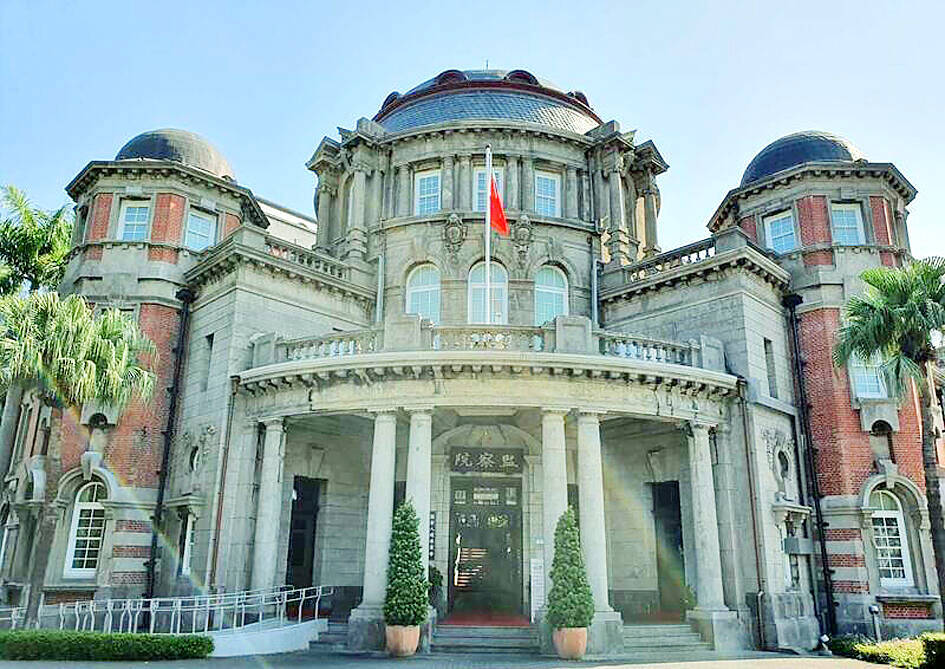
Photo: Hsieh Chun-lin, Taipei Times
The trio were found to have abused their authority regarding procurement tenders, obtaining financial benefits from two contractors, and were treated to banquets, entertainment at nightclubs and hostess services, the Control Yuan said.
They also leaked the details of new weapon designs and specifications to contractors, the release said.
Another three officers, including a former colonel surnamed Huang (黃) and two subordinate officers in charge of the 205th Arsenal’s materials supply section, received special treatment from two contractors, including entertainment at nightclubs and hostess services, and were invited to banquets, the release said.
The officers were in charge of procurement, but they colluded with contractors to receive benefits, it said.
“Other instances were found ... of improper actions by these and other staff. They took place for over a year, but no complaints or internal whistle-blower reports were filed,” the Control Yuan said.
During the period, the six officers still received A or A+ grades in their year-end performance evaluations, it said.
“This indicates that the 205th Arsenal has lax management, is lacking supervision and engaged in fraudulent evaluations,” the Control Yuan said.
“The Armaments Bureau has expanded its production plans over the past few years, opening up to private-sector suppliers and contractors. Therefore, it is necessary to monitor the efficiency and success rate of procurement programs,” it said.
“Systematic programs must be implemented to assist private firms in producing military hardware, to ensure Taiwan is self-sufficient with regard to its indigenous defense weapons production,” the Control Yuan added.

NATIONAL SECURITY: Authorities are working to confirm the identities of the military personnel involved and investigating possible illegal conduct and regulatory violations Authorities are probing possible national security implications after Kinmen police and immigration officers on Sunday found a Chinese woman allegedly posing as a tourist while engaging in prostitution involving more than 10 military personnel. The woman, surnamed Chen (陳), has since been deported, authorities said, adding that investigators are still working to confirm the identities of those implicated, as the records only listed code names and aliases. The case stemmed from a report received by the Kinmen District Prosecutors’ Office on Friday last week from the Jinhu Precinct of the Kinmen County Police Bureau. On Sunday, police, along with the National Immigration

REASONS FOR TRAVEL: An assistant professor said that proposed amendments to penalize drivers if they used drugs overseas would not deter people from traveling People who operate a motor vehicle under the influence of marijuana would have their driver’s license revoked, even if they used the substance while overseas, the Ministry of Transportation and Communications said yesterday, citing proposed amendments to the Road Traffic Management and Penalty Act (道路交通管理處罰條例). The amendments would also authorize the government to revoke the licenses of people determined to have used Category 1 or Category 2 narcotics, even if they were not operating a vehicle while under the influence of drugs, as well as ban them from taking the license test for three years, the ministry said. People aged 18 or

GLOBALGIVING: ‘ Caving to external pressure is not acceptable for an organization that has cultivated justice reform and human rights for 30 years,’ one NGO said A slew of non-government organizations (NGOs) have withdrawn from the GlobalGiving fundraising platform after it announced it would use “Chinese Taipei” instead of “Taiwan” from next month. The Taiwan Good Rice Association wrote on Facebook on Friday that it was informed on April 28 via a teleconference call of the change, which was made because the platform wanted to operate in China. Taiwan Good Rice is to terminate all cooperative relationships with GlobalGiving in response to the platform’s “unilateral and non-negotiable” decision to remove references to Taiwan, the NGO said. “Taiwan is in the official name of Taiwan Good Rice Association and the

HEAVY WEATHER: Typhoon Jangmi is due to crash straight into the Ryukyus as airlines look to shift flights to larger aircraft or cancel flights to Okinawa entirely Taiwan’s international air carriers announced flight adjustments over the weekend as Typhoon Jangmi is forecast to hit the Ryukyu Islands today and tomorrow. The Central Weather Administration (CWA) upgraded Jangmi from a tropical storm to a typhoon at 8am yesterday, with the eye located 580km south of Naha city. It was moving north at 19kph. Today, China Airlines’ CI-120, CI-121, CI-122 and CI-123 flights between Taoyuan and Naha, Okinawa, have been canceled as well as CI-132 and CI-133 between Kaohsiung and Naha. EVA Air’s BR-112, BR-113, BR-186 and BR-185 flights between Taoyuan and Naha are also canceled. Low-cost carrier Tigerair Taiwan canceled IT-230,


 RSS
RSS