


The Kaohsiung branch of the High Court yesterday increased prison sentences for four people who worked for a forced labor group in Cambodia after rejecting their claims in a second trial.
The defendants, women surnamed Chen (陳), Lai (賴) and Chou (周) and a man surnamed Lin (林), in the first trial said they had been physically forced to engage in fraud and other criminal activities after taking a job offer in the Southeast Asian country.
Accepting the claims, the Pingtung District Court sentenced the women to 11 months to two years and two months in prison, while Lin received a deferred sentence of five years in prison.
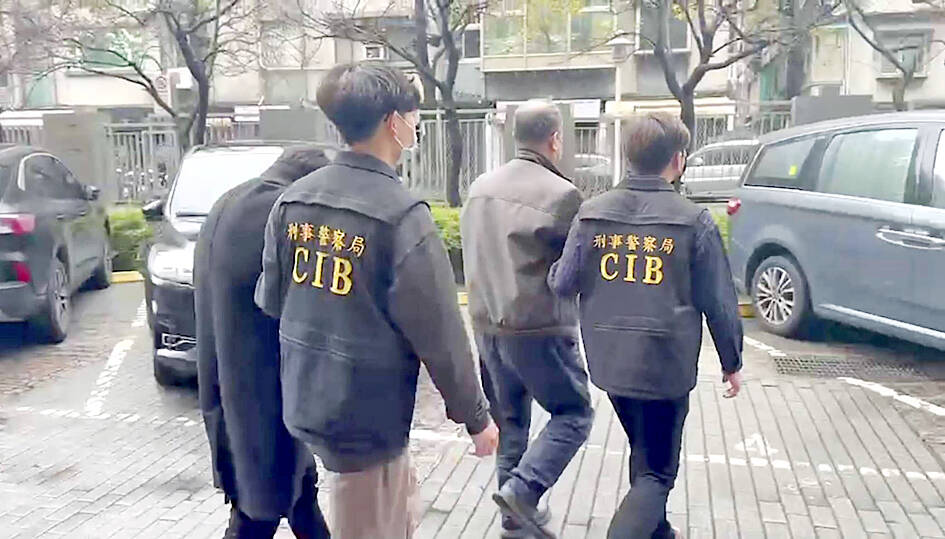
Photo: CNA
The High Court’s Kaohsiung branch determined the women willingly stayed in Cambodia without any coercion, it said.
There is evidence showing Chen, Lai and Chou partying at a pub in celebration of the business with the forced labor organization’s leaders, which disqualified them from sentence reduction, the court said.
There was no evidence that the women were abused, it added.
The male defendant surnamed Lin also had a disqualifying condition in the form of a prior conviction with a sentence of one year and eight months in prison, the court said.
The court sentenced Chen to three years and eight months in prison, Lai to three years and two months in prison, Chou to one year and seven months in prison, and Lin to two years, it said.
The branch court in the verdict said Chen, Lai and Chou were recruited into a snakehead organization known as Wanyuan (萬源), Wanli (萬利) or Wanku Group (萬古), creating job postings to find targets.
The three women told the victims via text messages that the group was hiring typists and that they would start at a salary of NT$40,000 per month in addition to bonuses, with accommodation and meals included, it said.
The man was tasked with transporting the victims after their arrival in Cambodia, taking care of paperwork and forging COVID-19 vaccination records, the branch court said.
The group would confiscate the victims’ passports and phones to make them work against their will, beating or confining those who disobeyed and sometimes sold them to other groups, it said.
A total of 10 people were caught in the scheme and eight of them were ransomed back to Taiwan by family, triggering a police investigation, the court said.
This verdict is not final.

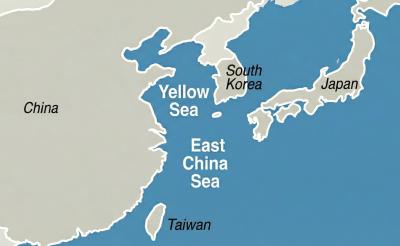
China has reserved offshore airspace in the Yellow Sea and East China Sea from March 27 to May 6, issuing alerts usually used to warn of military exercises, although no such exercises have been announced, the Wall Street Journal (WSJ) reported yesterday. Reserving such a large area for 40 days without explanation is an “unusual step,” as military exercises normally only last a few days, the paper said. These alerts, known as Notice to Air Missions (Notams), “are intended to inform pilots and aviation authorities of temporary airspace hazards or restrictions,” the article said. The airspace reserved in the alert is

South Korea is planning to revise its controversial electronic arrival card, a step Taiwanese officials said prompted them to hold off on planned retaliatory measures, a South Korean media report said yesterday. A Yonhap News Agency report said that the South Korean Ministry of Foreign Affairs is planning to remove the “previous departure place” and “next destination” fields from its e-arrival card system. The plan, reached after interagency consultations, is under review and aims to simplify entry procedures and align the electronic form with the paper version, a South Korean ministry official said. The fields — which appeared only on the electronic form

A bipartisan group of US senators has introduced a bill to enhance cooperation with Taiwan on drone development and to reduce reliance on supply chains linked to China. The proposed Blue Skies for Taiwan Act of 2026 was introduced by Republican US senators Ted Cruz and John Curtis, and Democratic US senators Jeff Merkley and Andy Kim. The legislation seeks to ease constraints on Taiwan-US cooperation in uncrewed aerial systems (UAS), including dependence on China-sourced components, limited access to capital and regulatory barriers under US export controls, a news release issued by Cruz on Wednesday said. The bill would establish a "Blue UAS
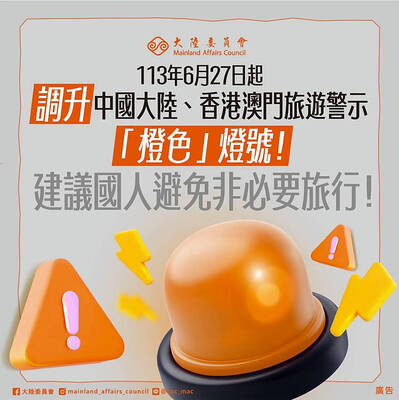
More than 6,000 Taiwanese students have participated in exchange programs in China over the past two years, despite the Mainland Affairs Council’s (MAC) “orange light” travel advisory, government records showed. The MAC’s publicly available registry showed that Taiwanese college and university students who went on exchange programs across the Strait numbered 3,592 and 2,966 people respectively. The National Immigration Agency data revealed that 2,296 and 2,551 Chinese students visited Taiwan for study in the same two years. A review of the Web sites of publicly-run universities and colleges showed that Taiwanese higher education institutions continued to recruit students for Chinese educational programs without


 RSS
RSS