


Seventy-eight percent of survey respondents in the latest British Business Survey have an optimistic outlook on Taiwan’s economic prospects in the next three years, the Britsh Office Taipei said.
“This latest survey received a total of 76 responses from British business, 59 percent of which operate in the energy and semiconductor sectors. Respondents were positive about Taiwan’s economy (78 percent) and optimistic about the outlook for their business in Taiwan over the next one to three years, a growth in confidence compared to previous years,” the office said in a release on Thursday.
“Respondents have high expectations of opportunities in the energy and net zero sectors (83 percent),” it added, citing British businesses as saying that digital trade and the investment environment are improving and that they generally feel comfortable conducting business in Taiwan.
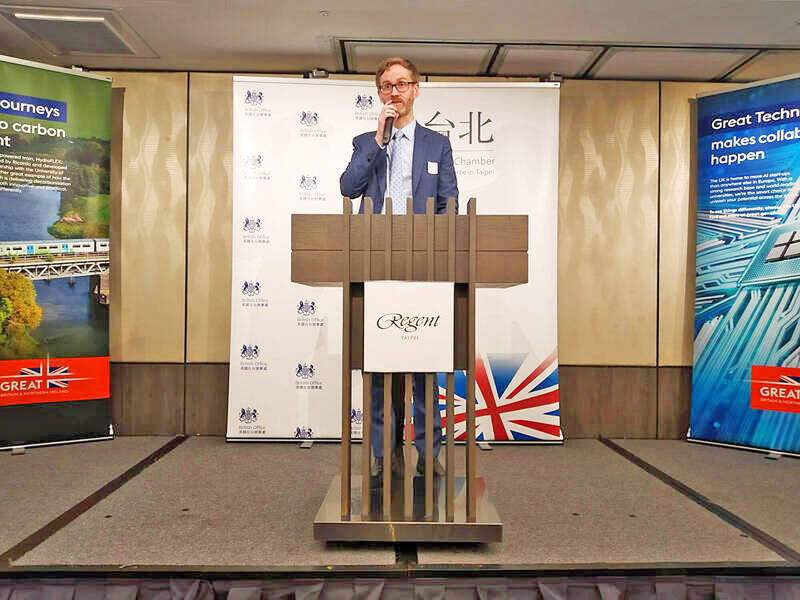
Photo courtesy of the British Office Taipei
“Fifty percent of the British businesses who responded said that Taiwan’s strengths in advanced technology was the primary reason they invested here, with the semiconductor, energy and advanced engineering sectors ranked top in Taiwan for growth potential and investment opportunities,” the office said.
Meanwhile, the annual British business survey results also noted challenges, including that “respondents think that public administration needs to be more efficient and digitalized,” while energy supply and cross-strait relations are seen as the most pressing policy challenges, especially with regard to investing into Taiwan.”
“Making renewable energy goals, plans and project requirements much clearer is seen as a pressing challenge to net zero [carbon emissions] and energy companies,” the survey results said. It added that “Domestic protectionism in the form of local content and local partnership requirements could be reduced,” while the import processes could be improved to be more in line with international standards.”

FUKUOKA SITUATION: Japanese media reported that the pathogen is expected to be identified by the summer, while the CDC downplayed the idea that it was hMPV A “mysterious cold-like illness” reported in Japan’s Fukuoka Prefecture does not seem to be a new disease, but Japanese authorities have been asked about the situation, the Centers for Disease Control (CDC) said yesterday. The Fukuoka Prefectural Medical Association on Wednesday told a news conference that a “mystery cold” that has become a hot topic on social media is “highly likely to be caused by some kind of viral infection,” Japan’s KBC News reported. “Many people are experiencing symptoms starting with a sore throat, followed by a runny nose, phlegm and a severe cough,” KBC News reported, citing association officials. Health authorities are

Nvidia Corp CEO Jensen Huang (黃仁勳) arrived in Taiwan yesterday ahead of upcoming AI and technology events, saying he plans to meet with clients and Taiwan Semiconductor Manufacturing Co Chairman C.C. Wei (魏哲家) during his visit. After landing at Taipei Songshan Airport, Huang posed for photos with fans and handed out Yakult drinks to reporters and supporters waiting at the scene, saying he has “a lot to do” during the trip. Asked about reports that Nvidia’s planned headquarters site in Taipei’s Beitou Shilin Technology Park could break ground on May 27, Huang said that if the company holds an event, he would

The Ministry of Finance this afternoon announced the winning numbers for the March-April uniform invoice lottery. The winning number for the NT$10 million (US$318,060) special prize is 19531471, and the winning number for the NT$2 million grand prize is 85941329. Three numbers were drawn for the NT$200,000 first prize: 07225810, 20231230 and 83518781. Those with receipts matching the last seven digits of any of the first-prize numbers will win the NT$40,000 second prize, while those matching the last six digits will win the NT$10,000 third prize. Those whose receipts match the last five digits of the first-prize numbers can claim the NT$4,000 fourth prize,
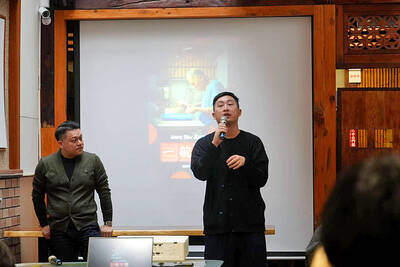
Taiwan Travelogue (臺灣漫遊錄), which earlier this week became the first Taiwanese novel to win the International Booker Prize, is to be adapted into a television series through a Taiwan-Japan coproduction, producer Chang Chen-yu (張辰漁) said yesterday. Chang, a producer at World Softest Production Film Co, wrote on Facebook that the company had been searching for projects with international appeal that retain a strong Taiwanese identity after colleagues and Japanese partners strongly recommended the novel. After reading the book, Chang said he immediately decided to pursue the screen rights. “A great story has the power to transcend time and borders, and connect countless people,”


 RSS
RSS