


Taiwan People’s Party (TPP) Chairman Ko Wen-je (柯文哲) said his party has successfully demonstrated through yesterday’s elections that Taiwanese politics involve more than just the pan-blue and pan-green camps, and he would continue to work hard to make the TPP the ruling party in four years.
Ko and his running mate, TPP Legislator Cynthia Wu (吳欣盈), arrived at a post-election rally in front of his national campaign headquarters in New Taipei City’s Sinjhuang District (新莊) at about 8pm and were greeted by supporters passionately waving flags and calling his name.
Expressing gratitude to his supporters and staff, Ko said he is grateful that despite what he called attacks from both the Chinese Nationalist Party (KMT) and the Democratic Progressive Party (DPP), so many people supported him and the TPP, and never gave up.
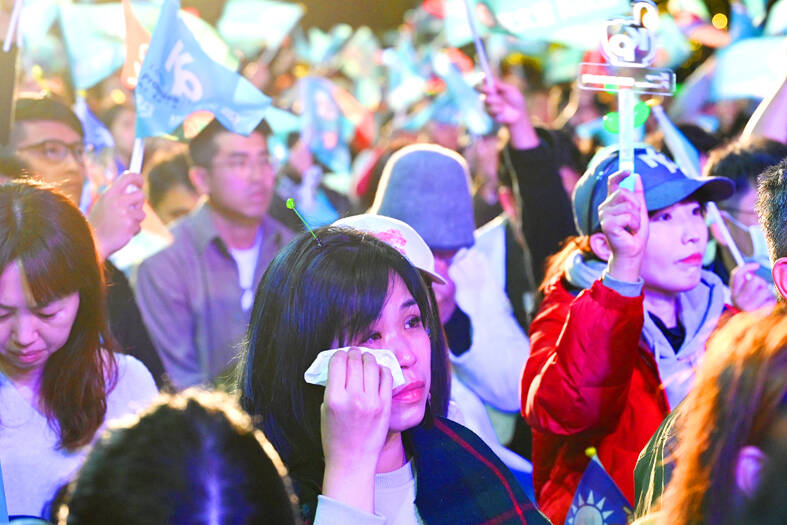
Photo: Wang Yi-sung, Taipei Times
“We have proven to the world that Taiwan does not only have the pan-blue and pan-green camps, and that democracy is ultimately the nation’s most important asset,” he said, adding that this is the first time in Taiwan’s history that three major parties emerged from the elections, and that the TPP has become a critical opposition force.
Ko said the party has achieved the impossible by running its election campaign solely with small donations, and the model would have a positive impact on the nation’s political development.
He would not give up on pursuing justice and a sustainable nation, Ko said, as he asked his supporters to never give up and continue being Taiwan’s conscience.
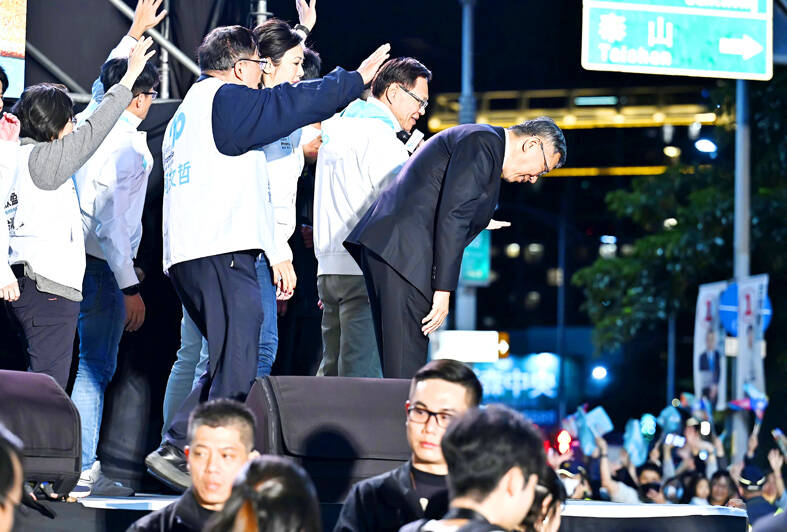
Photo: Chen Chih-chu, Taipei Times
“Everyone will feel sad tonight, but we have no time to remain sad, as the nation must move forward, and we cannot give up after a setback,” he said, adding that he and the TPP staffers would wake up and start working at 7:30am today, and his supporters should refresh themselves and start again today.
While he did not directly concede defeat, Ko said: “We must work hard for Taiwan’s future and save our future by ourselves. We can win more support in the next four years, become the ruling party next time, and win back the nation.”
“Ko Wen-je did not lose,” many of his supporters chanted in response.
Ko, a surgeon-turned-politician and former Taipei mayor for two terms, founded the TPP in 2019 and was elected its chairman in the first assembly that year.
Ko has been pitching himself as an alternative to people who are tired of the decades-long political struggle between the KMT and the DPP, and young people and first-time voters were overwhelmingly drawn to him.
Under the clear sky and warm weather, supporters began to arrive at the open-air rally yesterday afternoon, sitting on red plastic stools and preparing to watch a giant screen live broadcast of the ballot counting that began at 4pm.
The supporters — mostly young people, including couples with children — filled most of the seats as ballot counting began, while TPP New Taipei City Councilor Jimmy Chen (陳世軒) and TPP spokesman Adam Lee (李頂立) were on stage to lift the crowd’s mood.
However, many supporters sat quietly, while many others looked down at their smartphones, as the big screen showed Ko’s votes lagging behind the DPP’s and the KMT’s candidates from the start.
About an hour after the count began, former Taipei deputy mayor Vivian Huang (黃珊珊), Ko’s campaign chief of staff, arrived on stage and comforted the supporters by saying she understood that they might feel upset, but the final result had not been announced yet.
“The election process has been very difficult for this new, four-year-old political party, and although Ko made a wish to run for president four years ago, he did not abandon his Taipei mayoral post and waited until he completed his second term to start his nationwide campaign,” she said, as a few supporters cried.
She said that although political talk shows constantly attacked Ko, he continued to fight back.
Although the TPP did not have vote captains and it could not spend enormous amount of money, the party has grown together with the people — from a few members to thousands of volunteers across the nation — and become a new critical force in Taiwan’s politics, she said.
Huang said yesterday was only the beginning and the party has lit the first spark of a civic movement to establish a new election model, attracting almost one-third of voters to stand with it and identify with its values and beliefs, adding that she believed their supporters’ “small grass” would eventually grow into a forest.
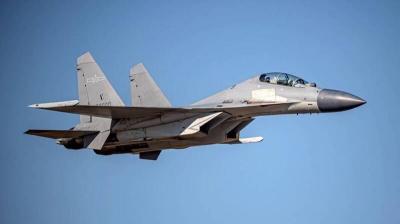
Eight Chinese naval vessels and 24 military aircraft were detected crossing the median line of the Taiwan Strait between 6am yesterday and 6am today, the Ministry of National Defense said this morning. The aircraft entered Taiwan’s northern, central, southwestern and eastern air defense identification zones, the ministry said. The armed forces responded with mission aircraft, naval vessels and shore-based missile systems to closely monitor the situation, it added. Eight naval vessels, one official ship and 36 aircraft sorties were spotted in total, the ministry said.
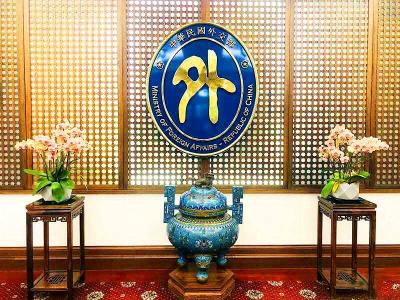
The Ministry of Foreign Affairs (MOFA) today said that if South Korea does not reply appropriately to its request to correct Taiwan’s name on its e-Arrival card system before March 31, it would take corresponding measures to alter how South Korea is labeled on the online Taiwan Arrival Card system. South Korea’s e-Arrival card system lists Taiwan as “China (Taiwan)” in the “point of departure” and “next destination” fields. The ministry said that it changed the nationality for South Koreans on Taiwan’s Alien Resident Certificates from “Korea” to “South Korea” on March 1, in a gesture of goodwill and based on the

Taiwanese officials were shown the first of 66 F-16V fighter jets purchased by Taiwan from the United States, the Ministry of National Defense said yesterday, adding the aircraft has completed an initial flight test and is expected to be delivered later this year. A delegation led by Deputy Minister of National Defense Hsu Szu-chien (徐斯儉) visited Lockheed Martin’s F-16 C/D Block 70 (also known as F-16V) assembly line in South Carolina on March 16 to view the aircraft. The jet will undergo a final acceptance flight in the US before being delivered to Taiwan, the
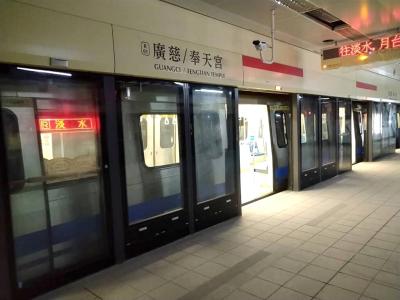
The New Taipei Metro's Sanyin Line and the eastern extension of the Taipei Metro's Tamsui-Xinyi Line (Red Line) are scheduled to begin operations in June, the National Development Council said today. The Red Line, which terminates at Xiangshan Station, would be connected by the 1.4km extension to a new eastern terminal, Guangci/Fengtian Temple Station, while the Sanyin Line would link New Taipei City's Tucheng and Yingge stations via Sanxia District (三峽). The council gave the updates at a council meeting reviewing progress on public construction projects for this year. Taiwan's annual public infrastructure budget would remain at NT$800 billion (US$25.08 billion), with NT$97.3


 RSS
RSS