


Sonkichi Sakihara recalls chancing upon some of the last refugees to arrive on Yonaguni island: four men who had sailed more than 2,000km from Vietnam to reach Japan’s westernmost inhabited island. It was 1977.
“I was out checking for stowaways from Taiwan when I found them,” Sakihara, 80, said at his family store near the port where he encountered the group, among 113 Vietnamese to make the journey after the Vietnam War ended.
Today, some residents of Yonaguni foresee another refugee crisis that they say their isolated outpost and its dwindling population of less than 1,700 would be ill-equipped to handle.
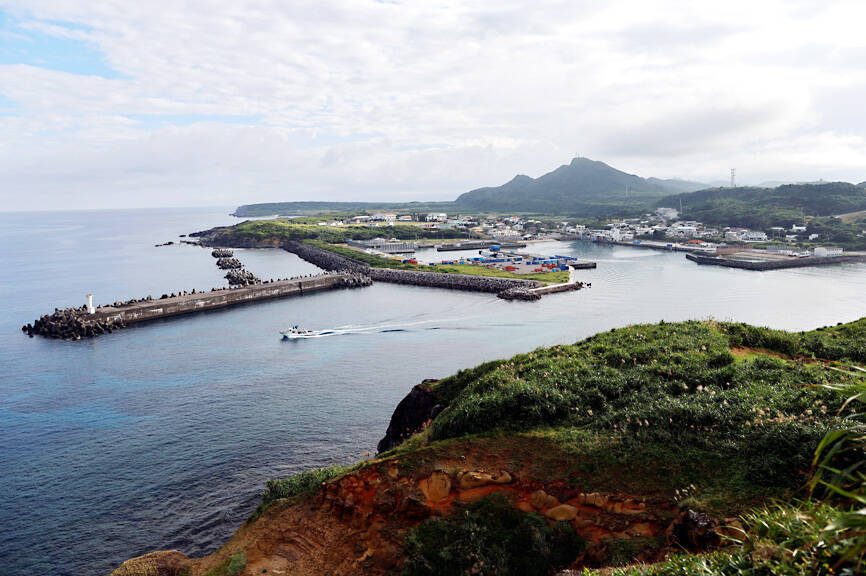
Photo: Reuters
Just 110km to the west, and occasionally visible from Yonaguni, is Taiwan, which China is menacing with simulated missile strikes and other displays of military firepower.
Concerned about the potential for conflict, Japan has embarked on its biggest defense buildup since World War II. Yet the US$290 billion outlay comes without a parallel plan to prepare Yonaguni for a possible humanitarian crisis that residents like Sakihara say could quickly overwhelm their shores.
In interviews with reporters, more than two dozen current and former Japanese officials and residents said that hundreds, if not thousands of refugees could try to reach Yonaguni in boats if China attacked Taiwan.
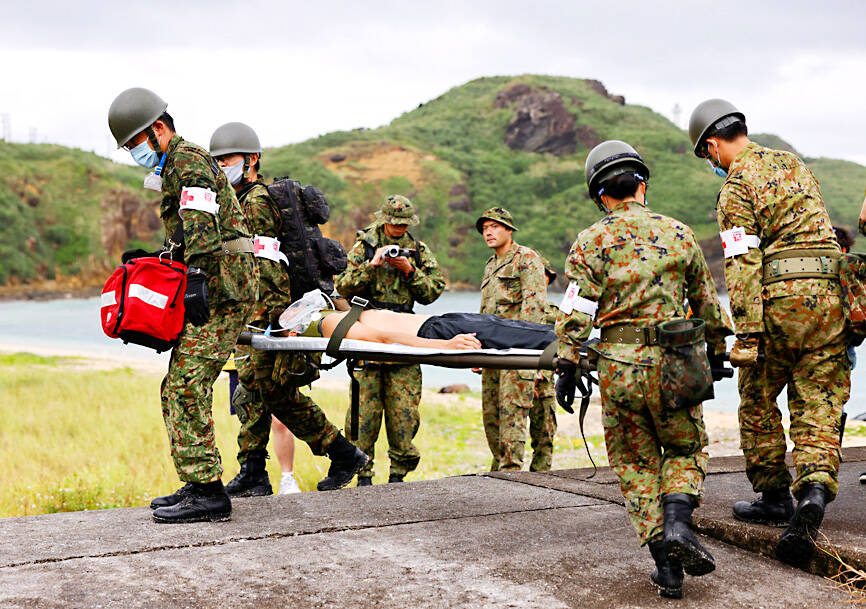
Photo: Reuters
Tokyo has no plan to deal with them, and locals’ pleas for help have gone unanswered, they said.
“It’s like their mouths are taped shut,” Yonaguni Mayor Kenichi Itokazu said, referring to Japan’s central government.
Itokazu said he had appealed directly to Japanese Chief Cabinet Secretary Hirokazu Matsuno for help when he came to Yonaguni in July, but received no response.
Some US officials say China might be ready to invade Taiwan by 2027. Chinese President Xi Jinping (習近平) told US President Joe Biden last month that no such plan exists, but he is raising pressure on Taiwan ahead of the nation’s Jan. 13 presidential and legislative elections.
In Taipei, the Ministry of Foreign Affairs declined to address questions about whether it had discussed humanitarian contingencies with Japan, but said Taiwan would not act rashly or succumb to Chinese coercion.
A spokesperson for Japan’s Cabinet Secretariat said that “if large numbers of refugees came to Japan, relevant government departments would work together to respond.”
He declined to comment on whether there was a specific plan for Yonaguni, saying he did not know whether the island’s mayor had directly asked Matsuno for help.
CRISIS SCENARIO
The people who spoke to reporters included nine current and six former officials with knowledge of Japan’s emergency planning, some of whom spoke on condition of anonymity due to being unauthorized to comment publicly.
While Taiwanese refugees could flee to Japan by sea, the nature of any conflict and the numbers who would come were hard to predict. Japan’s government has made no public mention of such a scenario, they said.
“There could be hundreds of boats, too many even for a Chinese blockade to stop,” a Japan Coast Guard official said.
The Cabinet Secretariat, headed by Japanese Prime Minister Fumio Kishida and run by Matsuno, is responsible for devising a plan, he added.
The current and former officials described a government focused on its military buildup rather than a complex humanitarian response plan encompassing the multiple departments, local authorities and companies that would have to screen, transport, feed and house possibly more refugees than Japan has ever encountered.
About 18,000 refugees were in Japan last year, mostly from Myanmar, Japan’s Migration Policy Institute said, citing UN figures that apply a broader definition than the Japanese government.
Amid conflict in Europe and the Middle East, Germany had more than 2 million refugees and Poland almost 1 million, many from Ukraine.
Tokyo has a political decision to make on whether to accept significant numbers of refugees, said Washington-based NMV Consulting senior adviser Kevin Maher, who was previously head of Japan affairs at the US Department of State.
“Japan has been reluctant to let in large numbers but, whatever the policy may be, the reality is that just about anything that floats could be headed for Japan,” he said.
A BIG JOB
Japanese General Yoshihide Yoshida, the head of Japan Self-Defense Forces (SDF), said he witnessed the refugee crisis caused by Russia’s attack on Ukraine when he visited Poland last year.
“If something similar happened near us, we would have to offer the same kind of humanitarian response, but that shouldn’t be left to the SDF, it’s for the whole of government to consider thoroughly,” he said on Tokunoshima, an island at the eastern end of the Ryukyu Islands that includes Yonaguni, where he was observing beach landing drills by Japanese forces on Nov. 19.
The roughly 200 SDF troops stationed on Yonaguni could be among the first to respond to any refugee crisis should East Asia, as Kishida warned last year, become the next Ukraine.
However, in more than 100 pages of documents outlining Kishida’s military buildup, refugees are mentioned only once, in a general reference to working with the UN.
Tokyo would hesitate to implement specific humanitarian plans on Yonaguni as it could lead China into believing Japan is preparing for a Taiwan conflict, a US official with knowledge of Japanese thinking said, speaking on condition of anonymity due to being unauthorized to comment publicly.
Even if he had a refugee plan, Kishida would still face an obstacle: his contentious relationship with the Okinawa prefectural government that administers Yonaguni.
The prefecture’s governor, Denny Tamaki, wants fewer US troops based in his prefecture, opposes Kishida’s military expansion and says it is the prime minister’s job to manage migrants arriving by boat.
“Even if it’s left to local government, the authority and financial resources for this have not yet been clearly defined,” he said in an interview.
Resentment with Tokyo lingers in Okinawa over the deaths of one in four islanders in World War II and the substantial military presence that has been there since.
In March, Okinawa and Tokyo officials conducted their first tabletop drill to simulate the evacuation of about 120,000 residents and tourists in Japan’s southwestern islands, including Yonaguni, calculating the operation would take about a week.
“There is no guarantee people won’t come from Taiwan and it would overwhelm the system,” said one of the drill’s advisers, Hironobu Nakabayashi from Kokushikan University’s Research Institute of Disaster Management and Emergency Medical System.
NOT ENOUGH TO SHARE
Back on Yonaguni, resident Satoshi Nagahama, 33, was surprised to learn that the government had no humanitarian plan in place for refugees.
“I don’t think we could handle any. The government would have to take them elsewhere,” he said.
Even the community center that temporarily housed the Vietnamese refugees Sakihara found has been closed for a decade, its crumbling concrete walls draped in green netting.
Without government help, some residents say it would fall to the island’s two police officers or town hall officials, including Koji Sugama, a 65-year-old former soldier, to handle any refugee crisis.
Since being hired in April to improve disaster management, one of Sugama’s tasks has been procuring emergency supplies for residents, including bottled water and ready meals packed into three heavy steel shipping containers dotted around the island.
“This will do for one, maybe two days,” he said, standing inside one of them. “There isn’t enough to share.”

The military has spotted two Chinese warships operating in waters near Penghu County in the Taiwan Strait and sent its own naval and air forces to monitor the vessels, the Ministry of National Defense (MND) said. Beijing sends warships and warplanes into the waters and skies around Taiwan on an almost daily basis, drawing condemnation from Taipei. While the ministry offers daily updates on the locations of Chinese military aircraft, it only rarely gives details of where Chinese warships are operating, generally only when it detects aircraft carriers, as happened last week. A Chinese destroyer and a frigate entered waters to the southwest
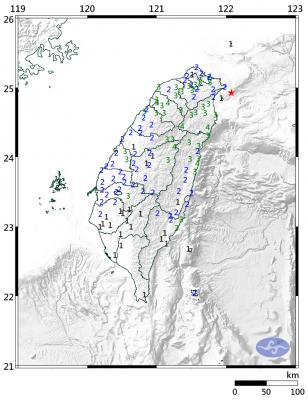
A magnitude 6.1 earthquake struck off the coast of Yilan County at 8:39pm tonight, the Central Weather Administration (CWA) said, with no immediate reports of damage or injuries. The epicenter was 38.7km east-northeast of Yilan County Hall at a focal depth of 98.3km, the CWA’s Seismological Center said. The quake’s maximum intensity, which gauges the actual physical effect of a seismic event, was a level 4 on Taiwan’s 7-tier intensity scale, the center said. That intensity level was recorded in Yilan County’s Nanao Township (南澳), Hsinchu County’s Guansi Township (關西), Nantou County’s Hehuanshan (合歡山) and Hualien County’s Yanliao (鹽寮). An intensity of 3 was
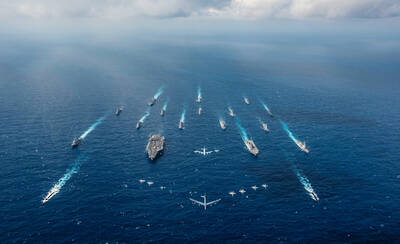
Japanese Prime Minister Sanae Takaichi’s comment last year on Tokyo’s potential reaction to a Taiwan-China conflict has forced Beijing to rewrite its invasion plans, a retired Japanese general said. Takaichi told the Diet on Nov. 7 last year that a Chinese naval blockade or military attack on Taiwan could constitute a “survival-threatening situation” for Japan, potentially allowing Tokyo to exercise its right to collective self-defense. Former Japan Ground Self-Defense Force general Kiyofumi Ogawa said in a recent speech that the remark has been interpreted as meaning Japan could intervene in the early stages of a Taiwan Strait conflict, undermining China’s previous assumptions
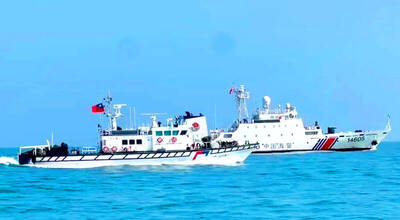
Instead of focusing solely on the threat of a full-scale military invasion, the US and its allies must prepare for a potential Chinese “quarantine” of Taiwan enforced through customs inspections, Stanford University Hoover fellow Eyck Freymann said in a Foreign Affairs article published on Wednesday. China could use various “gray zone” tactics in “reconfiguring the regional and ultimately the global economic order without a war,” said Freymann, who is also a nonresident research fellow at the US Naval War College. China might seize control of Taiwan’s links to the outside world by requiring all flights and ships entering or leaving Taiwan


 RSS
RSS