


Premier Chen Chien-jen (陳建仁) and others yesterday defended the work of Hsiao Bi-khim (蕭美琴) during her time as representative to the US after members of the Chinese Nationalist Party (KMT) said that she was a “pet cat of the US” and her diplomatic work had not benefited Taiwan.
The US-Taiwan Initiative on 21st Century Trade and other Taiwan-friendly legislation passed by US government bodies in the past few years are just a few of Hsiao’s achievements during her years in the US, Chen said.
“We urge the KMT not to misrepresent facts to tarnish the hard work of frontline foreign affairs officials and the contributions of many Taiwanese,” he said.
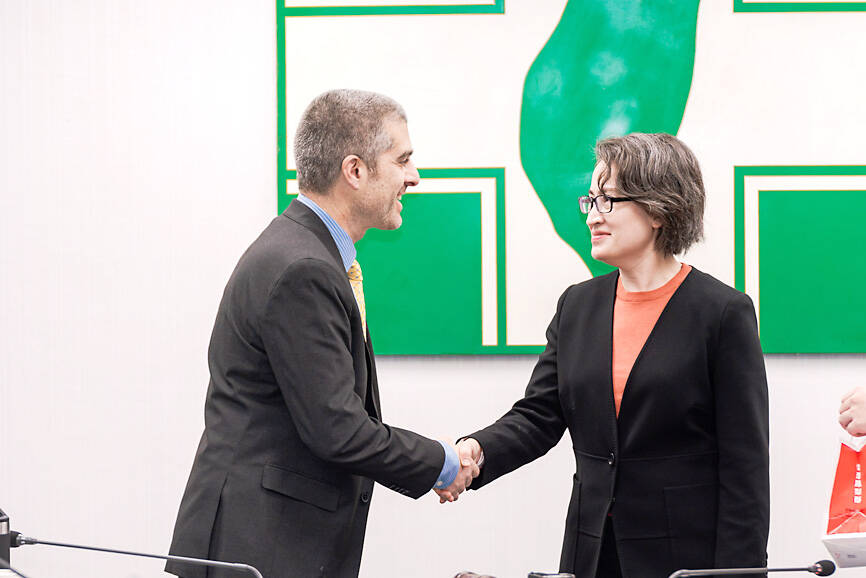
Photo: Chen Yun, Taipei Times
“Everyone can see that Taiwan-US ties have improved markedly in the past few years,” he said. “Both sides are working closely in many sectors.”
Earlier, KMT members said that Hsiao, the Democratic Progressive Party’s (DPP) vice presidential candidate, was not “Taiwan’s cat warrior,” but merely a “pet” of the US.
KMT Taipei City Councilor Hsu Chiao-hsin (徐巧芯) told a news conference at the KMT headquarters in Taipei that “Hsiao was fawning and servile in her dealings with US officials, and she did not bring Taiwan any trade or economic wins as top envoy to the US.”
“Taiwan made concessions in trade talks, but received nothing in return from Washington,” Hsu said.
“Even the US-led Indo-Pacific Economic Framework did not include Taiwan as a member, so talk by the DPP that Taiwan has forged good relations with US is nothing but propaganda,” she said.
KMT Taipei City Councilor Yu Shu-hui (游淑慧) said that “Taiwan had to open up to pork and beef from the US that have traces of ractopamine, as well as Japanese seafood from Fukushima Prefecture, but Washington did nothing for Taiwan during trade negotiations.”
“Hsiao’s diplomatic work was based on wishful thinking,” Yu said. “She fawned and cooperated with every US request, but Taiwan did not receive anything in exchange, including access to regional trade bodies.”
In an interview later yesterday, Hsiao said that Taiwan faces special circumstances in diplomatic work and it needs to be flexible at the negotiating table.
“However, I am confident that through the years, my work has granted Taiwanese more dignity,” she said. “In the US, Taiwanese are received with respect, and we have no need to be humble or fawning.”
“My job was not easy, but I had the support of many Taiwanese,” she said. “Throughout the world, more countries support, respect and trust Taiwan.”
“Of course, we faced many setbacks and frustrations, but we overcame obstacles to get good results,” she added.
Separately, DPP spokesman Chang Chih-hao (張志豪) said that the KMT “follows the one China policy as an ally of the Chinese Communist Party.”
“It is the KMT that kowtows and grovels — but it does so to Chinese officials,” Chang said.
“Hsiao as our top US envoy built a solid foundation for the growth of ties with the US,” he said. “The KMT should refrain from false accusations during the election campaign.”
Vice Premier Cheng Wen-tsan (鄭文燦) said that “Taiwan has difficulties in international engagements, and all Taiwanese should stand together to fight for their presence on the world stage, not scheme to sabotage such efforts.”
“Taiwan and the US have made tremendous progress on national defense programs, bilateral trade and in the semiconductor, health and education sectors,” he added.
Additional reporting by Chu Chun-fu and Wang Meng-lun

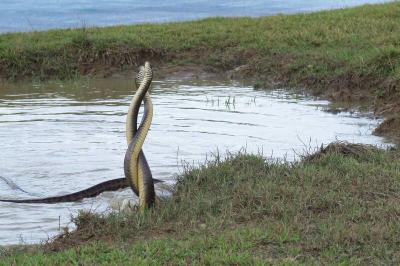
Kenting National Park service technician Yang Jien-fon (楊政峰) won a silver award in World Grand Prix Photography Awards Spring Season for his photograph of two male rat snakes intertwined in combat. Yang’s colleagues at Kenting National Park said he is a master of nature photography who has been held back by his job in civil service. The awards accept entries in all four seasons across six categories: architectural and urban photography, black-and-white and fine art photography, commercial and fashion photography, documentary and people photography, nature and experimental photography, and mobile photography. Awards are ranked according to scores and divided into platinum, gold and
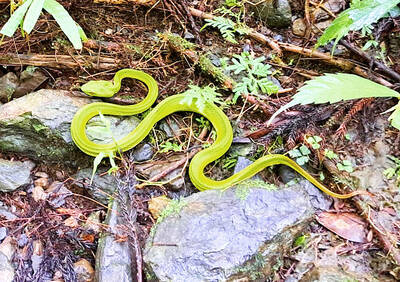
More than half of the bamboo vipers captured in Tainan in the past few years were found in the city’s Sinhua District (新化), while other districts had smaller catches or none at all. Every year, Tainan captures about 6,000 snakes which have made their way into people’s homes. Of the six major venomous snakes in Taiwan, the cobra, the many-banded krait, the brown-spotted pit viper and the bamboo viper are the most frequently captured. The high concentration of bamboo vipers captured in Sinhua District is puzzling. Tainan Agriculture Bureau Forestry and Nature Conservation Division head Chu Chien-ming (朱健明) earlier this week said that the
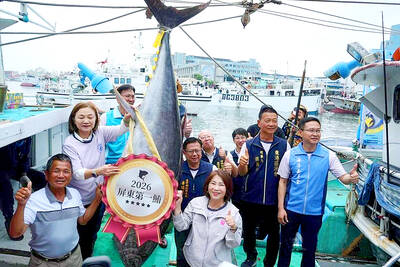
The first bluefin tuna of the season, brought to shore in Pingtung County and weighing 190kg, was yesterday auctioned for NT$10,600 (US$333.5) per kilogram, setting a record high for the local market. The auction was held at the fish market in Donggang Fishing Harbor, where the Siaoliouciou Island-registered fishing vessel Fu Yu Ching No. 2 delivered the “Pingtung First Tuna” it had caught for bidding. Bidding was intense, and the tuna was ultimately jointly purchased by a local restaurant and a local company for NT$10,600 per kilogram — NT$300 ,more than last year — for a total of NT$2.014 million. The 67-year-old skipper
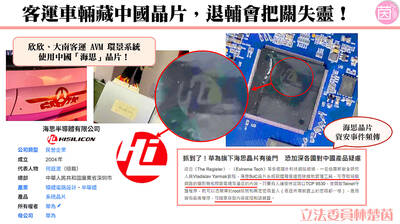
BREACH OF CONTRACT: The bus operators would seek compensation and have demanded that the manufacturer replace the chips with ones that meet regulations Two bus operators found to be using buses with China-made chips are to demand that the original manufacturers replace the systems and provide compensation for breach of contract, the Veterans Affairs Council said yesterday. Democratic Progressive Party Legislator Michelle Lin (林楚茵) yesterday said that Da Nan Bus Co and Shin-Shin Bus Co Ltd have fielded a total of 82 buses that are using Chinese chips. The bus models were made by Tron-E, while the systems provider was CYE Electronics, Lin said. Lin alleged that the buses were using chips manufactured by Huawei subsidiary HiSilicon Co, which presents a national security risk if the


 RSS
RSS