


All sauces imported from Indonesia are to be subject to batch-by-batch inspections until May 5 next year, the Food and Drug Administration (FDA) said yesterday.
The announcement came after six types of Indonesian sauces were among the latest list of products seized at Taiwan’s borders after failing customs inspections, bringing to 22 the number of batches of Indonesian sauces intercepted from Jan. 1 to Oct. 28.
All six products contained excessive levels of sulfur dioxide, a bleaching agent, FDA Deputy Director Lin Chin-fu (林金富) said, adding that 3,419kg of intercepted imports had been returned or destroyed.
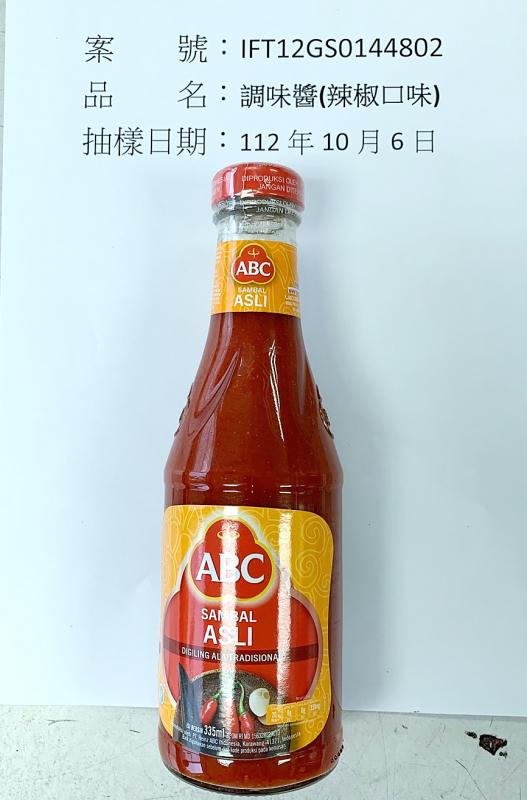
Photo courtesy of the Food and Drug Administration
The FDA has also asked Indonesian authorities for a written description of improvement measures before Nov. 27, Lin said.
CHILI POWDER
A total of 24 types of products — including Dutch marigolds, edible lilies imported from Japan, as well as Chinese and Mexican chili powder — did not pass the latest round of customs inspections and were returned or destroyed, the FDA said.
Two types of Chinese chili powder products were found to contain excessive levels of chlormequat chloride, a pesticide, and Sudan III, a dye that is not allowed in food products, it said.
Ten batches of Chinese chili powder failed customs inspections from Jan. 1 to Oct. 28, Lin said.
The FDA had increased the frequency of random checks on chili powders imported from China since May 22, and would continue doing so until Nov. 21.
Lin said that this was the first time this year chili powder imported from Mexico had failed customs inspections.
The five product types, which were imported by Chale Ltd and manufactured by Mission Laredo Partners, were all found to have excessive levels of pesticides, including chlorpyrifos and ethylene oxide, Lin said.
Effective immediately, the FDA will increase the frequency of random inspections of imported chili powder manufactured by Mission Laredo Partners and products imported by Chale Ltd, Lin said.

Considering that most countries issue more than five denominations of banknotes, the central bank has decided to redesign all five denominations, the bank said as it prepares for the first major overhaul of the banknotes in more than 24 years. Central bank Governor Yang Chin-lung (楊金龍) is expected to report to the Legislative Yuan today on the bank’s operations and the redesign’s progress. The bank in a report sent to the legislature ahead of today’s meeting said it had commissioned a survey on the public’s preferences. Survey results showed that NT$100 and NT$1,000 banknotes are the most commonly used, while NT$200 and NT$2,000

The Centers for Disease Control (CDC) yesterday reported the first case of a new COVID-19 subvariant — BA.3.2 — in a 10-year-old Singaporean girl who had a fever upon arrival in Taiwan and tested positive for the disease. The girl left Taiwan on March 20 and the case did not have a direct impact on the local community, it said. The WHO added the BA.3.2 strain to its list of Variants Under Monitoring in December last year, but this was the first imported case of the COVID-19 variant in Taiwan, CDC Deputy Director-General Lin Ming-cheng (林明誠) said. The girl arrived in Taiwan on

ANNUAL EVENT: Two massive Pokemon balloons are to be set up in Daan Park, with an event zone operating from 10am to 6pm This year’s Taipei Floral Picnic is to be held at Daan Park today and tomorrow, featuring an exclusive Pokemon Go event, a themed food market, a coffee rave picnic area and stage performances, the Taipei Department of Information and Tourism said yesterday. Two massive Pokemon balloons are to be set up in the park as attractions, with an exclusive event zone operating from 10am to 6pm, it said. Participants who complete designated tasks on-site would have a chance to receive limited-edition souvenirs, it added. People could also try the newly launched game Pokemon Pokopia in the trial area, the department said. Three PokeStops are

South Korea is planning to revise its controversial electronic arrival card, a step Taiwanese officials said prompted them to hold off on planned retaliatory measures, a South Korean media report said yesterday. A Yonhap News Agency report said that the South Korean Ministry of Foreign Affairs is planning to remove the “previous departure place” and “next destination” fields from its e-arrival card system. The plan, reached after interagency consultations, is under review and aims to simplify entry procedures and align the electronic form with the paper version, a South Korean ministry official said. The fields — which appeared only on the electronic form


 RSS
RSS