


The Mainland Affairs Council has reached out to temples across Taiwan to promote awareness of Chinese misinformation campaigns, after national security agencies reported a “high occurrence” of election disinformation being spread among the religious community, a senior government official said.
The Executive Yuan has established a special task force on preventing the spread of false news and disinformation ahead of next year’s presidential election, headed by Executive Yuan member Lo Ping-cheng (羅秉成) and spokesman Lin Tzu-lun (林子倫), the official said, speaking on the condition of anonymity.
China has been building a network within Taiwan’s religious community by treating Taiwanese temple members visiting China with food, board and other amenities, the source said.
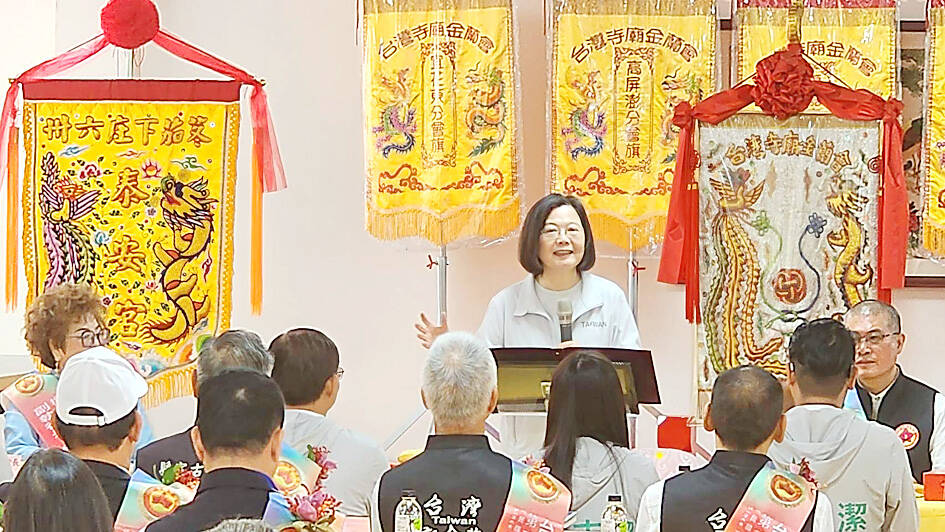
Photo: Tsai Chang-sheng, Taipei Times
China is known to spread disinformation among networks in Taiwan, especially during election season, the official said.
On Sunday last week at an event in Hsinchu City, President Tsai Ing-wen (蔡英文) urged temple organizations and members to be aware that misleading or false information could be circulating through their ranks, and they should verify information before spreading it.
The government cannot limit speech in a way that would go against the spirit of democracy, but with the help of Taiwanese, the nation can do its best to prevent social instability brought about by misinformation and false news, Tsai said.
Some of the misinformation is being spread through the efforts of hostile foreign forces and domestic organizations, and some of that disinformation has distinct political motives, the official said.
They said the Executive Yuan’s efforts would focus on recognizing, exposing and suppressing false news, and identifying those spreading such information.
The task force is to respond to false news and provide factual clarification within four hours of it being discovered, they said.
The task force’s responses should not only be issued as news releases, but also on multiple platforms, including online with short videos, the official said.
The Criminal Investigation Bureau and the Ministry of Justice Investigation Bureau are using technology such as artificial intelligence software to identify false news, the government said.
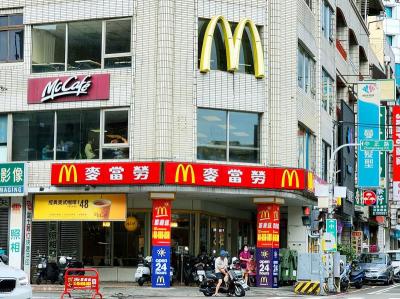
Fast food chain McDonald's is to raise prices by up to NT$5 on some products at its restaurants across Taiwan, starting on Wednesday next week, the company announced today. The prices of all extra value meals and sharing boxes are to increase by NT$5, while breakfast combos and creamy corn soup would go up by NT$3, the company said in a statement. The price of the main items of those meals, if ordered individually, would remain the same. Meanwhile, the price of a medium-sized lemon iced tea and hot cappuccino would rise by NT$3, extra dipping sauces for chicken nuggets would go up

FUKUOKA SITUATION: Japanese media reported that the pathogen is expected to be identified by the summer, while the CDC downplayed the idea that it was hMPV A “mysterious cold-like illness” reported in Japan’s Fukuoka Prefecture does not seem to be a new disease, but Japanese authorities have been asked about the situation, the Centers for Disease Control (CDC) said yesterday. The Fukuoka Prefectural Medical Association on Wednesday told a news conference that a “mystery cold” that has become a hot topic on social media is “highly likely to be caused by some kind of viral infection,” Japan’s KBC News reported. “Many people are experiencing symptoms starting with a sore throat, followed by a runny nose, phlegm and a severe cough,” KBC News reported, citing association officials. Health authorities are

Nvidia Corp CEO Jensen Huang (黃仁勳) arrived in Taiwan yesterday ahead of upcoming AI and technology events, saying he plans to meet with clients and Taiwan Semiconductor Manufacturing Co Chairman C.C. Wei (魏哲家) during his visit. After landing at Taipei Songshan Airport, Huang posed for photos with fans and handed out Yakult drinks to reporters and supporters waiting at the scene, saying he has “a lot to do” during the trip. Asked about reports that Nvidia’s planned headquarters site in Taipei’s Beitou Shilin Technology Park could break ground on May 27, Huang said that if the company holds an event, he would

Carrefour Taiwan is to begin using a new name from the start of July, but it cannot divulge the name until then, the chairman of the supermarket chain's parent company said today. President Chain Store Co chairman Lo Chih-hsien (羅智先) was asked by reporters after a shareholders' meeting to confirm whether the company has settled on a new name for the supermarket brand. In March, the government-registered name of two Carrefour Taiwan branches was quietly changed to "Le Chia Kang" (樂家康) in Chinese, raising speculation that has been selected as the name. Lo said that because of local regulations and contractual obligations, the


 RSS
RSS