

Minister of Foreign Affairs Joseph Wu (吳釗燮) yesterday slammed comments made by former president Ma Ying-jeou (馬英九) during his visit to the US, saying he has undermined Taiwan’s diplomacy and attacked its allies.
Speaking at a symposium held by New York University Law School on Monday, Ma was cited by Central News Agency as saying that Taiwan and China are “not separate countries” like Ukraine and Russia.
The former president was also paraphrased as having condemned former US national security adviser Robert O’Brien and other US politicians of trying to “weaponize Taiwan,” which could turn the nation into a battlefield like Ukraine.
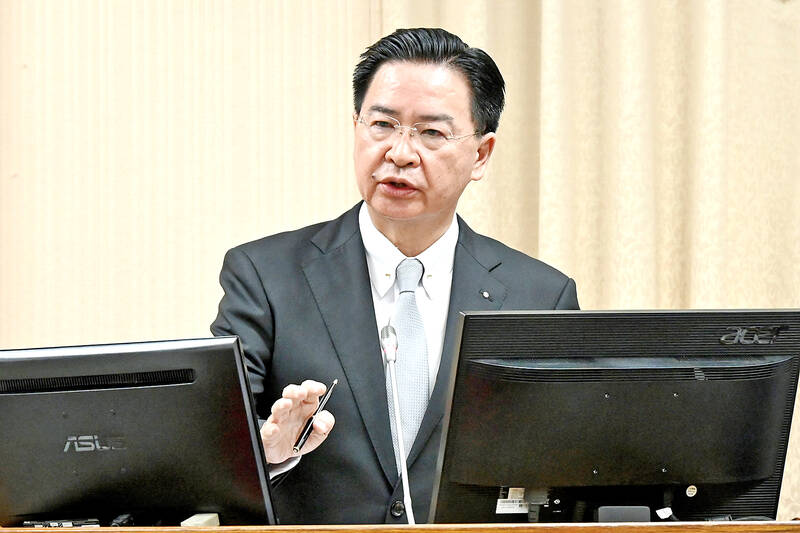
Photo: George Tsorng, Taipei Times
Wu said on the sidelines of an interpellation in the Legislative Yuan that Beijing’s “relentless and ever-increasing military, political and economic pressure” is the most significant challenge faced by the nation.
“Under the circumstances, I believe important Taiwanese political figures have a responsibility to rally foreign countries’ support for Taiwan,” he said. “Former president Ma did not do so.”
The government “deeply regrets” Ma’s behavior of “visiting a foreign country to cast aspersions on the people there who support Taiwan,” Wu said.
“US politicians have a saying that politics stops at the water’s edge,” he said. “All our high-ranking officials follow this rule of leaving domestic politics at home, when going overseas, to better represent the nation’s interests.”
Later that day, the Ministry of Foreign Affairs issued a statement expressing its “profound disappointment” at the former president’s speech, adding that the comments “attacked the democratically elected government and the nation’s staunch international supporters.”
Ma’s remarks were not factual or representative of public opinion, but closely toed China’s line on Taiwan, it said.
China, and not Taiwan or the US, is the country responsible for constant saber-rattling, provocative actions against neighboring states and causing the rise in regional tensions, the ministry said.
Taipei has consistently offered goodwill and left open the possibility of dialogue with Beijing under conditions of rational discussions, equality and mutual respect, it said, adding that the nation’s commitment to being a force of good is widely acknowledged globally.
In contrast, China repeatedly caused harm to peace and stability in the region and conducted an extensive campaign of military threats, disinformation and economic coercion to interfere in Taiwan’s democratic elections, it said.
These acts have sparked concern and voices of condemnation in the international community, the ministry said.
The ministry urged Ma to take advantage of his visit to the US to educate himself on the international community’s mainstream views, the meaning of free and democratic values, and face the reality of Taiwanese public opinion, it said.
Separately, the Mainland Affairs Council (MAC) on Tuesday issued a statement, saying that in the past eight years, President Tsai Ing-wen (蔡英文) has kept her promises and maintained the “status quo,” while adhering to her “four commitments.”
It added that in her Double Ten National Day address on Oct. 10, Tsai said: “We do not provoke, we do not act rashly, and we will absolutely not bow to pressure.”
Many opinion polls show that the majority of Taiwanese support Tsai’s stance of maintaining stability and peace in the Taiwan Strait, it said.
Ma condemning the government and catering to China’s political stance is against mainstream public opinion in Taiwan, it said.
Additional reporting by CNA
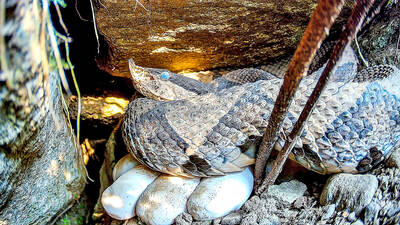
NATURE TAKES ITS COURSE: The agency’s head said he felt a sense of loss watching red-banded snakes eat the babies, as they had decided on non-intervention The Forestry and Nature Conservation Agency yesterday released a documentary on a hundred-pace viper that had incubated 16 eggs, all of which hatched, but only a baby viper escaped after they were attacked by red-banded snakes. The agency’s Taichung branch last year launched the viper reproduction monitoring project soon after forest rangers Lin Chun-yu (林俊佑) and Chou Chia-cheng (周家成) spotted a pregnant hundred-pace viper in a grass-covered burrow near a parking lot in Tbulan Village (松鶴部落). The Atayal village, in Taichung’s Heping District (和平), is headed by Ecyang Yapu, who was positive about the project and assisted in access control and power
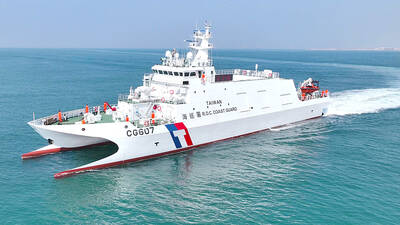
The Coast Guard Administration (CGA) yesterday said that it had deployed vessels to “monitor” Chinese ships operating in waters off the east coast. The CGA said it dispatched vessels in response to a China Coast Guard announcement that it had carried out another “routine law-enforcement patrol” in waters off the east coast. “The CGA firmly rejects China’s cognitive warfare campaign of ‘law enforcement in name, jurisdictional expansion in practice,’” it said on X. As of 11am yesterday, two China Coast Guard ships were “loitering and drifting” about 105 nautical miles (195km) and 74 nautical miles east of Green Island (綠島) respectively, it said. It
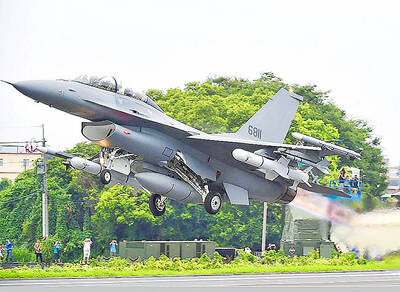
A sharp rise in compensation to be paid by air force officers who leave before completing their required service could indicate an increase in pilots leaving the military early, an analyst said on Friday, warning that the trend could worsen a shortage of experienced personnel. Chieh Chung (揭仲), a researcher at the Association for Strategic Foresight, issued the warning even though the number of volunteer military personnel is expected to increase next year. The planned headcount for volunteer military personnel, covering officers, noncommissioned officers (NCO) and enlisted soldiers, is 158,223 for next year, up 4,258 from 153,965 this year, Chieh said. The increase
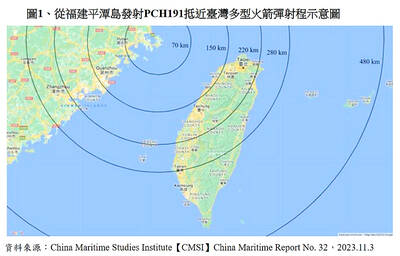
Potential improvements to munitions used by China’s long-range rocket-artillery units could extend their range to cover the entire Miyako Strait, which might give the Chinese People’s Liberation Army (PLA) the ability to secure the strategic waterway, the Mainland Affairs Council (MAC) said in a report. The PLA’s long-range rocket-artillery units deployed along the Taiwan Strait are concentrated along the coast of Fujian Province, including Changle, Pingtan and Shishi, the quarterly report on China said. The artillery brigades of the PLA’s 71st, 72nd and 73rd group armies have been deployed, with preparations for potential battlefield operations under way since August 2022, the report


 RSS
RSS