


The US and Taiwan stand together on the front lines of the fight against disinformation and have both faced harmful misinformation in their democratic elections, the US’ top envoy to Taipei said yesterday.
Speaking at the opening ceremony of the Indo-Pacific Workshop on Countering Disinformation, American Institute in Taiwan (AIT) Director Sandra Oudkirk praised Taiwan for its respect for “fundamental freedoms” and its strong commitment to the “free exchange of ideas.”
“At a time of democratic backsliding and human rights abuses elsewhere in the Indo-Pacific, Taiwan serves as an invaluable model to others,” Oudkirk said.
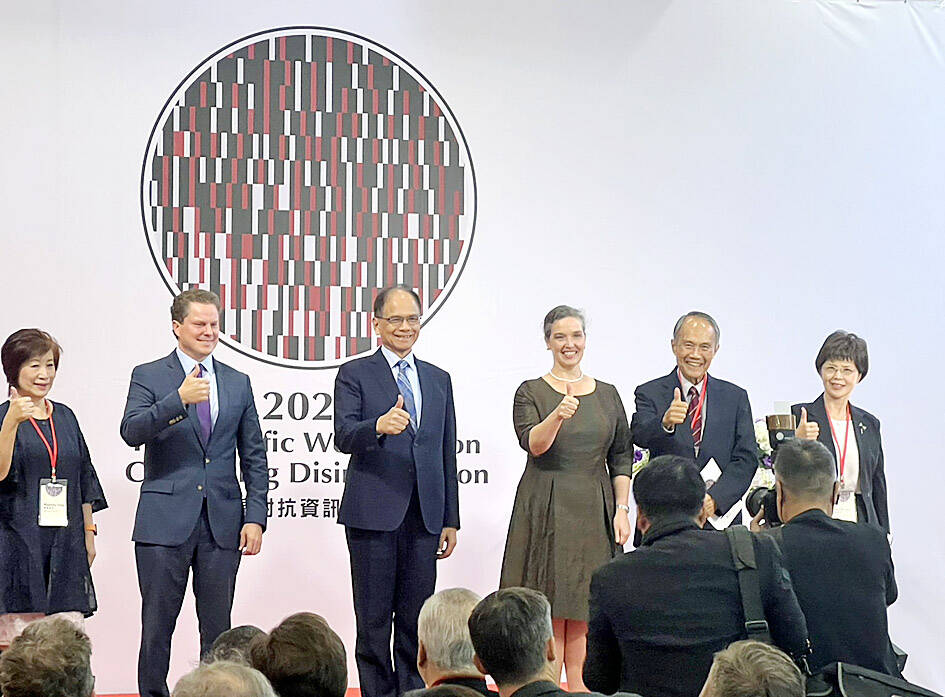
Photo: CNA
However, in the Internet age and with the emergence of artificial intelligence, the spread of disinformation to open democratic societies is becoming more challenging to combat, she said.
The “United States, Taiwan and many others are on the front lines as we grapple with the spread of disinformation and propaganda, particularly as foreign actors seek to use social media and emerging technologies to manipulate public discourse ... and undermine confidence in our democratic institutions,” she said.
Amid this threat, such a forum is important for sharing experiences and best practices with like-minded representatives of governments, civil society and academia from around the world, she said.
“We believe a well-informed citizenry is key to the strength of democratic institutions, healthy and robust public debate, based on facts, evidence and research, are integral to effective civic engagement,” Oudkirk said.
David Shullman, senior director of the Global China Hub at the US-based think tank the Atlantic Council, also spoke at the forum, warning of China’s disinformation campaign targeting Taiwan.
Beijing’s Taiwan-focused disinformation efforts used to be “primarily focused on promoting a positive narrative, making the argument that unification will restore cultural ties and bring economic benefits to Taiwan,” Shullman said.
However, as support for the “one country, two systems” model has faded in Taiwan, Chinese disinformation is now primarily directed at undermining trust in democracy and Taiwan’s government, he said.
With Taiwan’s rich experience in combating Chinese disinformation, it has also become an expert in this area, he said.
“Taiwan has combined high-tech efforts with more analogue solutions, like improving government communication, crowdsourcing and maintaining tools for fact-checking and countering conspiracies and propaganda, and expanding the media literacy of education,” he said.
The two-day workshop is organized by the Taiwan Foundation for Democracy, a government-funded non-governmental organization.

NATIONAL SECURITY: Authorities are working to confirm the identities of the military personnel involved and investigating possible illegal conduct and regulatory violations Authorities are probing possible national security implications after Kinmen police and immigration officers on Sunday found a Chinese woman allegedly posing as a tourist while engaging in prostitution involving more than 10 military personnel. The woman, surnamed Chen (陳), has since been deported, authorities said, adding that investigators are still working to confirm the identities of those implicated, as the records only listed code names and aliases. The case stemmed from a report received by the Kinmen District Prosecutors’ Office on Friday last week from the Jinhu Precinct of the Kinmen County Police Bureau. On Sunday, police, along with the National Immigration

GLOBALGIVING: ‘ Caving to external pressure is not acceptable for an organization that has cultivated justice reform and human rights for 30 years,’ one NGO said A slew of non-government organizations (NGOs) have withdrawn from the GlobalGiving fundraising platform after it announced it would use “Chinese Taipei” instead of “Taiwan” from next month. The Taiwan Good Rice Association wrote on Facebook on Friday that it was informed on April 28 via a teleconference call of the change, which was made because the platform wanted to operate in China. Taiwan Good Rice is to terminate all cooperative relationships with GlobalGiving in response to the platform’s “unilateral and non-negotiable” decision to remove references to Taiwan, the NGO said. “Taiwan is in the official name of Taiwan Good Rice Association and the

HEAVY WEATHER: Typhoon Jangmi is due to crash straight into the Ryukyus as airlines look to shift flights to larger aircraft or cancel flights to Okinawa entirely Taiwan’s international air carriers announced flight adjustments over the weekend as Typhoon Jangmi is forecast to hit the Ryukyu Islands today and tomorrow. The Central Weather Administration (CWA) upgraded Jangmi from a tropical storm to a typhoon at 8am yesterday, with the eye located 580km south of Naha city. It was moving north at 19kph. Today, China Airlines’ CI-120, CI-121, CI-122 and CI-123 flights between Taoyuan and Naha, Okinawa, have been canceled as well as CI-132 and CI-133 between Kaohsiung and Naha. EVA Air’s BR-112, BR-113, BR-186 and BR-185 flights between Taoyuan and Naha are also canceled. Low-cost carrier Tigerair Taiwan canceled IT-230,

Chinese Nationalist Party (KMT) Chairwoman Cheng Li-wun (鄭麗文) yesterday briefed her party’s Central Standing Committee regarding her scheduled visit to the US between Monday next week and June 16, saying that her purpose would be to persuade the US that the Republic of China (ROC) Constitution was a “one China” constitution that would foster stable and peaceful cross-strait relations. The ROC Constitution is the most important defense for all Taiwanese citizens, as it upholds our democracy and has contributed to our robust economy, which aligns with international and US interests, she said. “We would not be troublemakers and drag the US under,”


 RSS
RSS