


A Russian victory in Ukraine would give a “green light” for an invasion of Taiwan by the People’s Republic of China (PRC), which justifies US aid, former US vice president Mike Pence said on Tuesday.
Pence, who is seeking the Republican nomination for next year’s US presidential election, was speaking at the first event in a series of conversations with Republican candidates cohosted by The Associated Press and the Georgetown Institute of Politics and Public Service in Washington.
The contrast between Pence and some other Republicans has been particularly stark on Ukraine.

Photo: AP
Many Republican voters oppose sending more military aid to Kyiv and Pence is polling in single digits.
Helping Ukraine is also the best way to check China’s ambitions in the Asia-Pacific region, he said.
“I really do believe that if Russia overruns Ukraine, that’ll give a green light to China to move against Taiwan,” he said. “And quite frankly, if we don’t check the efforts by authoritarian regimes to redraw international lines by force, the rest of the 21st century could look a lot like the first half of the 20th century.”
Pence has accused rivals for the Republican nomination, including former US president Donald Trump, of abandoning US allies.
The only way to keep the US safe is by engaging with the world, he said.
“America is the leader of the free world,” he said. “If we’re not leading the free world, the free world is not being led.”
Pence has previously cast China as a major threat.
In a speech last month at the Hudson Institute think tank in the US capital, he called Beijing “the greatest strategic and economic threat to the United States of America in the 21st century” and said it was at risk of becoming an “evil empire.”
In response, the US should work to bolster Taiwan’s defense capabilities to stave off any threat, he said.
He also wants to ban China from purchasing new US farmland and has called to move high-tech manufacturing out of the country and to ban TikTok.
Asked on Tuesday if it was realistic to ask tens of millions of young people to stop using the app, Pence said: “I don’t know about realistic, but it’s the right idea.”

Fast food chain McDonald's is to raise prices by up to NT$5 on some products at its restaurants across Taiwan, starting on Wednesday next week, the company announced today. The prices of all extra value meals and sharing boxes are to increase by NT$5, while breakfast combos and creamy corn soup would go up by NT$3, the company said in a statement. The price of the main items of those meals, if ordered individually, would remain the same. Meanwhile, the price of a medium-sized lemon iced tea and hot cappuccino would rise by NT$3, extra dipping sauces for chicken nuggets would go up
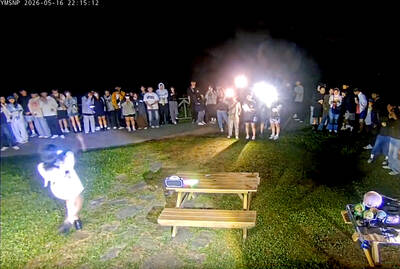
Yangmingshan National Park’s Qingtiangang (擎天崗) nature area has gone viral after a park livestream camera observed a couple in the throes of intimate congress, which was broadcast live on YouTube, drawing large late-night crowds and sparking a backlash over noise, bright lights and disruption to wildlife habitat. The area’s livestream footage appeared to show a couple engaging in sexual activity on a picnic table in the park on Friday last week, with the uncensored footage streamed publicly online. The footage quickly spread across social media, prompting a tide of visitors to travel to the site to “check in” and recreate the

Minister of Digital Affairs Lin Yi-ching (林宜敬) yesterday cited regulatory issues and national security concerns as an expert said that Taiwan is among the few Asian regions without Starlink. Lin made the remarks on Facebook after funP Innovation Group chief executive officer Nathan Chiu (邱繼弘) on Friday said Taiwan and four other countries in Asia — China, North Korea, Afghanistan and Syria — have no access to Starlink. Starlink has become available in 166 countries worldwide, including Ukraine, Malaysia, the Philippines and Vietnam, in the six years since it became commercial, he said. While China and North Korea block Starlink, Syria is not
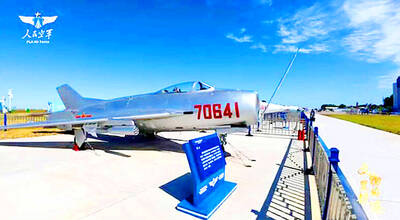
GROUNDED: A KMT lawmaker proposed eliminating drone development programs and freezing funding for counterdrone systems, despite China’s adoption of the technology China has deployed attack drones at air bases near the Taiwan Strait in a strategy aimed at overwhelming Taiwan’s air defense systems through saturation attacks, the Mainland Affairs Council (MAC) said. The council’s latest quarterly report on China said that satellite imagery and open-source intelligence indicate that the Chinese People’s Liberation Army (PLA) had converted retired J-6 fighter jets into J-6W drones, which the PLA has stationed at six air bases near Taiwan, five in China’s Fujian Province and one in Guangdong Province. The report cited J. Michael Dahm, a senior fellow at the US-based Mitchell Institute, as saying that China has


 RSS
RSS