


Hikers should be on their guard and take precautions against attacks by hornets, as late summer to autumn is the breeding season when the insects are most active, local authorities said after two people last week died from hornet stings.
The Pingtung County Government last week said that for the past three months, it had received 1,472 reports of “hornet nest” sightings, and experts had removed 1,311 of the nests — or an average of 15.8 nests per day.
The county added that 86 percent of the sightings were hornet nests, and the rest were wild bee nests.
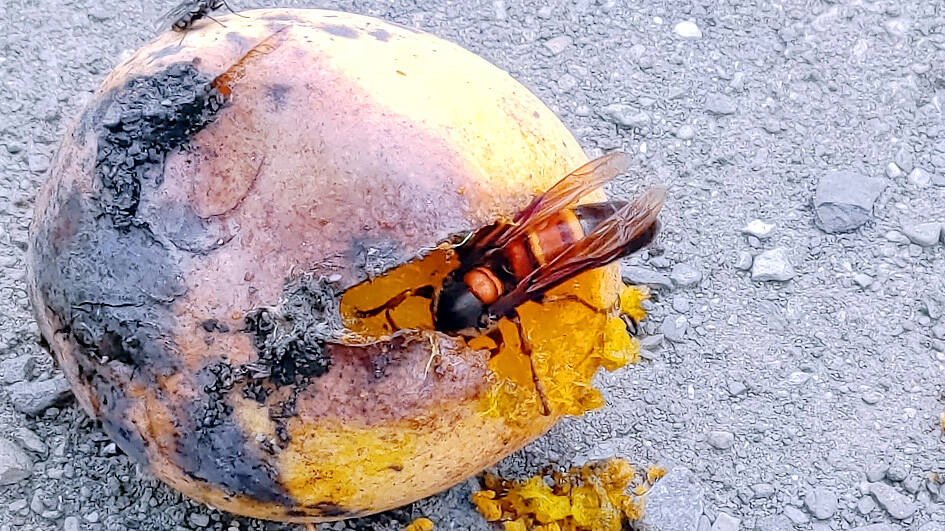
Photo courtesy of Yushan National Park Administration Office
Data from the county’s Department of Agriculture showed that it recorded 429 nest sightings in July, of which 424 were removed; 695 sightings last month, of which 541 were removed; and from Sept. 1 to Thursday last week, 348 sightings, with 346 removed.
In Taitung County, the local government said it had received about 30 reports of nest sightings per week in July and last month, but the figure has soared to about 100 per week this month.
People are advised to take precautions when hiking in trails, following a fatal incident in New Taipei City’s Rueifang District (瑞芳) on Wednesday last week, when a group of hikers were attacked by hornets, resulting in two deaths and at least nine others injured.
Based on specimens gathered at the site, experts identified the culprits as Asian hornets, also known as yellow-legged hornets or Asian predatory wasps, which are indigenous to Taiwan and Southeast Asia.
Less than a week after that deadly incident, four people were yesterday sent to a hospital for treatment after being stung by hornets in the same area.
The Keelung Fire Department said it received a call at 10:46am that five people had been attacked by hornets while hiking in Rueifang.
One of the hikers sustained only minor injuries and returned home, while the other four were taken to Keelung Hospital, it said.
One of the injured went into anaphylactic shock, but was stabilized after receiving medication, the hospital said.
Experts said that Asian hornets breed from August through the autumn months, when they are most active. In Taiwan, they can be found from the low plains up to 1,500m-high mountains, living in woodlands and forests, and building their nests on tree branches or burrows on the ground.
The Pingtung County Government has released a public warning and advice to prevent and deal with hornet attacks.
First, wear light-colored clothes and hats, and do not put on perfume, cologne or a scented spray, as hornets are attracted to fruity aromas, such as the odor of tree sap or decomposing fruit.
Second, stick to open walking trails and avoid getting into areas with dense vegetation.
Third, quickly cover the head with a hat, jacket, clothing, or arms, lower the body and walk in the opposite direction when you see a hornet or hornet nest. Do not wave your arms or clothing as this would help hornets zero in on their target.

Considering that most countries issue more than five denominations of banknotes, the central bank has decided to redesign all five denominations, the bank said as it prepares for the first major overhaul of the banknotes in more than 24 years. Central bank Governor Yang Chin-lung (楊金龍) is expected to report to the Legislative Yuan today on the bank’s operations and the redesign’s progress. The bank in a report sent to the legislature ahead of today’s meeting said it had commissioned a survey on the public’s preferences. Survey results showed that NT$100 and NT$1,000 banknotes are the most commonly used, while NT$200 and NT$2,000

The Centers for Disease Control (CDC) yesterday reported the first case of a new COVID-19 subvariant — BA.3.2 — in a 10-year-old Singaporean girl who had a fever upon arrival in Taiwan and tested positive for the disease. The girl left Taiwan on March 20 and the case did not have a direct impact on the local community, it said. The WHO added the BA.3.2 strain to its list of Variants Under Monitoring in December last year, but this was the first imported case of the COVID-19 variant in Taiwan, CDC Deputy Director-General Lin Ming-cheng (林明誠) said. The girl arrived in Taiwan on

South Korea is planning to revise its controversial electronic arrival card, a step Taiwanese officials said prompted them to hold off on planned retaliatory measures, a South Korean media report said yesterday. A Yonhap News Agency report said that the South Korean Ministry of Foreign Affairs is planning to remove the “previous departure place” and “next destination” fields from its e-arrival card system. The plan, reached after interagency consultations, is under review and aims to simplify entry procedures and align the electronic form with the paper version, a South Korean ministry official said. The fields — which appeared only on the electronic form

The Ministry of Foreign Affairs (MOFA) is suspending retaliation measures against South Korea that were set to take effect tomorrow, after Seoul said it is updating its e-arrival system, MOFA said today. The measures were to be a new round of retaliation after Taiwan on March 1 changed South Korea's designation on government-issued alien resident certificates held by South Korean nationals to "South Korea” from the "Republic of Korea," the country’s official name. The move came after months of protests to Seoul over its listing of Taiwan as "China (Taiwan)" in dropdown menus on its new online immigration entry system. MOFA last week


 RSS
RSS