


No expired imported eggs were found to have entered the domestic market, the Food and Drug Administration (FDA) said yesterday, adding that it would initiate an inspection of more than 50 liquid egg processing factories in the nation within a week.
Facing a shortage of eggs earlier this year, the Ministry of Agriculture introduced a special egg import program to maintain steady supply at reasonable prices, but it has stirred controversy, including speculation on how local egg importers were decided and whether 54 million expired eggs were properly disposed of.
A case of imported eggs with an incorrect expiration date were recalled last week.
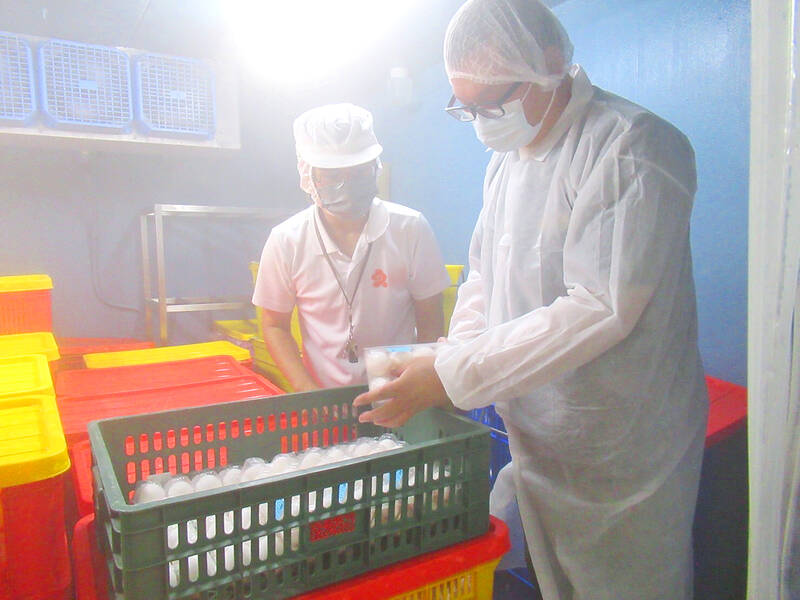
Photo courtesy of the New Taipei City Department of Health
Minister of Agriculture Chen Chi-chung (陳吉仲) on Tuesday apologized for the disturbance caused to the public surrounding the egg import program and in the evening announced that he would resign from his post, but stated that the government was right in initiating the program.
FDA Deputy Director Lin Chin-fu (林金富) yesterday said the agency together with local health departments had inspected shell eggs and their labels at retailers nationwide from Thursday last week to Tuesday.
All 1,533 items passed the inspection, while 50 specimens had been sent for tests for veterinary drug residues, Lin said.
The FDA and the ministry on Tuesday began inspecting egg-washing factories. Among the six factories inspected on the first day, one had imported eggs from Thailand, but no abnormalities were detected at any of the factories, Lin said.
All of the imported eggs were tested batch-by-batch at border inspections, and those that failed the inspection were returned or disposed of, so they did not enter the domestic market, he said, adding that inspections at retailers by local health departments had not found any expired eggs.
INCORRECT EXPIRY DATES
Although there was a case of mislabeled imported eggs (eggs that are to expire late this month were labeled as expiring early next month), they still have a shelf life, so after paying a penalty, the company can still sell the eggs with the correct expiration dates or use them as liquid egg or for food products, Lin said.
The FDA yesterday would have completed an inspection of 13 storage locations, where the Ministry of Agriculture said the expired imported eggs are being stored, he said.
The inspections focused on whether the expired eggs are clearly marked and stored separately, and the refrigerated storage temperature, he said.
Meanwhile, the New Taipei City Department of Health yesterday said a liquid egg company in the city was found to have mixed eggs imported from three nations — Turkey, Brazil and the US — with domestic eggs and falsely labeled the liquid eggs as made in Taiwan between June and last month.
The liquid eggs were sold to three catering companies that service 13 schools, as well as 20 bakeries and other food processing companies in Taoyuan and New Taipei City, New Taipei City Deputy Mayor Liu He-jan (劉和然) said, adding that the eggs were not expired, but mislabeled.
NOT ILLEGAL
Lin said that mixing eggs from different countries of origin as liquid egg is not illegal, but the company must list the nations according to the regulations, from the highest proportion to the lowest proportion.
The FDA would also initiate an inspection of the more than 50 liquid egg processing companies nationwide within the next week and advise them on the correct labeling methods, he said.
Additional reporting by CNA

Considering that most countries issue more than five denominations of banknotes, the central bank has decided to redesign all five denominations, the bank said as it prepares for the first major overhaul of the banknotes in more than 24 years. Central bank Governor Yang Chin-lung (楊金龍) is expected to report to the Legislative Yuan today on the bank’s operations and the redesign’s progress. The bank in a report sent to the legislature ahead of today’s meeting said it had commissioned a survey on the public’s preferences. Survey results showed that NT$100 and NT$1,000 banknotes are the most commonly used, while NT$200 and NT$2,000

The Centers for Disease Control (CDC) yesterday reported the first case of a new COVID-19 subvariant — BA.3.2 — in a 10-year-old Singaporean girl who had a fever upon arrival in Taiwan and tested positive for the disease. The girl left Taiwan on March 20 and the case did not have a direct impact on the local community, it said. The WHO added the BA.3.2 strain to its list of Variants Under Monitoring in December last year, but this was the first imported case of the COVID-19 variant in Taiwan, CDC Deputy Director-General Lin Ming-cheng (林明誠) said. The girl arrived in Taiwan on

ANNUAL EVENT: Two massive Pokemon balloons are to be set up in Daan Park, with an event zone operating from 10am to 6pm This year’s Taipei Floral Picnic is to be held at Daan Park today and tomorrow, featuring an exclusive Pokemon Go event, a themed food market, a coffee rave picnic area and stage performances, the Taipei Department of Information and Tourism said yesterday. Two massive Pokemon balloons are to be set up in the park as attractions, with an exclusive event zone operating from 10am to 6pm, it said. Participants who complete designated tasks on-site would have a chance to receive limited-edition souvenirs, it added. People could also try the newly launched game Pokemon Pokopia in the trial area, the department said. Three PokeStops are

South Korea is planning to revise its controversial electronic arrival card, a step Taiwanese officials said prompted them to hold off on planned retaliatory measures, a South Korean media report said yesterday. A Yonhap News Agency report said that the South Korean Ministry of Foreign Affairs is planning to remove the “previous departure place” and “next destination” fields from its e-arrival card system. The plan, reached after interagency consultations, is under review and aims to simplify entry procedures and align the electronic form with the paper version, a South Korean ministry official said. The fields — which appeared only on the electronic form


 RSS
RSS