


President Tsai Ing-wen (蔡英文) wished Taiwan and the Kingdom of Eswatini would continue to support each other toward reaching the milestone for a century-long friendship at the celebration ceremony of the 55th anniversary of Taiwan’s African diplomatic ally’s independence on Wednesday.
Tsai, together with guests including former Botswanan president Ian Khama, former South African president Jacob Zuma and Basotho King Letsie III, attended the ceremony to celebrate the country’s independence and King Mswati III of Eswatini’s 55th birthday.
It was a big day for both Eswatini and Taiwan, as the day also marked the 55th anniversary of diplomatic relations between the two sides, Tsai said.
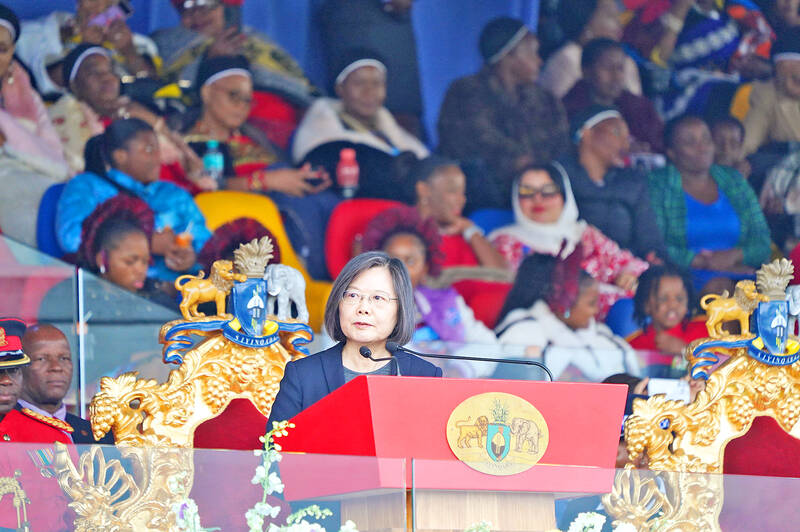
Photo: CNA
“History brought us together and our warm friendship and mutual goodwill have kept us together these 55 years,” she said.
Mswati III once said that Taiwan had become a “home away from home” for him and the people of Eswatini, she said, adding that she also felt at home in Eswatini.
The partnership between Taiwan and Eswatini “has been the epitome of progress and development,” she said.
The two sides collaborated on rural electrification, helping 82 percent of the people in the African country gain access to electricity, the second-highest penetration rate in Africa, she said.
“I am confident of an even brighter future for Eswatini,” she added.
It is great to see many young students from Eswatini studying in universities in Taiwan and later returning to Eswatini to contribute to their society and help cultivate the next generation of talents, Tsai said.
On gender equality and women’s empowerment, issues that Eswatini Queen Mother Ntombi Tfwala cares a lot about, Taiwan and Eswatini signed a memorandum of understanding for cooperation on women’s empowerment in 2019 and Taiwan is to help launch a “Women Business Startup Microfinance Revolving Fund” to help uplift the women in Eswatini, Tsai said.
Mswati III said that the greatest blessing of his country is peace, adding that he hopes people can resolve conflicts and promote peace by putting aside their differences and discussing their ideas peacefully.
He called on Eswatini’s international partners to support his country in the pursuit of its continued development, especially in education, social welfare and healthcare services.
Separately, Eswatini Minister of Health Lizzie Nkosi said that it is unreasonable to exclude Taiwan from the WHO, while Tsai hoped the world could see Taiwan’s contribution to public health during her visit to the Mbabane Government Hospital on Wednesday night.
Tsai was accompanied by Nkosi and hospital superintendent Thando Tembe on a tour of the hospital, whose reconstruction Taiwan and Eswatini cooperated on, to learn about its operation.
This reconstruction plan is an example that “Taiwan can help,” as the country provided its best medical expertise and engineering technology to help improve people’s lives, Tsai said.
Tsai thanked the Taiwanese medical mission based in Eswatini, which is led by the Taipei Medical University Hospital and Cheng Wen-hsuan (鄭文炫), to overcome the challenges posed by the COVID-19 pandemic.
For the past 14 years, the mission has been helping at two hospitals and providing outpatient services at three locations in Eswatini as well as offering free medical consultation services nationwide, she said.
She believed that the fruitful results of the cooperation could let the world see the positive sides of making friends with Taiwan and the country’s commitment to contributing to the world.
Nkosi said that the ministry has long been working with Taiwan’s mission, including launching plans to promote maternal healthcare and national healthcare.
The two sides plan to further cooperate in medical information systems and chronic disease prevention and treatment, she added.
Eswatini would continue to support Taiwan’s meaningful participation in the WHO and other international mechanisms as “Taiwan can definitely contribute to the world,” Nkosi said.
“Taiwan has rich and good experiences in public health and healthcare, so it is unreasonable that it is unable to participate [in the WHO],” Nkosi said.

Considering that most countries issue more than five denominations of banknotes, the central bank has decided to redesign all five denominations, the bank said as it prepares for the first major overhaul of the banknotes in more than 24 years. Central bank Governor Yang Chin-lung (楊金龍) is expected to report to the Legislative Yuan today on the bank’s operations and the redesign’s progress. The bank in a report sent to the legislature ahead of today’s meeting said it had commissioned a survey on the public’s preferences. Survey results showed that NT$100 and NT$1,000 banknotes are the most commonly used, while NT$200 and NT$2,000

The Centers for Disease Control (CDC) yesterday reported the first case of a new COVID-19 subvariant — BA.3.2 — in a 10-year-old Singaporean girl who had a fever upon arrival in Taiwan and tested positive for the disease. The girl left Taiwan on March 20 and the case did not have a direct impact on the local community, it said. The WHO added the BA.3.2 strain to its list of Variants Under Monitoring in December last year, but this was the first imported case of the COVID-19 variant in Taiwan, CDC Deputy Director-General Lin Ming-cheng (林明誠) said. The girl arrived in Taiwan on

ANNUAL EVENT: Two massive Pokemon balloons are to be set up in Daan Park, with an event zone operating from 10am to 6pm This year’s Taipei Floral Picnic is to be held at Daan Park today and tomorrow, featuring an exclusive Pokemon Go event, a themed food market, a coffee rave picnic area and stage performances, the Taipei Department of Information and Tourism said yesterday. Two massive Pokemon balloons are to be set up in the park as attractions, with an exclusive event zone operating from 10am to 6pm, it said. Participants who complete designated tasks on-site would have a chance to receive limited-edition souvenirs, it added. People could also try the newly launched game Pokemon Pokopia in the trial area, the department said. Three PokeStops are
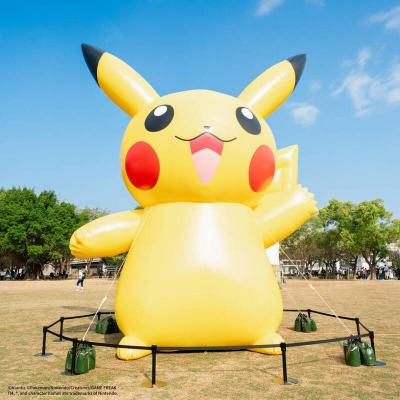
This year’s Taipei Floral Picnic is to be held at Daan Park this weekend, featuring an exclusive Pokemon Go event, a theme food market, a coffee rave picnic area and stage performances. Pokemon Go Two massive Pokemon balloons are to be set up in the park as photo attractions, with an exclusive event zone operating from 10am to 6pm. Participants who complete designated tasks on-site would have a chance to receive limited-edition souvenirs. Pokemon trainers could also experience the newly launched game Pokemon Pokopia in the trial area. Three PokeStops are to be set up in the park. Trainers are invited to take


 RSS
RSS