


An exhibition celebrating Taiwan and Japan’s comic culture opened on Saturday in Taichung, featuring a section that explores Taiwanese reproductions of Japanese comics from when martial law limited Japanese representation.
“A Century of Manga Culture: An Encounter of Taiwan and Japan’s Youth” held its Taiwan opening ceremony at Taichung’s National Taiwan Museum of Comics after an initial one-month run in Japan’s Kyoto International Manga Museum between May 24 and June 24.
Much like the Kyoto exhibition, the show mainly celebrates the comic connection between Taiwan and Japan through late Taiwanese comic book publisher Tsai Kun-lin (蔡焜霖), and Shin Takarajima Magazine started in 1947 by Japan’s “god of manga” Osamu Tezuka and Shichima Sakai, another Japanese comic giant.
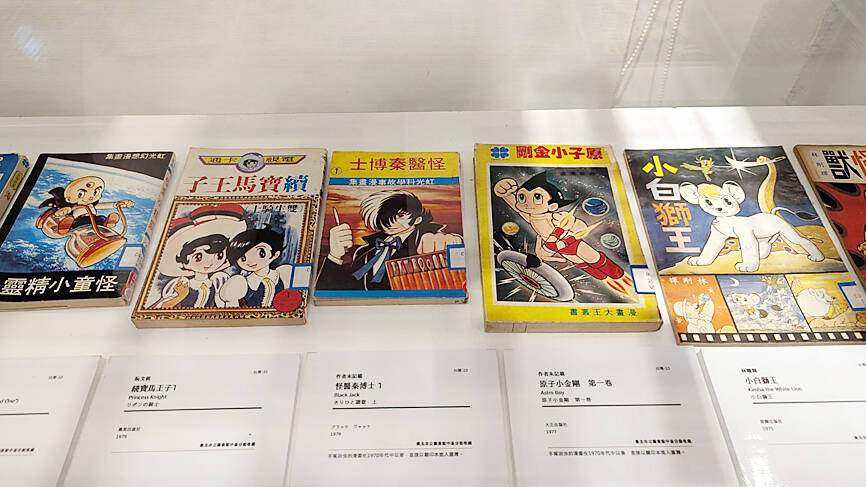
Photo: CNA
However, the Taiwan leg of the show features a special section that explores a time when Taiwan plagiarized Japanese manga.
The section showcases old comics such as Professor Chin the Strange Doctor (怪醫秦博士), which was itself a publication that both reproduced and at times plagiarized Tezuka’s Black Jack.
According to the Taiwan show’s curator Lee I-yun (李衣 雲), the reason behind Taiwanese artists directly copying the art style and adapting stories of famous Japanese mangakas was for the sake of publication.
In the 1960s in Taiwan, laws meant that any art or language referencing Japan would have to be taken out, leading to altered art and words, according to Lee.
The plagiarized art also gave birth to Taiwanese exclusive sequels of Japanese stories, which local artists reproduced from in the past, such as several issues of Taiwan’s publication of the famous Japanese manga Doraemon.
On Taiwan’s plagiarism, Japanese mangaka and comics researcher Tokushige Kawakatsu, who attended the opening of the Taiwan show, observed that Japanese manga is a source of inspiration to Taiwan.
Japan, conversely, was also deeply influenced by American comics in the past, such as how famed mangaka Shigeru Mizuki of GeGeGe no Kitaro fame got his start, Kawakatsu said.
Kawakatsu went on to add that such mutual copying illustrates the fact that comics are a medium involving the reproduction of images.
The special section of the exhibition containing the plagiarized comics was also erected in the likeness of a traditional comics rental shop commonly found in Japan between the 1950s and 1960s and in Taiwan in the 1960s.
Aside from the display of copied stories, the special section also showcases Kawakatsu’s findings from research trips the Japanese artist took to Taiwan to study the history behind the plagiarized publications.
The Taiwan leg of “A Century of Manga Culture: An Encounter of Taiwan and Japan’s Youth” will run from Aug. 15 to Oct. 12 as the National Taiwan Museum of Comics’ first large-scale exhibition since opening its doors in late December 2023.
The show centers around Tsai and Tezuka, both iconic figures in the comic book industry, through the lens of two works: The Boy from Clearwater, a comic book series based on Tsai’s life, and The Osamu Tezuka Story, a biography of Tezuka.

The military has spotted two Chinese warships operating in waters near Penghu County in the Taiwan Strait and sent its own naval and air forces to monitor the vessels, the Ministry of National Defense (MND) said. Beijing sends warships and warplanes into the waters and skies around Taiwan on an almost daily basis, drawing condemnation from Taipei. While the ministry offers daily updates on the locations of Chinese military aircraft, it only rarely gives details of where Chinese warships are operating, generally only when it detects aircraft carriers, as happened last week. A Chinese destroyer and a frigate entered waters to the southwest

A magnitude 6.1 earthquake struck off the coast of Yilan County at 8:39pm tonight, the Central Weather Administration (CWA) said, with no immediate reports of damage or injuries. The epicenter was 38.7km east-northeast of Yilan County Hall at a focal depth of 98.3km, the CWA’s Seismological Center said. The quake’s maximum intensity, which gauges the actual physical effect of a seismic event, was a level 4 on Taiwan’s 7-tier intensity scale, the center said. That intensity level was recorded in Yilan County’s Nanao Township (南澳), Hsinchu County’s Guansi Township (關西), Nantou County’s Hehuanshan (合歡山) and Hualien County’s Yanliao (鹽寮). An intensity of 3 was
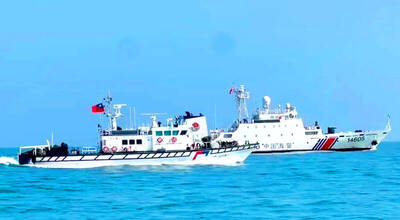
Instead of focusing solely on the threat of a full-scale military invasion, the US and its allies must prepare for a potential Chinese “quarantine” of Taiwan enforced through customs inspections, Stanford University Hoover fellow Eyck Freymann said in a Foreign Affairs article published on Wednesday. China could use various “gray zone” tactics in “reconfiguring the regional and ultimately the global economic order without a war,” said Freymann, who is also a nonresident research fellow at the US Naval War College. China might seize control of Taiwan’s links to the outside world by requiring all flights and ships entering or leaving Taiwan
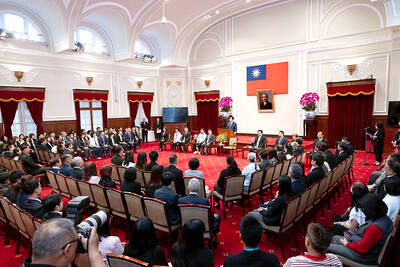
The next minimum wage hike is expected to exceed NT$30,000, President William Lai (賴清德) said yesterday during an award ceremony honoring “model workers,” including migrant workers, at the Presidential Office ahead of Workers’ Day today. Lai said he wished to thank the awardees on behalf of the nation and extend his most sincere respect for their hard work, on which Taiwan’s prosperity has been built. Lai specifically thanked 10 migrant workers selected for the award, saying that although they left their home countries to further their own goals, their efforts have benefited Taiwan as well. The nation’s industrial sector and small businesses lay


 RSS
RSS