


At a memorial service in Taipei on Sunday last week, the Ministry of Culture conferred on photojournalist Pan Hsiao-hsia (潘小俠) a special commendation, while tributes poured in celebrating the “street fighter” and photojournalist, who died late last month.
A native of Taipei’s Shilin District (士林), Pan rose to prominence covering the fervent pro-democracy street protests of the 1980s and 1990s, leaving behind a large collection of photographs, books and documentaries from his career.
He held his final photography exhibition last year, before he was diagnosed and hospitalized with esophageal cancer. He died aged 69 on July 31.
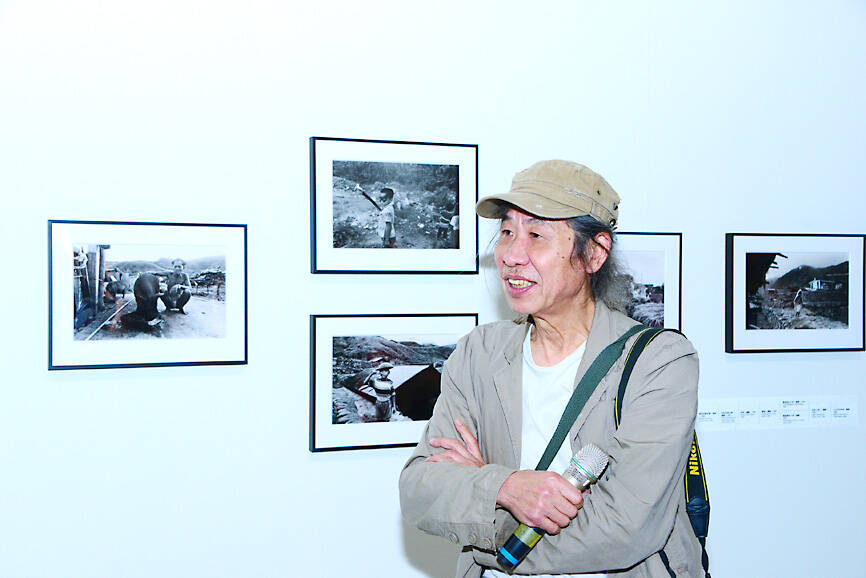
Photo courtesy of the National Taiwan Museum of Fine Arts
After completing his mandatory military service on Matsu, Pan worked in advertising and photography during the late 1970s, before starting his career in news, when he was hired by a weekly magazine. In 1987, he joined the Independent Evening Post as a news photographer.
Minister of Culture Shih Che (史哲) said in the special commendation that during the 1980s, Pan’s photography and reporting focused on Taiwan’s transition to democracy and social movements.
Later, he sought to document the 228 Incident and the lives of those persecuted during the White Terror era, searching for the victims and their family members, Shih said.
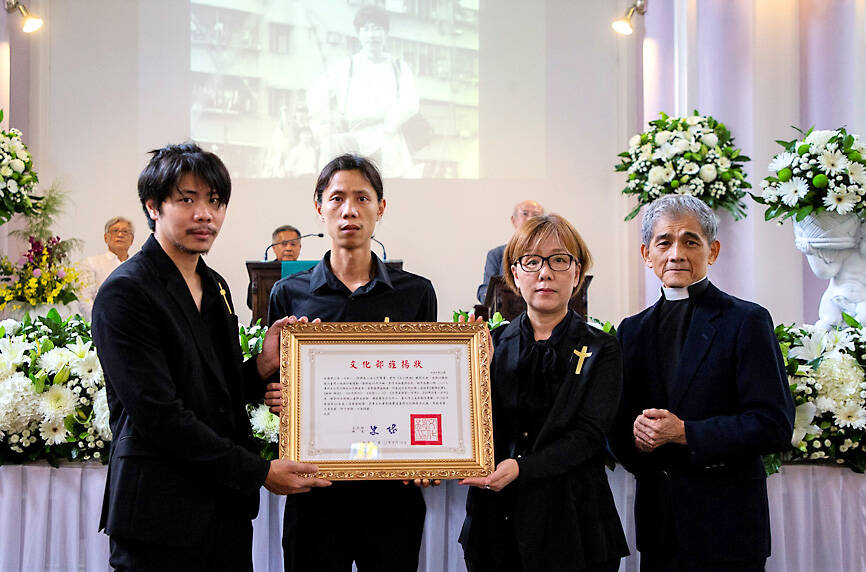
Photo courtesy of the Ministry of Culture
The 228 Incident refers to a crackdown launched by the then-Chinese Nationalist Party (KMT) regime against civilian demonstrations following an incident in Taipei on Feb. 27, 1947.
The event also marked the beginning of the White Terror era that saw thousands of people arrested, imprisoned or executed.
“Pan’s lifetime of work enriched the documentation of Taiwanese culture and history with images and portraits. He was an important witness and participant in many vital moments in Taiwan’s modern transition and recent history,” the commendation said.
Among his well-known works and collections are the books The Photographic Reportage of Orchid Island 1980-2022 (蘭嶼記事1980-2022:潘小俠影像), 100 Years of Taiwan Artists: Pan Hsiao Hsia’s Portrait Making 1905-2017 (台灣美術家一百年: 潘小俠攝影造像簿) and 100 Years of Taiwan Writer: Pan Hsiao Hsia’s Portrait Making 1920-2020 (台灣作家一百年: 潘小俠攝影造像簿).
Pan received the Wu San Lien Foundation Award in 2017, and from the 1980s also covered indigenous peoples, bull-collar workers, sex workers, street entertainers and traditional opera performers.
Veteran photographer Shawn Shih (施宗暉) said that the newspaper industry in the 1980s and 1990s was vibrant, providing new freedom for many start-up news outlets.
Previously, all publications and broadcast television and radio had been controlled by the KMT regime, which imposed strict censorship, he said.
Pan’s colleagues remembered him as a constant presence at democracy movement gatherings, as well as protests against nuclear power, arising from his friendships with members of the Tao community, who have long sought the removal of a nuclear waste storage facility on Orchid Island (Lanyu, 蘭嶼), Shawn Shih said.
Pan also collaborated with historian Yang Bi-chuan (楊碧川) and human rights activist Chen Ming-cheng (陳銘城) on the two-volume collection The Testimonies of 228 (見證228) published in 2015, featuring interviews with black-and-white portraits of survivors and their families of the 228 Incident.
“When Pan began working as a photographer for the Independent Evening Post in 1987, Taiwan was in political and social upheaval, with people taking up the struggle to demand freedom and democratic elections, and all kinds of street protests were going on,” photographer and close friend Chiu Wan-hsing (邱萬興) wrote of Pan. “Taiwan was experiencing a rapid transformation, and people could feel the fast pace of political and social changes. Society was becoming robust from the reforms, with newfound freedoms of expression and media.”
Chiu said that Pan told him about seeing farmers being beaten by baton-wielding police during a protest on May 20, 1988.
“From that day on, Pan said that he was determined to be an activist, to fight against government repression, having witnessed the barbaric use of state violence against unarmed people,” he said.
Pan was present for many significant events of the era, including the 1989 funeral of free-speech advocate Deng Nan-jung (鄭南榕); the Wild Lily student movement of 1990; and the movement to abolish Article 100 of the Criminal Code in 1991.
Pan later turned to film, directing documentaries mainly focused on indigenous peoples, including a 2002 movie about the Takasago volunteers who fought for the Japanese Imperial Army, a documentary on Atayal face tattoo culture in 2003 and 2011’s Dream for Returning Home (回家的夢) on the Rukai people’s struggle to rebuild their Kucapungane community in Pingtung County’s Wutai Township (霧台) after Typhoon Morakot in 2009.


China has reserved offshore airspace in the Yellow Sea and East China Sea from March 27 to May 6, issuing alerts usually used to warn of military exercises, although no such exercises have been announced, the Wall Street Journal (WSJ) reported yesterday. Reserving such a large area for 40 days without explanation is an “unusual step,” as military exercises normally only last a few days, the paper said. These alerts, known as Notice to Air Missions (Notams), “are intended to inform pilots and aviation authorities of temporary airspace hazards or restrictions,” the article said. The airspace reserved in the alert is
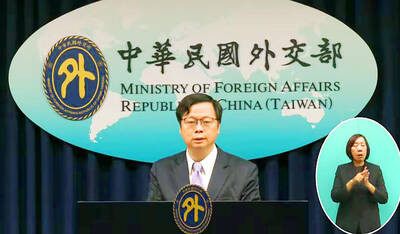
NAMING SPAT: The foreign ministry called on Denmark to propose an acceptable solution to the erroneous nationality used for Taiwanese on residence permits Taiwan has revoked some privileges for Danish diplomatic staff over a Danish permit that lists “Taiwan” as “China,” Eric Huang (黃鈞耀), head of the Ministry of Foreign Affairs’ Department of European Affairs, told a news conference in Taipei yesterday. Reporters asked Huang whether the Danish government had responded to the ministry’s request that it correct the nationality on Danish residence permits of Taiwanese, which has been listed as “China” since 2024. Taiwan’s representative office in Denmark continues to communicate with the Danish government, and the ministry has revoked some privileges previously granted to Danish representatives in Taiwan and would continue to review

More than 6,000 Taiwanese students have participated in exchange programs in China over the past two years, despite the Mainland Affairs Council’s (MAC) “orange light” travel advisory, government records showed. The MAC’s publicly available registry showed that Taiwanese college and university students who went on exchange programs across the Strait numbered 3,592 and 2,966 people respectively. The National Immigration Agency data revealed that 2,296 and 2,551 Chinese students visited Taiwan for study in the same two years. A review of the Web sites of publicly-run universities and colleges showed that Taiwanese higher education institutions continued to recruit students for Chinese educational programs without

A bipartisan group of US senators has introduced a bill to enhance cooperation with Taiwan on drone development and to reduce reliance on supply chains linked to China. The proposed Blue Skies for Taiwan Act of 2026 was introduced by Republican US senators Ted Cruz and John Curtis, and Democratic US senators Jeff Merkley and Andy Kim. The legislation seeks to ease constraints on Taiwan-US cooperation in uncrewed aerial systems (UAS), including dependence on China-sourced components, limited access to capital and regulatory barriers under US export controls, a news release issued by Cruz on Wednesday said. The bill would establish a "Blue UAS


 RSS
RSS