


President Tsai Ing-wen (蔡英文) touted the need for a bilateral investment agreement (BIA) between Taiwan and the European Union during a meeting with members of a European Parliament delegation yesterday in Taipei.
Tsai made the comments while receiving the Members of the European Parliament (MEPs) led by Estonian MEP Urmas Paet. She said that such a deal would “strengthen our partnership” and consolidate the unity of democracies, without elaborating.
She also expressed hope that Taiwan and the EU will continue to deepen cooperation in the fields of supply chain resiliency, investment, cybersecurity and technological innovation, as the world faces the challenge of expanding authoritarianism and the restructuring of global supply chains.
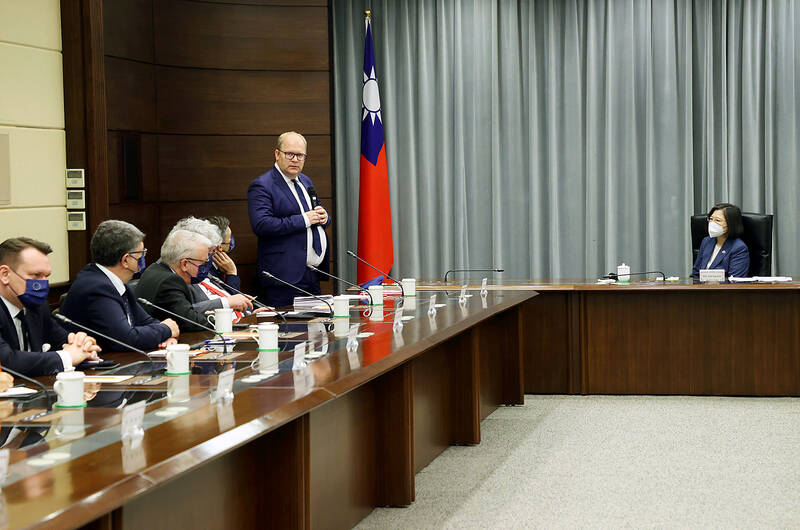
Photo: CNA
Paet, the vice chair of European Parliament’s Committee on Foreign Affairs (AFET), expressed similar views and said it was “absolutely necessary that democracies stick together and deepen [their] cooperation.”
While Paet did not immediately comment on Tsai’s calls for a BIA, he told reporters later the same day that the EU is a “complicated” organization and it is not easy for its 27 member-states to reach consensus on the issue.
While it would be “good” if the two sides could reach a deal, Paet said, the strong trade and investment ties currently enjoyed between Taiwan and the EU show that “the absence of an agreement is not so big [an] obstacle.”
At the same time, Paet said he looks forward to seeing more bilateral cooperation on security, mentioning that the two sides could share best practices in countering cyberattacks.
Russia’s invasion of Ukraine has shown that authoritarian regimes support each other in their aggression, he said, adding that cooperation between democracies were thus needed to “balance this negative influence.”
Paet and his delegation arrived in Taiwan on Tuesday for a visit from July 25-27, after first stopping in Japan.
The 15-member delegation includes seven other MEPs, namely Reinhard Butikofer, Michael Gahler, Tonino Picula, Nathalie Loiseau, Dominik Tarczy?ski, Jakop G. Dalunde and Susanna Ceccardi.

Considering that most countries issue more than five denominations of banknotes, the central bank has decided to redesign all five denominations, the bank said as it prepares for the first major overhaul of the banknotes in more than 24 years. Central bank Governor Yang Chin-lung (楊金龍) is expected to report to the Legislative Yuan today on the bank’s operations and the redesign’s progress. The bank in a report sent to the legislature ahead of today’s meeting said it had commissioned a survey on the public’s preferences. Survey results showed that NT$100 and NT$1,000 banknotes are the most commonly used, while NT$200 and NT$2,000

The Centers for Disease Control (CDC) yesterday reported the first case of a new COVID-19 subvariant — BA.3.2 — in a 10-year-old Singaporean girl who had a fever upon arrival in Taiwan and tested positive for the disease. The girl left Taiwan on March 20 and the case did not have a direct impact on the local community, it said. The WHO added the BA.3.2 strain to its list of Variants Under Monitoring in December last year, but this was the first imported case of the COVID-19 variant in Taiwan, CDC Deputy Director-General Lin Ming-cheng (林明誠) said. The girl arrived in Taiwan on

ANNUAL EVENT: Two massive Pokemon balloons are to be set up in Daan Park, with an event zone operating from 10am to 6pm This year’s Taipei Floral Picnic is to be held at Daan Park today and tomorrow, featuring an exclusive Pokemon Go event, a themed food market, a coffee rave picnic area and stage performances, the Taipei Department of Information and Tourism said yesterday. Two massive Pokemon balloons are to be set up in the park as attractions, with an exclusive event zone operating from 10am to 6pm, it said. Participants who complete designated tasks on-site would have a chance to receive limited-edition souvenirs, it added. People could also try the newly launched game Pokemon Pokopia in the trial area, the department said. Three PokeStops are

South Korea is planning to revise its controversial electronic arrival card, a step Taiwanese officials said prompted them to hold off on planned retaliatory measures, a South Korean media report said yesterday. A Yonhap News Agency report said that the South Korean Ministry of Foreign Affairs is planning to remove the “previous departure place” and “next destination” fields from its e-arrival card system. The plan, reached after interagency consultations, is under review and aims to simplify entry procedures and align the electronic form with the paper version, a South Korean ministry official said. The fields — which appeared only on the electronic form


 RSS
RSS