


Taiwan passport holders have visa-free access to 144 countries and territories around the world, ranking it 31st in the latest Henley Passport Index published on Tuesday.
Taiwan’s passport climbed four places from 35th in the previous survey issued by the London-based consulting firm Henley & Partners in January, putting it in a tie with Panama and Macau in 31st place.
Singapore topped the rankings, with its passport giving holders visa-free access to 192 nations in the world.
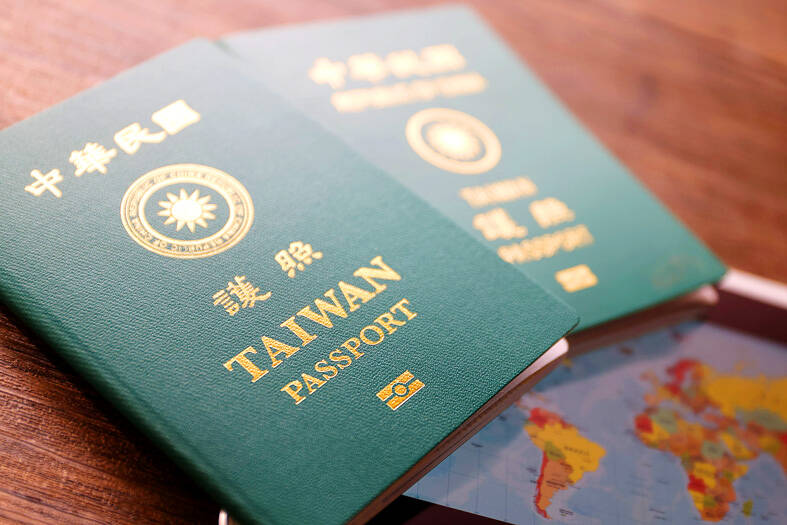
Photo: CNA
Germany shared second place with Italy and Spain with access to 190 destinations, while Japan, after ranking first for five years, fell two places to third, allowing its passport holders access to 189 countries without a visa.
Multiple countries can hold the same spot in the rankings in the case of a tie. As a result, although Taiwan’s passport ranked 31st, a total of 65 countries had passports with more visa-free access.
In the previous survey, though Taiwan ranked 35th, behind 64 other countries, and its passport had visa-free access to 145 destinations.
The Henley Passport Index compares the visa-free access of 199 different passports to 227 travel destinations. Its first index was issued in 2006.
Austria, Finland, France, Luxembourg, South Korea and Sweden shared third place with Japan, while Denmark, Ireland, the Netherlands, and the UK ranked fourth with 188 destinations.
Belgium, the Czech Republic, Malta, New Zealand, Norway, Portugal and Switzerland took the fifth place in the index.
Meanwhile, China ranked 63rd — with a total of 112 countries ahead of it — with visa-free access to 80 countries.
Afghanistan was at the bottom on the index with only 27 destinations offering visa-free travel to its passport holders.
The Henley Passport Index is based on exclusive and official data from the International Air Transport Association.
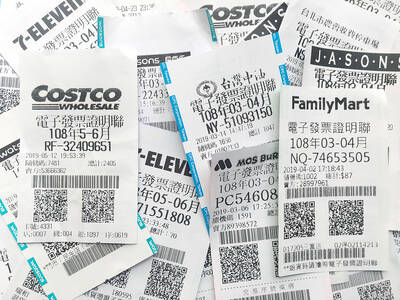
A NT$39 receipt for two bottles of tea at a FamilyMart was among the NT$10 million (US $312,969) special prize winners in the January-February uniform invoice lottery. FamilyMart said that two NT$10 million-winning receipts were issued at its stores, as well as two NT$2 million grand prizes and three NT$200,000 first prizes. The two NT$10 million receipts were issued at stores in Pingtung County and Yilan County’s Dongshan Township (冬山). One winner spent just NT$39 on two bottles of tea, while another spent NT$80 on water, tea and coffee, the company said. Meanwhile, 7-Eleven reported three NT$10 million winners — in New Taipei

Considering that most countries issue more than five denominations of banknotes, the central bank has decided to redesign all five denominations, the bank said as it prepares for the first major overhaul of the banknotes in more than 24 years. Central bank Governor Yang Chin-lung (楊金龍) is expected to report to the Legislative Yuan today on the bank’s operations and the redesign’s progress. The bank in a report sent to the legislature ahead of today’s meeting said it had commissioned a survey on the public’s preferences. Survey results showed that NT$100 and NT$1,000 banknotes are the most commonly used, while NT$200 and NT$2,000

The Centers for Disease Control (CDC) yesterday reported the first case of a new COVID-19 subvariant — BA.3.2 — in a 10-year-old Singaporean girl who had a fever upon arrival in Taiwan and tested positive for the disease. The girl left Taiwan on March 20 and the case did not have a direct impact on the local community, it said. The WHO added the BA.3.2 strain to its list of Variants Under Monitoring in December last year, but this was the first imported case of the COVID-19 variant in Taiwan, CDC Deputy Director-General Lin Ming-cheng (林明誠) said. The girl arrived in Taiwan on

ANNUAL EVENT: Two massive Pokemon balloons are to be set up in Daan Park, with an event zone operating from 10am to 6pm This year’s Taipei Floral Picnic is to be held at Daan Park today and tomorrow, featuring an exclusive Pokemon Go event, a themed food market, a coffee rave picnic area and stage performances, the Taipei Department of Information and Tourism said yesterday. Two massive Pokemon balloons are to be set up in the park as attractions, with an exclusive event zone operating from 10am to 6pm, it said. Participants who complete designated tasks on-site would have a chance to receive limited-edition souvenirs, it added. People could also try the newly launched game Pokemon Pokopia in the trial area, the department said. Three PokeStops are


 RSS
RSS