


Ballistic plates made in Taiwan for use in military-grade bulletproof vests have met local and international standards, and passed tests showing their effectiveness, the Ministry of National Defense said yesterday.
The ministry made the statement at a news conference after a video on YouTube said that bulletproof vests used by Taiwan’s military were ineffective.
Major General Pan Huan-ya (潘煥亞) of the Armaments Bureau’s 205th Arsenal said that ballistic plates produced by his arsenal have repeatedly passed required tests in Taiwan and the US.
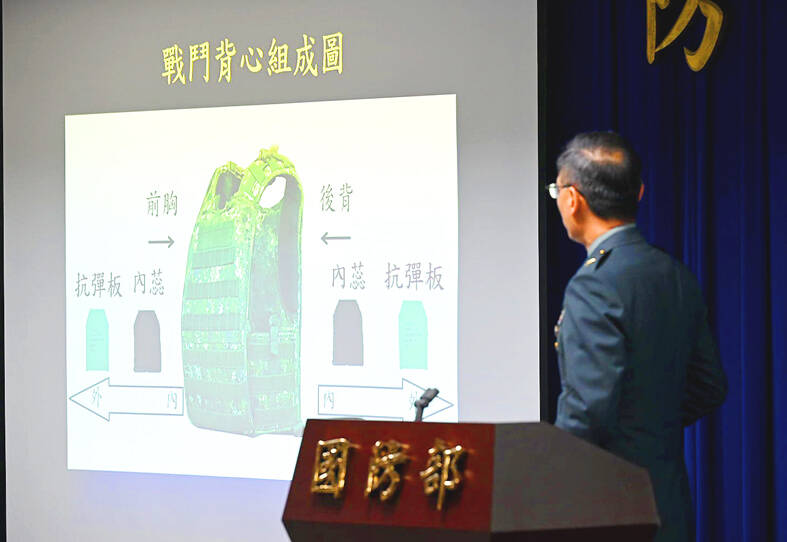
Photo: Chang Chia-ming, Taipei Times
In 2016 the plates were sent to Riverside, Maryland-based Chesapeake Testing, which specializes in testing ballistic and armor protection systems, and passed Level III body armor compliance testing, which is administered by the US Department of Justice’s National Institute of Justice (NIJ), Pan said.
The military also conducted four rounds of tests locally on Nov. 15 and Nov. 30 last year, and on Feb. 7 and June 27, which also showed the domestically made ballistic plates meet NIJ Level III ballistic capabilities in accordance with NIJ Standard 0101.04, he said.
Pan said that tests shown in videos released by YouTuber Uncle Sam Gun & Fun (山姆小叔 Gun & Fun) on Friday revealed that the YouTuber did not understand NIJ body armor compliance testing standards.
NIJ Level III testing is conducted with regular 7.62mm NATO full-metal jacket bullets, but the YouTuber used 5.56mm armor-piercing bullets, Pan said.
The NIJ standard also stipulates that body armor compliance testing be done on ballistic plates with inserts, but the YouTuber either failed to use inserts or put them in the wrong place, he said, without elaborating on the nature of the insert or its proper use.
The US-based Taiwanese YouTuber said that the ballistic plate was provided by New Taipei City Councilor Lin Ping-yu (林秉宥), a member of the Democratic Progressive Party.
The camera operator and narrator in the videos said that the guns and bullets used to test the body armor were not those used by the Chinese army, but were similar.
Lin has refused to say where he found the plate purported to be made by the 205th Arsenal.
He said his main goal was to show that Taiwanese soldiers need better protection from Chinese bullets.
The ministry said that if the ballistic plate used in the videos was found to be a controlled product of Taiwan’s armed forces, it would hold whoever was responsible for the item being given to a member of the public legally responsible.

Considering that most countries issue more than five denominations of banknotes, the central bank has decided to redesign all five denominations, the bank said as it prepares for the first major overhaul of the banknotes in more than 24 years. Central bank Governor Yang Chin-lung (楊金龍) is expected to report to the Legislative Yuan today on the bank’s operations and the redesign’s progress. The bank in a report sent to the legislature ahead of today’s meeting said it had commissioned a survey on the public’s preferences. Survey results showed that NT$100 and NT$1,000 banknotes are the most commonly used, while NT$200 and NT$2,000

The Centers for Disease Control (CDC) yesterday reported the first case of a new COVID-19 subvariant — BA.3.2 — in a 10-year-old Singaporean girl who had a fever upon arrival in Taiwan and tested positive for the disease. The girl left Taiwan on March 20 and the case did not have a direct impact on the local community, it said. The WHO added the BA.3.2 strain to its list of Variants Under Monitoring in December last year, but this was the first imported case of the COVID-19 variant in Taiwan, CDC Deputy Director-General Lin Ming-cheng (林明誠) said. The girl arrived in Taiwan on

South Korea is planning to revise its controversial electronic arrival card, a step Taiwanese officials said prompted them to hold off on planned retaliatory measures, a South Korean media report said yesterday. A Yonhap News Agency report said that the South Korean Ministry of Foreign Affairs is planning to remove the “previous departure place” and “next destination” fields from its e-arrival card system. The plan, reached after interagency consultations, is under review and aims to simplify entry procedures and align the electronic form with the paper version, a South Korean ministry official said. The fields — which appeared only on the electronic form

The Ministry of Foreign Affairs (MOFA) is suspending retaliation measures against South Korea that were set to take effect tomorrow, after Seoul said it is updating its e-arrival system, MOFA said today. The measures were to be a new round of retaliation after Taiwan on March 1 changed South Korea's designation on government-issued alien resident certificates held by South Korean nationals to "South Korea” from the "Republic of Korea," the country’s official name. The move came after months of protests to Seoul over its listing of Taiwan as "China (Taiwan)" in dropdown menus on its new online immigration entry system. MOFA last week


 RSS
RSS