


The Ministry of Health and Welfare reported 236 cases of heat injury between July 1 and Saturday, twice the amount as the same period last year, but summer is also the peak period for acute cardiovascular events, the symptoms of which are often ignored given their similarity to heat injury, a doctor said on Sunday.
Heatstroke occurs when the body can no longer control its temperature as it rises above 40°C. The skin might turn red and dry and become hot, and the affected person might lose consciousness, the Health Promotion Administration (HPA) said.
Left untreated, heatstroke can quickly lead to shock, heart failure, multiple organ failure, rhabdomyolysis (rapid break down of damaged muscle tissue), disseminated intravascular coagulation (abnormal blood clotting) and other fatal complications.
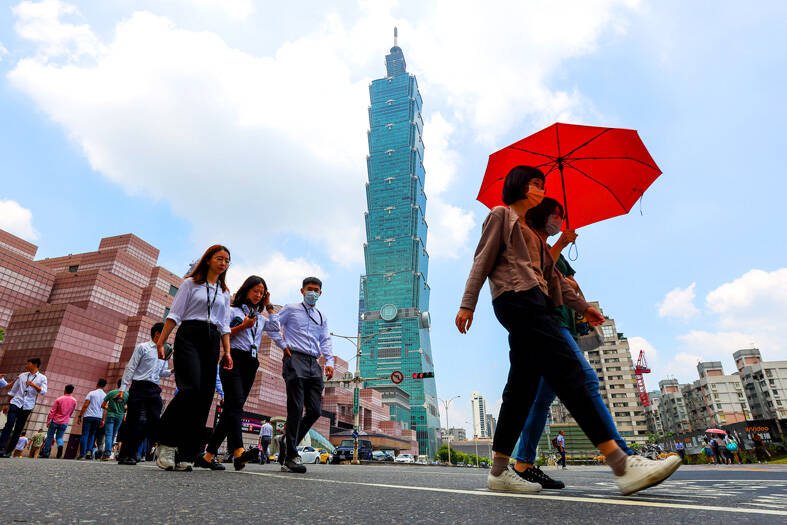
Photo: Ritchie B. Tongo, EPA-EFE
Cathay General Hospital cardiovascular intensive care unit director Chang Chao-chien (張釗監) said that aside from heatstroke, heat causes blood vessels to widen, increasing blood flow and lowering blood pressure.
If a person sweats a lot, but does not drink enough water, their blood can thicken, causing increased risk of coronary or cerebrovascular occlusion, Chang said.
Drastic temperature changes, such as entering an air-conditioned room from a heated outdoor environment, can also increase blood pressure and the risk of cardiovascular events, he said.
Chest tightness and pain, cold sweats and shortness of breath are common symptoms of a heart attack, and severe symptoms include shock, an irregular heartbeat or sudden cardiac arrest, he said, adding that heat can cause sudden death.
People should seek immediate medical attention when experiencing these symptoms, he said.
Older adults are more prone to heatstroke when exposed to high temperatures and humidity, so they should drink plenty of water, avoid direct sun exposure to the skin, wear cooling clothing and stay in cool environments, to avoid dehydration, heat exhaustion and skin injury, doctors say.
The HPA said that older adults have reduced environmental sensitivity, and might collapse or lose consciousness before they are even aware of the early signs of heatstroke, but as the body temperature has risen too much, they might have brain damage or be at risk of death.
Moreover, many older adults take daily medication for chronic diseases, but it might affect blood flow or decrease their ability to sweat, limiting their body’s ability to dissipate heat, such as antihistamines for relieving symptoms of allergies, diuretics used in the management of hypertension, beta blockers and calcium channel blockers, it said.
Extreme heat can also worsen cardiovascular disease, forcing the heart to pump harder and beat faster to reroute more blood to the skin, and people with heart disease would be at higher risk of heart failure, it said.
In addition to drinking plenty of water and taking precautions when going out in the heat, older adults should also get regular health checkups, the HPA said.
When people notice signs of suspected heat injury, they should immediately leave the hot environment, try to lower their body temperature and seek medical attention, it said.

Considering that most countries issue more than five denominations of banknotes, the central bank has decided to redesign all five denominations, the bank said as it prepares for the first major overhaul of the banknotes in more than 24 years. Central bank Governor Yang Chin-lung (楊金龍) is expected to report to the Legislative Yuan today on the bank’s operations and the redesign’s progress. The bank in a report sent to the legislature ahead of today’s meeting said it had commissioned a survey on the public’s preferences. Survey results showed that NT$100 and NT$1,000 banknotes are the most commonly used, while NT$200 and NT$2,000

The Centers for Disease Control (CDC) yesterday reported the first case of a new COVID-19 subvariant — BA.3.2 — in a 10-year-old Singaporean girl who had a fever upon arrival in Taiwan and tested positive for the disease. The girl left Taiwan on March 20 and the case did not have a direct impact on the local community, it said. The WHO added the BA.3.2 strain to its list of Variants Under Monitoring in December last year, but this was the first imported case of the COVID-19 variant in Taiwan, CDC Deputy Director-General Lin Ming-cheng (林明誠) said. The girl arrived in Taiwan on

South Korea is planning to revise its controversial electronic arrival card, a step Taiwanese officials said prompted them to hold off on planned retaliatory measures, a South Korean media report said yesterday. A Yonhap News Agency report said that the South Korean Ministry of Foreign Affairs is planning to remove the “previous departure place” and “next destination” fields from its e-arrival card system. The plan, reached after interagency consultations, is under review and aims to simplify entry procedures and align the electronic form with the paper version, a South Korean ministry official said. The fields — which appeared only on the electronic form

The Ministry of Foreign Affairs (MOFA) is suspending retaliation measures against South Korea that were set to take effect tomorrow, after Seoul said it is updating its e-arrival system, MOFA said today. The measures were to be a new round of retaliation after Taiwan on March 1 changed South Korea's designation on government-issued alien resident certificates held by South Korean nationals to "South Korea” from the "Republic of Korea," the country’s official name. The move came after months of protests to Seoul over its listing of Taiwan as "China (Taiwan)" in dropdown menus on its new online immigration entry system. MOFA last week


 RSS
RSS