


Choreographer Shao Chen-yu (邵震宇) is on a mission to put his own stamp on Middle Eastern dance and use it to explore common social issues he cares deeply about, such as sexism and discrimination against minorities.
“This is something that no one has done before,” Shao said, adding that in the Middle East, people often danced about kings and politics in ancient times, but not social issues.
The Madinat Al Hob, or City of Love in English, is the latest dance performed by Shao’s Asad Oriental Dance troupe, after it made its debut at the Wellspring Theater in Taipei in April and performed at the Taikang Cultural Center in Tainan on Saturday and Sunday.
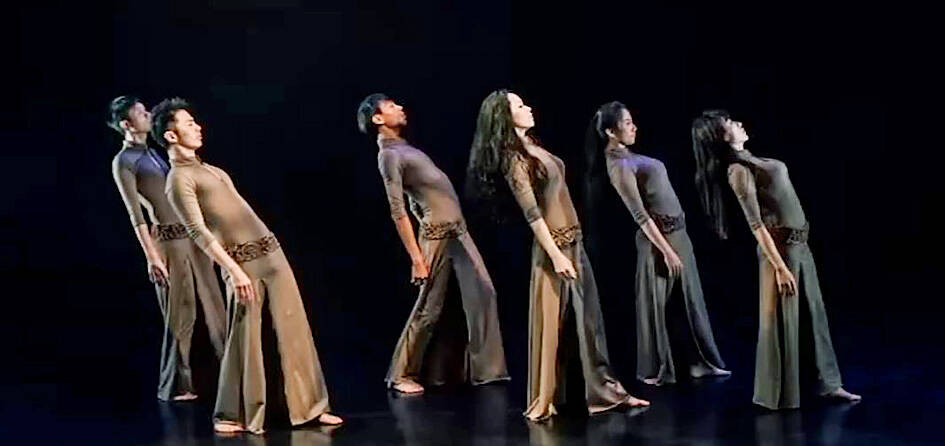
Photo: Screen grab from YouTube
The show follows a loose plot that deals with stigma and discrimination against women, such as stereotypes of how women are supposed to dress and pejoratives in different languages that are derived from female genitals or whose etymology has to do with women, Shao said.
In one act, a person covered in a piece of red cloth lies sideways on the stage and is circled by people in black cloaks. The people dressed in black wear somber expressions as they play a “daf,” or Middle Eastern hand drum, starting with simple single beats before launching into an increasingly complex rhythm.
This symbolizes the funeral of a woman who died after being subjected to misogynistic treatment, gender inequality and bullying, Shao said.
The daf players mourn the woman’s death, but at the same time are reinvigorating her with the life force she needs to be resurrected, he said.
Some scenes are set to rearranged tunes from April Rain (四月望雨), a collection of classic 1930s folk songs by late Taiwanese composer Teng Yu-hsien (鄧雨賢).
A Middle Eastern flavor was added to these classics by playing them to the rhythm of traditional Arabic music to fit Middle Eastern dance, although City of Love also blends in contemporary dance, Shao said.
A Hoklo (commonly known as Taiwanese) version of Window, a poem by Iranian poet Forugh Farrokhzad about the restrictions society imposes on women’s sexuality, is another unusual element in the show.
The hardest part about weaving many Taiwanese elements into Middle Eastern dance, is trying to push the envelope while remaining true to the art form’s roots, so that it remains genuine enough for people in the Middle East, Shao said.
He said his addiction to Middle Eastern dance was triggered by accident in the late 2000s when he was teaching street dance at a dance studio. A colleague who taught belly dancing went on vacation, and the dance studio owner asked him to fill in.
Shao never expected he would love it so much that he entered belly dancing contests and became the first man to win the top prize in the Taiwan Belly Dance Competition in 2009, he said.
Since 2010, he has traveled to the Middle East and Egypt for about two months every year to learn authentic Middle Eastern dance, and in in 2012 formed Asad Oriental Dance.
Despite a lack of funding, Shao said performing overseas is still a priority.
“If we performed mainstream US and European stuff, we would be just like everybody else,” he said. “But if we, an Oriental dance troupe from Taiwan, dance about worldwide issues, people will know there is a different side of the people of Taiwan, and that they not only care about the US and Europe, but the Middle East as well.”

Considering that most countries issue more than five denominations of banknotes, the central bank has decided to redesign all five denominations, the bank said as it prepares for the first major overhaul of the banknotes in more than 24 years. Central bank Governor Yang Chin-lung (楊金龍) is expected to report to the Legislative Yuan today on the bank’s operations and the redesign’s progress. The bank in a report sent to the legislature ahead of today’s meeting said it had commissioned a survey on the public’s preferences. Survey results showed that NT$100 and NT$1,000 banknotes are the most commonly used, while NT$200 and NT$2,000

The Centers for Disease Control (CDC) yesterday reported the first case of a new COVID-19 subvariant — BA.3.2 — in a 10-year-old Singaporean girl who had a fever upon arrival in Taiwan and tested positive for the disease. The girl left Taiwan on March 20 and the case did not have a direct impact on the local community, it said. The WHO added the BA.3.2 strain to its list of Variants Under Monitoring in December last year, but this was the first imported case of the COVID-19 variant in Taiwan, CDC Deputy Director-General Lin Ming-cheng (林明誠) said. The girl arrived in Taiwan on

ANNUAL EVENT: Two massive Pokemon balloons are to be set up in Daan Park, with an event zone operating from 10am to 6pm This year’s Taipei Floral Picnic is to be held at Daan Park today and tomorrow, featuring an exclusive Pokemon Go event, a themed food market, a coffee rave picnic area and stage performances, the Taipei Department of Information and Tourism said yesterday. Two massive Pokemon balloons are to be set up in the park as attractions, with an exclusive event zone operating from 10am to 6pm, it said. Participants who complete designated tasks on-site would have a chance to receive limited-edition souvenirs, it added. People could also try the newly launched game Pokemon Pokopia in the trial area, the department said. Three PokeStops are

South Korea is planning to revise its controversial electronic arrival card, a step Taiwanese officials said prompted them to hold off on planned retaliatory measures, a South Korean media report said yesterday. A Yonhap News Agency report said that the South Korean Ministry of Foreign Affairs is planning to remove the “previous departure place” and “next destination” fields from its e-arrival card system. The plan, reached after interagency consultations, is under review and aims to simplify entry procedures and align the electronic form with the paper version, a South Korean ministry official said. The fields — which appeared only on the electronic form


 RSS
RSS