


A proposal to put Taiwan under the US nuclear umbrella has drawn mostly positive responses from defense experts, after Minister of Foreign Affairs Joseph Wu (吳釗燮) told lawmakers at the Legislative Yuan on Monday that Taipei and Washington are engaged in talks on the matter.
Taiwan’s national security doctrine explicitly rejects the development of nuclear, chemical and biological weapons of mass destruction, despite the nation facing the threat of such weapons being used against it, Institute for National Defense and Security research fellow Su Tzu-yun (蘇紫雲) said yesterday.
The extension of an ally’s nuclear umbrella over Taiwan would be significantly beneficial to the Taiwan’s security, he said.
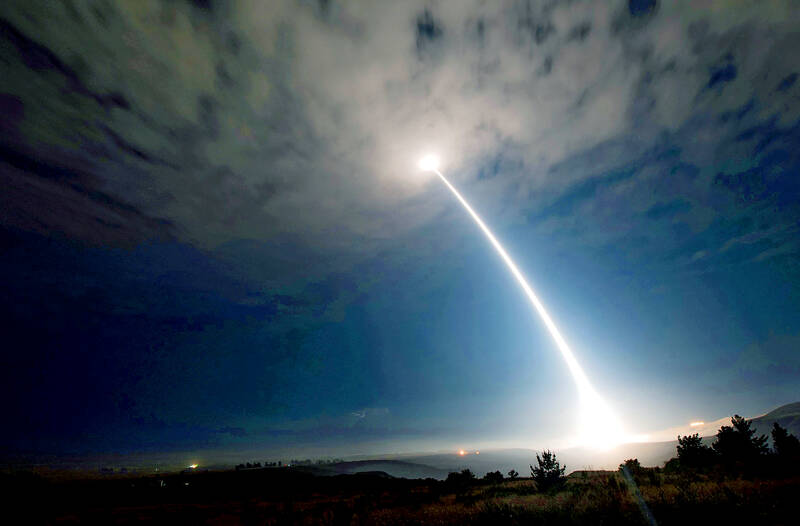
Photo: Reuters
The nuclear umbrella is a deterrence strategy developed during the Cold War. The US uses it to guarantee the safety of smaller countries by threatening to retaliate in kind if those allies came under nuclear attack, he said.
Taiwan’s armed forces already provide conventional deterrence, but obtaining a nuclear deterrence would reduce its susceptibility to nuclear coercion, Su said.
Taiwan’s bid to be protected by the US nuclear umbrella would depend on domestic and international factors, including the outcome of the presidential election next year, Lu Hsin-chi (盧信吉), an assistant professor of international politics at National Chung Hsing University, told an Institute for National Policy Research forum on Monday.
The political will of Taiwanese would play a large part in the international community’s perception and assessment of the cross-strait situation, while the forcefulness of China’s reaction would also likely affect the outcome, he said.
If international and domestic conditions align, it would be possible for the US to provide Taiwan with a certain level of nuclear deterrence, including deploying ballistic missile submarines to patrol the nation’s waters, he said.
The threat of a nuclear-armed North Korea has reinvigorated the South Korea-US military alliance, with South Korean President Yoon Suk-yeol’s administration and US officials issuing the Washington Declaration last month, he said.
Expansion of the US nuclear umbrella over South Korea and Japan would potentially pave the way for Taiwan, he said.

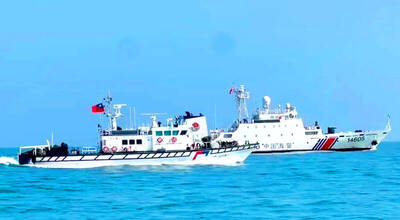
The military has spotted two Chinese warships operating in waters near Penghu County in the Taiwan Strait and sent its own naval and air forces to monitor the vessels, the Ministry of National Defense (MND) said. Beijing sends warships and warplanes into the waters and skies around Taiwan on an almost daily basis, drawing condemnation from Taipei. While the ministry offers daily updates on the locations of Chinese military aircraft, it only rarely gives details of where Chinese warships are operating, generally only when it detects aircraft carriers, as happened last week. A Chinese destroyer and a frigate entered waters to the southwest
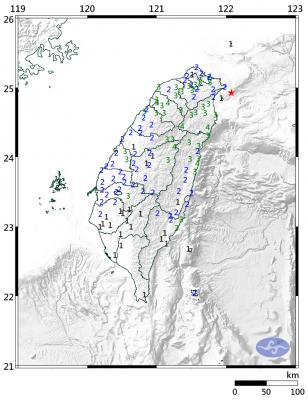
A magnitude 6.1 earthquake struck off the coast of Yilan County at 8:39pm tonight, the Central Weather Administration (CWA) said, with no immediate reports of damage or injuries. The epicenter was 38.7km east-northeast of Yilan County Hall at a focal depth of 98.3km, the CWA’s Seismological Center said. The quake’s maximum intensity, which gauges the actual physical effect of a seismic event, was a level 4 on Taiwan’s 7-tier intensity scale, the center said. That intensity level was recorded in Yilan County’s Nanao Township (南澳), Hsinchu County’s Guansi Township (關西), Nantou County’s Hehuanshan (合歡山) and Hualien County’s Yanliao (鹽寮). An intensity of 3 was
Instead of focusing solely on the threat of a full-scale military invasion, the US and its allies must prepare for a potential Chinese “quarantine” of Taiwan enforced through customs inspections, Stanford University Hoover fellow Eyck Freymann said in a Foreign Affairs article published on Wednesday. China could use various “gray zone” tactics in “reconfiguring the regional and ultimately the global economic order without a war,” said Freymann, who is also a nonresident research fellow at the US Naval War College. China might seize control of Taiwan’s links to the outside world by requiring all flights and ships entering or leaving Taiwan
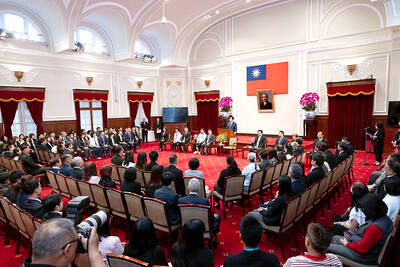
The next minimum wage hike is expected to exceed NT$30,000, President William Lai (賴清德) said yesterday during an award ceremony honoring “model workers,” including migrant workers, at the Presidential Office ahead of Workers’ Day today. Lai said he wished to thank the awardees on behalf of the nation and extend his most sincere respect for their hard work, on which Taiwan’s prosperity has been built. Lai specifically thanked 10 migrant workers selected for the award, saying that although they left their home countries to further their own goals, their efforts have benefited Taiwan as well. The nation’s industrial sector and small businesses lay


 RSS
RSS