


Taipei Mayor Chiang Wan-an (蔣萬安) yesterday announced that the city government is planning to create 7,000 new social housing units, but refused to sign a letter of commitment to work toward the goal of providing 50,000 social housing units when pressed by Taiwan People’s Party (TPP) city councilors.
The city government said in a presentation that it would add 7,000 social housing units during Chiang’s first mayoral term, which ends in 2026, but several city councilors accused him of “painting a rosy picture” without explaining how the plan can be achieved.
Chiang said that more than 4,000 units were built and construction began on 10,332 units during former Taipei mayor Ko Wen-je’s (柯文哲) two mayoral terms, so he expects to start construction on more than 2,000 units and complete more than 7,000 during his first term.
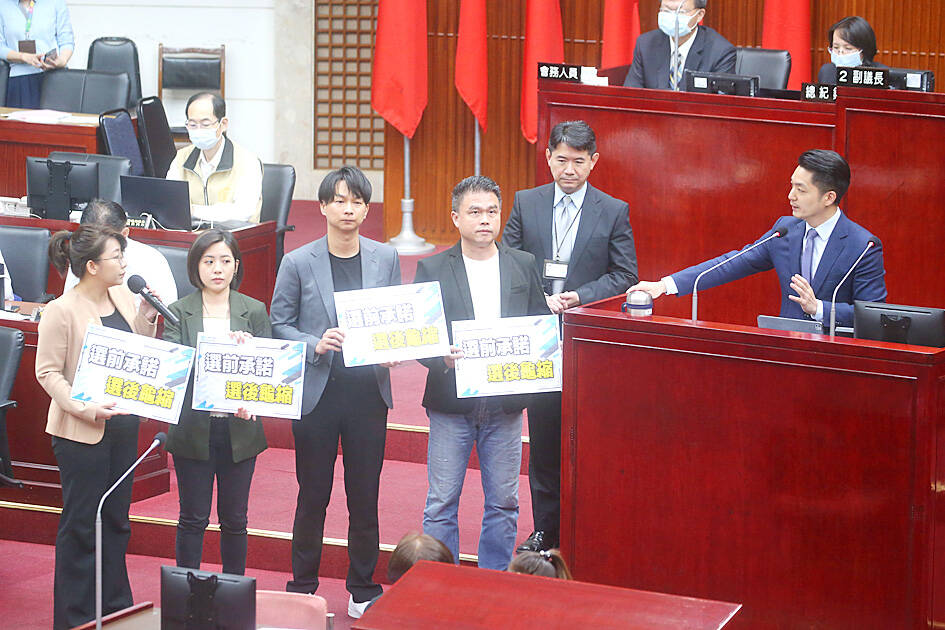
Photo: CNA
Asked by TPP Taipei City Councilor Huang Ching-ying (黃?瑩) where the 7,000 units would be located, Chiang said there are many ways to solve housing issues, such as rent subsidies or subletting and lease management programs.
Democratic Progressive Party Taipei City Councilor Chen E-jun (陳怡君) asked whether the plan to allocate 7,000 units was only a vague “rosy picture.”
As only 1,000 of them would be covered by government-led urban renewal projects, Chen asked where the remaining 6,000 units would be located.
Land is difficult to obtain for the construction of new social housing, but the city government would try to acquire it by offering a building bulk ratio bonus and focusing transit-oriented development, among other methods, Chiang said.
TPP city councilors Huang, Chang Chih-hao (張志豪), Nicole Lin (林珍羽) and Chen You-cheng (陳宥丞) presented Chiang with a letter of commitment asking him to promise to complete the units that were planned during Ko’s administration, and to work toward his goal of creating 50,000 units.
However, the mayor refused to sign the letter, saying that he had already made the promise and that they can discuss the issue further.
The TPP city councilors chanted “promises before the election, but chickening out after the election.” during the council session.
Their letter said that “the Taipei Mayor should sign ... to show his determination to realize his policy promises, and not chicken out.”
Taipei City Government spokesperson Yin Wei (殷瑋) said Chiang publicly said that the city government would work to achieve the goal of 50,000 new social housing units, so the city councilors did not need to use the term “chickening out” for political gain.

The military has spotted two Chinese warships operating in waters near Penghu County in the Taiwan Strait and sent its own naval and air forces to monitor the vessels, the Ministry of National Defense (MND) said. Beijing sends warships and warplanes into the waters and skies around Taiwan on an almost daily basis, drawing condemnation from Taipei. While the ministry offers daily updates on the locations of Chinese military aircraft, it only rarely gives details of where Chinese warships are operating, generally only when it detects aircraft carriers, as happened last week. A Chinese destroyer and a frigate entered waters to the southwest

A magnitude 6.1 earthquake struck off the coast of Yilan County at 8:39pm tonight, the Central Weather Administration (CWA) said, with no immediate reports of damage or injuries. The epicenter was 38.7km east-northeast of Yilan County Hall at a focal depth of 98.3km, the CWA’s Seismological Center said. The quake’s maximum intensity, which gauges the actual physical effect of a seismic event, was a level 4 on Taiwan’s 7-tier intensity scale, the center said. That intensity level was recorded in Yilan County’s Nanao Township (南澳), Hsinchu County’s Guansi Township (關西), Nantou County’s Hehuanshan (合歡山) and Hualien County’s Yanliao (鹽寮). An intensity of 3 was

Japanese Prime Minister Sanae Takaichi’s comment last year on Tokyo’s potential reaction to a Taiwan-China conflict has forced Beijing to rewrite its invasion plans, a retired Japanese general said. Takaichi told the Diet on Nov. 7 last year that a Chinese naval blockade or military attack on Taiwan could constitute a “survival-threatening situation” for Japan, potentially allowing Tokyo to exercise its right to collective self-defense. Former Japan Ground Self-Defense Force general Kiyofumi Ogawa said in a recent speech that the remark has been interpreted as meaning Japan could intervene in the early stages of a Taiwan Strait conflict, undermining China’s previous assumptions
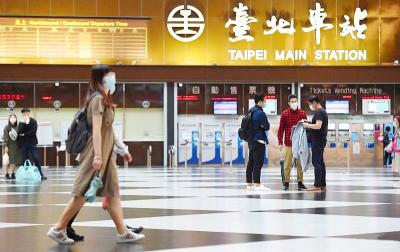
Taiwan Railways Corp (TRC) today announced that Shin Kong Mitsukoshi has been selected as the preferred bidder to operate the Taipei Railway Station shopping mall, replacing the current operator, Breeze Development Co Ltd. Among eight qualified firms that delivered presentations and were evaluated by a review committee, Shin Kong Mitsukoshi was ranked first, while Breeze was named the runner-up, the rail company said in a statement. Contract negotiations are to proceed in accordance with regulations, it said, adding that if negotiations with the top bidder fail, it could invite the second-ranked applicant to enter talks. Breeze in a statement today expressed doubts over


 RSS
RSS