

China might be using a suspected leak of personal information from the Eslite bookstore chain to wage cognitive warfare against Taiwanese, the Taiwan Statebuilding Party said yesterday.
Cynthia Yang (楊欣慈), deputy secretary-general of the Here I Stand Project, told a news conference in Taipei that she received a telephone call on Saturday night from a woman who said she worked at Eslite’s marketing department.
The woman asked Yang if she wanted to participate in an opinion survey the company is conducting among its customers.

Photo: Chen Yu-fu, Taipei Times
She also said that the book If China Attacks (阿共打來怎麼辦), which Yang bought from Eslite’s online site in February, contains “inappropriate” content.
Yang agreed to participate in the survey and prepared to record the conversation.
A man, who also identified himself as Eslite staff, but seemed to have an accent unlike Taiwanese, called 10 minutes later to conduct the survey, Yang said.
The man had no intention of concealing his position and said “the Chinese military’s capabilities are strong, so there is no way Taiwan can win a war,” Yang said.
He repeatedly said that “the US will not help,” “Taiwanese soldiers are afraid to fight,” “the Chinese Nationalist Party [KMT] is better” and “unification with Taiwan is inevitable,” she said.
The man also did not know that Taichung is a city in Taiwan, she added.
Yang said she told him that “people who bought the book will not be brainwashed by you.”
“This was not a scam call, but a call to wage cognitive warfare,” she told the news conference.
She asked how the callers knew what book she had purchased and demanded an explanation from Eslite.
Taiwan Statebuilding Party secretary-general Wang Hsing-huan (王興煥) said the personal information of Eslite customers might have been leaked and used by China to conduct cognitive warfare against Taiwan.
Information security is a national security issue, so the Ministry of Digital Affairs should shoulder the responsibility for this incident, he said.
China is using telephone polls to spread conspiracies and rumors, such as that the military is not strong enough to repel a Chinese attack, and that the KMT would bring peace while the Democratic Progressive Party would bring conflict, he said.
The government should take the issue seriously, as China is targeting specific Taiwanese with these calls, he said.
Wu Hsin-tai (吳欣岱), convener of the party’s Taipei chapter, urged government agencies to curb Chinese propaganda.
Eslite yesterday on its Web site said that it would continue to boost its information security and regularly provide reminders about fraud to its readers.
Additional reporting by Ling Mei-hsueh

The donation of offshore patrol vessel Kinmen to the Philippines includes provisions that protect Taiwanese fishers and facilitate security cooperation across the First Island Chain, officials said yesterday. The comment was made during the Cabinet’s comprehensive administrative report at the legislature after Chinese Nationalist Party (KMT) Legislator Hsu Yu-chen (許宇甄) expressed concerns about the decision to give a ship to a country whose coast guard had in 2013 fired on a Taiwanese trawler and killed its captain without provocation. The Cabinet should lay out the safeguards that have been established to prevent the Philippine government from using the Kinmen to harass, expel
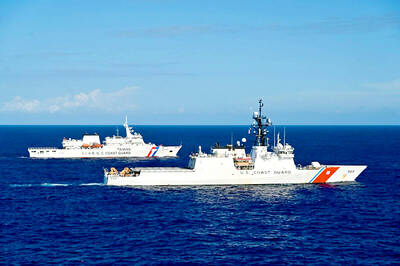
GROWING TIES: The CGA is planning a goodwill mission to the Philippines, in what would be the first time since 1975 a Taiwanese paramilitary vessel has visited the country The Coast Guard Administration (CGA) plans to significantly expand its participation in international security cooperative frameworks and its operational capabilities, a budget proposal for next year showed. The budget indicates a transformation of the CGA from a maritime law enforcement arm into a national defense and intelligence gathering entity capable of tackling larger regional security matters. The proposal showed that personnel from the coast guard’s Intelligence Division and Special Action Support Center are to participate in high-level national security talks with the US. As the CGA has dealt with China’s rising “gray zone” threats around Taiwan, it has become a valuable asset to
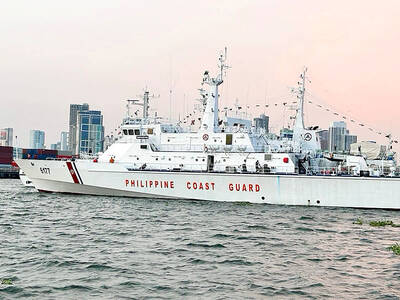
A patrol vessel donated by the Coast Guard Administration (CGA) to the Philippines was commissioned into the Philippine Coast Guard (PCG) on Friday, a Philippine non-governmental organization said. The CGA on Sept. 16 confirmed media reports that Taiwan had donated a retired 500-tonne patrol vessel to the Philippines. The Manila-based We Protect Our Seas (WPS) foundation, which served as an intermediary in the transfer, said that the vessel was formerly the CGA’s 500-tonne petrol vessel Kinmen (CG123). The WPS, in a statement issued on Friday, said the vessel, renamed as the BRP Sarangani, had been commissioned into the PCG the
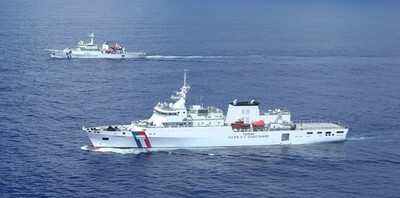
The Coast Guard Administration (CGA) today said that two of its patrol vessels have docked at Palau's Malakal Harbor as part of an expedition exercise and diplomatic visit, during which a senior official is expected to meet with the Palauan president. The two vessels, the 4,000-tonne-class Chiayi (嘉義) and the 1,000-tonne-class Penghu (澎湖), set sail for Palau from Taiwan last week and arrived at Malakal Harbor yesterday, the CGA's Fleet Branch said in a statement. The journey marked the second time the CGA has dispatched a "Friendship Fleet" to another country, after it sent its first-ever goodwill fleet, comprising the Hualien (花蓮)


 RSS
RSS