


Hon Hai Precision Industry Co founder Terry Gou (郭台銘) yesterday apologized for saying that small modular nuclear reactors (SMRs) should be built in Kaohsiung.
Gou is vying for the Chinese Nationalist Party (KMT) nomination for next year’s presidential election.
Asked about his views on green power during a speech on Monday, Gou said establishing SMRs near Banpingshan (半屏山) in Kaohsiung would be “the right move” and is guaranteed to make money, adding that the government should take the lead in making the investment.
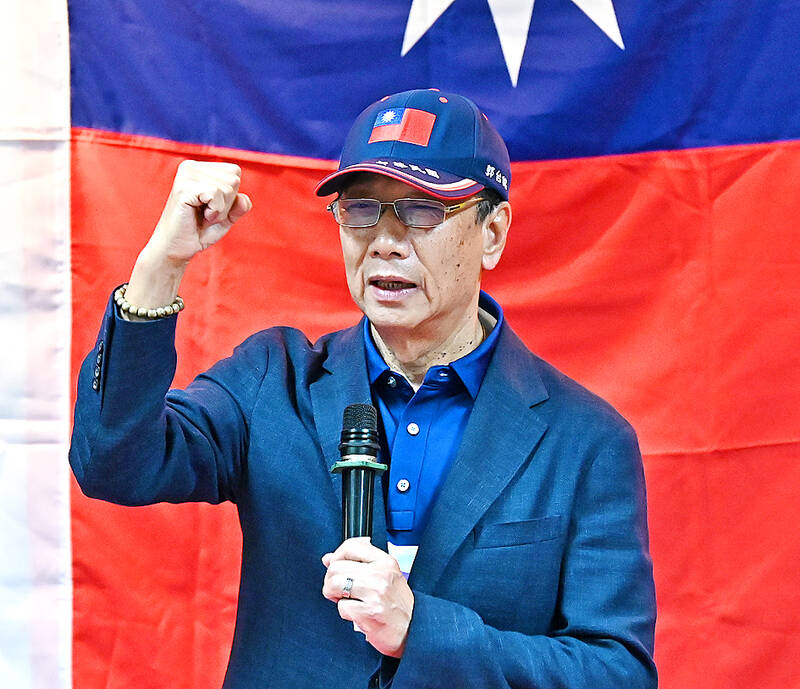
Photo: Lee Hui-chou, Taipei Times
The remarks caused a stir, with Citizen of the Earth, Taiwan saying that research into SMR technology worldwide is incomplete, adding that even if Taiwan wished to develop such technology, there is no mature predecessor for reference.
“We hope that Mr Gou will spend more time finalizing his energy policy platforms before commenting, or he might risk propagating untrue information,” the group said.
Later on Monday evening, Gou said on Facebook that he meant to highlight that Taiwan’s power provision capabilities were unstable and often fell short of actual usage.
He added that this would, inevitably, impact industry as it transitions toward a more sustainable model of production.
Gou said he was perhaps too brash in his haste to highlight the issue, but he also believes that at this juncture, nuclear power is among the options that need to be taken into account when considering the nation’s energy policy.
He said his team would present a transparent energy policy, adding that he understands that the decision for any public policy must consider multiple facets.
Gou also apologized for saying that he hopes to run the government like a corporation.
“We will not need the legislature to provide oversight; we will do it ourselves,” he said earlier.
Legislative oversight is an immutable part of the democratic process and should not be challenged or destroyed, Gou said on Monday, calling on people to understand what he meant instead of just listening to his words.
Gou also said he would use robots to defend Taiwan from the Chinese People’s Liberation Army and hopes to begin the production of the robots within three years.
Democratic Progressive Party Legislator Su Chiao-hui (蘇巧慧) yesterday called Gou a “failed presidential candidate.”
“That was basically an attempt by Gou to cover up his ridiculous remarks by brushing them off as a gaffe,” Su said.
Additional reporting by Wang Jung-hsiang
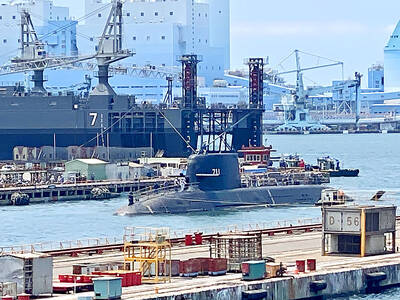
AGING: While Japan has 22 submarines, Taiwan only operates four, two of which were commissioned by the US in 1945 and 1946, and transferred to Taiwan in 1973 Taiwan would need at least 12 submarines to reach modern fleet capabilities, CSBC Corp, Taiwan chairman Chen Cheng-hung (陳政宏) said in an interview broadcast on Friday, citing a US assessment. CSBC is testing the nation’s first indigenous defense submarine, the Hai Kun (海鯤, Narwhal), which is scheduled to be delivered to the navy next month or in July. The Hai Kun has completed torpedo-firing tests and is scheduled to undergo overnight sea trials, Chen said on an SET TV military affairs program. Taiwan would require at least 12 submarines to establish a modern submarine force after assessing the nation’s operational environment and defense

A white king snake that frightened passengers and caused a stir on a Taipei MRT train on Friday evening has been claimed by its owner, who would be fined, Taipei Rapid Transit Corp (TRTC) said yesterday. A person on Threads posted that he thought he was lucky to find an empty row of seats on Friday after boarding a train on the Bannan (Blue) Line, only to spot a white snake with black stripes after sitting down. Startled, he jumped up, he wrote, describing the encounter as “terrifying.” “Taipei’s rat control plan: Release snakes on the metro,” one person wrote in reply, referring
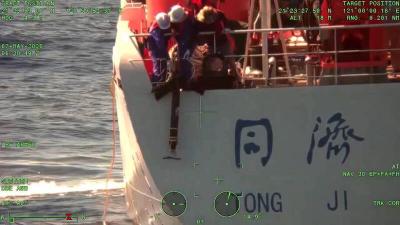
The coast guard today said that it had disrupted "illegal" operations by a Chinese research ship in waters close to the nation and driven it away, part of what Taipei sees a provocative pattern of China's stepped up maritime activities. The coast guard said that it on Thursday last week detected the Chinese ship Tongji (同濟號), which was commissioned only last year, 29 nautical miles (54km) southeast of the southern tip of Taiwan, although just outside restricted waters. The ship was observed lowering ropes into the water, suspected to be the deployment of scientific instruments for "illegal" survey operations, and the coast
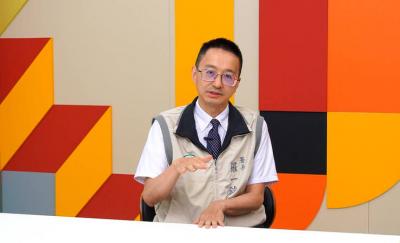
Taiwan’s two cases of hantavirus so far this year are on par with previous years’ case numbers, and the government is coordinating rat extermination work, so there should not be any outbreaks, Centers for Disease Control (CDC) Director-General Philip Lo (羅一鈞) said today in an interview with the Liberty Times (the Taipei Times’ sister newspaper). An increase in rat sightings in Taipei and New Taipei City has raised concerns about the spread of hantavirus, as rats can carry the disease. In January, a man in his 70s who lived in Taipei’s Daan District (大安) tested positive posthumously for hantavirus, Taiwan’s


 RSS
RSS