


COVID-19 cases have risen slightly in the past three weeks and five cases of the new XBB.1.16 strain were detected last week, the Centers for Disease Control (CDC) said yesterday.
CDC Epidemic Intelligence Center Director Guo Hung-wei (郭宏偉) said that the average number of daily new moderate to severe COVID-19 cases reported last week was 114, slightly higher than the average of 98 per day in the week before.
Daily new cases have been increasing slightly for the past three weeks, Guo said.
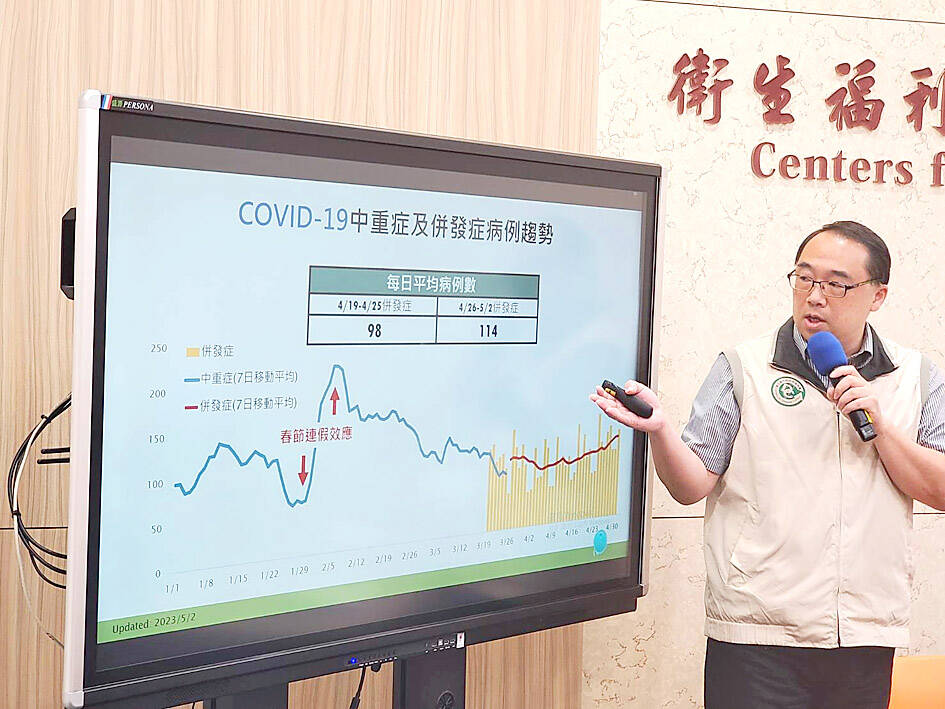
Photo: Lin Hui-chin, Taipei Times
Prescriptions for oral anti-viral drugs to treat COVID-19 have also increased in the past three weeks, as has the positivity rate from testing at residential care facilities, he said.
Genome sequencing of 77 local cases last week showed that Omicron BA.2.75 is still the dominant strain, accounting for 65 percent of cases, followed by Omicron XBB, accounting for 26 percent, he said.
Five local cases with the new Omicron XBB.1.16 subvariant, also known as Arcturus, were identified last week, CDC data showed.
In related news, 58,588 hospital visits for flu-like illnesses were reported last week, with cases trending upward in the past few weeks, Guo said, adding that 13 new cases of serious flu complications were confirmed last week, including seven people with influenza H3N2 and six with H1N1.
Since the flu season began on Oct. 1 last year, 127 cases of serious flu complications have been reported, including 91 with H3N2, with 20 among them having died, he said.
CDC Deputy Director-General Philip Lo (羅一鈞) said that flu cases and serious complications continue to rise gradually, and as the mask mandate implemented for the COVID-19 pandemic has been almost completely lifted, people face greater risk of exposure to infectious respiratory diseases.
Elderly people and those with underlying health conditions should wear a mask in crowded venues, Lo said.
People with respiratory symptoms should wear a mask outdoors to reduce the risk of spreading droplets, he said.
As for mpox infections, 12 new local cases were confirmed last week, all of them men aged 20 to 50, Guo added.
The number of enterovirus infections are rapidly increasing, reaching 10,066 hospital visits last week, Guo said, adding that enterovirus infections next week are expected to cross the threshold of 11,000 per week to be deemed an epidemic.
Laboratory data showed that the coxsackie virus A group is the most common type circulating in local communities, but a new mild case of enterovirus 71 was reported last week, he said, adding that a serious complication from echovirus 21 infection was confirmed in a one-year-old boy last week.
Common early symptoms of enterovirus infection are mouth blisters, and hand, foot and mouth disease, as well as fever, and a rash or blisters on the hands and feet, Guo said, adding that severe complications can include meningitis, encephalitis, sepsis and myocarditis.
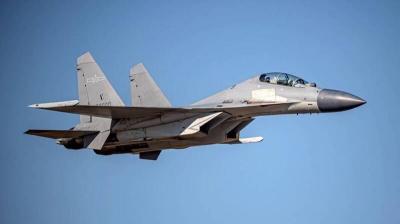
Eight Chinese naval vessels and 24 military aircraft were detected crossing the median line of the Taiwan Strait between 6am yesterday and 6am today, the Ministry of National Defense said this morning. The aircraft entered Taiwan’s northern, central, southwestern and eastern air defense identification zones, the ministry said. The armed forces responded with mission aircraft, naval vessels and shore-based missile systems to closely monitor the situation, it added. Eight naval vessels, one official ship and 36 aircraft sorties were spotted in total, the ministry said.
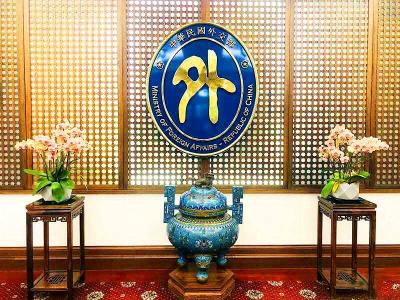
The Ministry of Foreign Affairs (MOFA) today said that if South Korea does not reply appropriately to its request to correct Taiwan’s name on its e-Arrival card system before March 31, it would take corresponding measures to alter how South Korea is labeled on the online Taiwan Arrival Card system. South Korea’s e-Arrival card system lists Taiwan as “China (Taiwan)” in the “point of departure” and “next destination” fields. The ministry said that it changed the nationality for South Koreans on Taiwan’s Alien Resident Certificates from “Korea” to “South Korea” on March 1, in a gesture of goodwill and based on the

Taiwanese officials were shown the first of 66 F-16V fighter jets purchased by Taiwan from the United States, the Ministry of National Defense said yesterday, adding the aircraft has completed an initial flight test and is expected to be delivered later this year. A delegation led by Deputy Minister of National Defense Hsu Szu-chien (徐斯儉) visited Lockheed Martin’s F-16 C/D Block 70 (also known as F-16V) assembly line in South Carolina on March 16 to view the aircraft. The jet will undergo a final acceptance flight in the US before being delivered to Taiwan, the

The New Taipei Metro's Sanyin Line and the eastern extension of the Taipei Metro's Tamsui-Xinyi Line (Red Line) are scheduled to begin operations in June, the National Development Council said today. The Red Line, which terminates at Xiangshan Station, would be connected by the 1.4km extension to a new eastern terminal, Guangci/Fengtian Temple Station, while the Sanyin Line would link New Taipei City's Tucheng and Yingge stations via Sanxia District (三峽). The council gave the updates at a council meeting reviewing progress on public construction projects for this year. Taiwan's annual public infrastructure budget would remain at NT$800 billion (US$25.08 billion), with NT$97.3


 RSS
RSS