


The opening of a trade office and the signing of a cooperation pact would make the Taiwan-Virginia partnership stronger, Virginia Governor Glenn Youngkin said yesterday as he concluded a two-day visit to Taiwan.
Youngkin on Monday announced that he had approved the establishment of a Virginia trade office in Taiwan and yesterday signed a memorandum of understanding (MOU) on economic and trade cooperation with the nation.
Speaking at a press event after the signing, Youngkin said the moves “will build on an already strong relationship.”
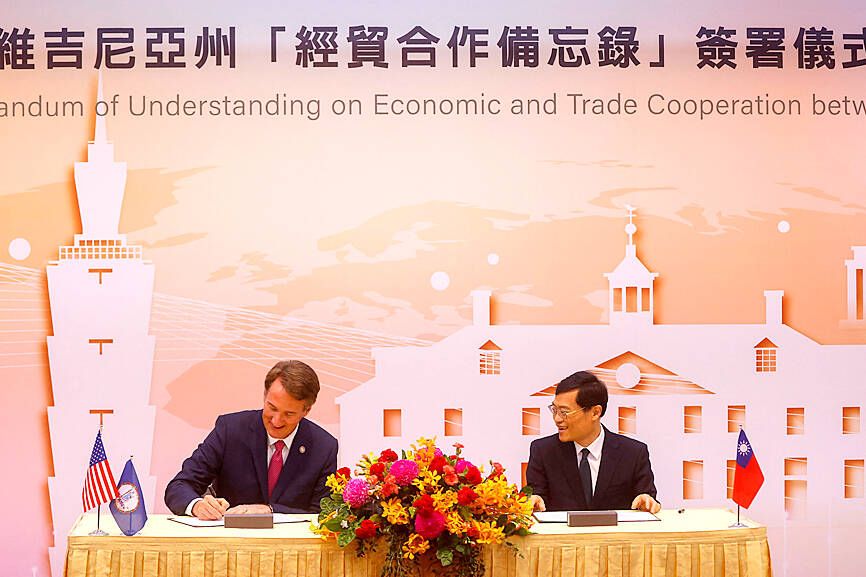
Photo: Ann Wang, Reuters
“And I have very high aspirations that Virginia and Taiwan will have a great future, both economically and in partnership going forward,” he said.
Asked about his first international trade mission since taking office as governor in January — two days in Taiwan before visits to Japan and South Korea — Youngkin said it “could not begin in a more appropriate place.”
He said the aim of traveling to the three Asian destinations was to bolster cooperation with “trusted partners” in supply chains in key industries, such as semiconductors, pharmaceutical manufacturing, automotive supplies, and electric vehicle batteries and storage.
“These are critical supply chains for our collective future, and ones that I believe we must continue to forge with trusted partners. That’s why I’m here,” he said.
Youngkin signed the MOU with Deputy Minister of Economic Affairs Chen Chern-chyi (陳正祺) at a ceremony at the Ministry of Foreign Affairs headquarters in Taipei that Deputy Minister of Foreign Affairs Tien Chung-kwang (田中光) also attended.
Tien said that Virginia is Taiwan’s 10th-largest source of imports and ninth-largest export market among the US’ 50 states.
The MOU would help to foster even more opportunities for both sides, he said.
Chen praised Virginia as a home to engineering talent with a strong workforce and sound education system.
The MOU would be the starting point to further reinforce cooperation of the fields of economic and trade, and open a new chapter in Taiwan-Virginia relations, he said.

NATIONAL SECURITY: Authorities are working to confirm the identities of the military personnel involved and investigating possible illegal conduct and regulatory violations Authorities are probing possible national security implications after Kinmen police and immigration officers on Sunday found a Chinese woman allegedly posing as a tourist while engaging in prostitution involving more than 10 military personnel. The woman, surnamed Chen (陳), has since been deported, authorities said, adding that investigators are still working to confirm the identities of those implicated, as the records only listed code names and aliases. The case stemmed from a report received by the Kinmen District Prosecutors’ Office on Friday last week from the Jinhu Precinct of the Kinmen County Police Bureau. On Sunday, police, along with the National Immigration

GLOBALGIVING: ‘ Caving to external pressure is not acceptable for an organization that has cultivated justice reform and human rights for 30 years,’ one NGO said A slew of non-government organizations (NGOs) have withdrawn from the GlobalGiving fundraising platform after it announced it would use “Chinese Taipei” instead of “Taiwan” from next month. The Taiwan Good Rice Association wrote on Facebook on Friday that it was informed on April 28 via a teleconference call of the change, which was made because the platform wanted to operate in China. Taiwan Good Rice is to terminate all cooperative relationships with GlobalGiving in response to the platform’s “unilateral and non-negotiable” decision to remove references to Taiwan, the NGO said. “Taiwan is in the official name of Taiwan Good Rice Association and the

HEAVY WEATHER: Typhoon Jangmi is due to crash straight into the Ryukyus as airlines look to shift flights to larger aircraft or cancel flights to Okinawa entirely Taiwan’s international air carriers announced flight adjustments over the weekend as Typhoon Jangmi is forecast to hit the Ryukyu Islands today and tomorrow. The Central Weather Administration (CWA) upgraded Jangmi from a tropical storm to a typhoon at 8am yesterday, with the eye located 580km south of Naha city. It was moving north at 19kph. Today, China Airlines’ CI-120, CI-121, CI-122 and CI-123 flights between Taoyuan and Naha, Okinawa, have been canceled as well as CI-132 and CI-133 between Kaohsiung and Naha. EVA Air’s BR-112, BR-113, BR-186 and BR-185 flights between Taoyuan and Naha are also canceled. Low-cost carrier Tigerair Taiwan canceled IT-230,

REASONS FOR TRAVEL: An assistant professor said that proposed amendments to penalize drivers if they used drugs overseas would not deter people from traveling People who operate a motor vehicle under the influence of marijuana would have their driver’s license revoked, even if they used the substance while overseas, the Ministry of Transportation and Communications said yesterday, citing proposed amendments to the Road Traffic Management and Penalty Act (道路交通管理處罰條例). The amendments would also authorize the government to revoke the licenses of people determined to have used Category 1 or Category 2 narcotics, even if they were not operating a vehicle while under the influence of drugs, as well as ban them from taking the license test for three years, the ministry said. People aged 18 or


 RSS
RSS