


Ten Vietnamese whose bodies were found washed ashore last month were not victims of human trafficking and were attempting to return to Taiwan for work, investigators said yesterday.
Using a photograph of 14 people, likely taken when they boarded a vessel in China on their way to Taiwan, along with documents and other information found on their bodies, the Criminal Investigation Bureau (CIB) working with the Vietnam Economic and Cultural Office in Taipei identified eight of the men and two women, the bureau said.
The group traveled from Vietnam to China’s Fujian Province, where they bought a motorized fishing boat to travel across the Taiwan Strait, and their vessel likely capsized due to inclement weather, CIB International Criminal Affairs Division head Dustin Lee (李泱輯) told a news conference in Taipei.
“Our investigation in Taiwan, in collaboration with Vietnamese authorities to obtain information from families of the victims, has thus far produced no evidence linking them with criminal organizations or international trafficking rings,” Lee said.
Four of the women in the photograph remain missing, and it is uncertain if they survived, he said.
A CIB officer stationed in the Taipei Economic and Cultural Office in Vietnam has been working with the Vietnamese Ministry of Public Security and police in Hanoi to gather information from relatives of the victims, he said.
“Vietnamese authorities said the group of 14 were from the same north Vietnam township and knew each other. They were between 30 and 42 years old, and all had previously worked in Taiwan in agriculture and fishing. Records show that all 14 had been deported after they were found to be working illegally in Taiwan,” Lee said.
The group told their families they planned to return to Taiwan to work, and in the middle of February traveled by foot on mountain trails to enter China’s Guangxi region, where they took a bus to Fujian’s Pingtan, the CIB said, citing interviews with their relatives.
They took photographs and left records of their journey on their cellphones, Vietnamese authorities told investigators.
They pooled their money to buy the boat in Pingtan for about NT$1 million (US$32,782), and likely departed on Feb. 14, which was the last day of known contact with their families, Lee said.
One of the men, surnamed Nguyen, had apparently swum to an offshore wind turbine off Changhua County, climbing the ladder to its platform, but had no means of calling for rescue, and died of exposure and dehydration, the CIB said.
Examinations by coroners determined that the rest had drowned and that no foul play was suspected, Lee said.
The bodies of nine men and five women, all identified as Taiwanese and determined to have drowned, also washed ashore in February and last month, he said.
Investigations have so far indicated that their deaths were accidental or suicides, he said.
Prosecutors last month formed a task force to investigate the deaths and are continuing to work with Vietnamese authorities, while they search for the four missing women and seek to determine whether human trafficking or criminal organizations were involved, he said.

The Ministry of Finance this afternoon announced the winning numbers for the March-April uniform invoice lottery. The winning number for the NT$10 million (US$318,060) special prize is 19531471, and the winning number for the NT$2 million grand prize is 85941329. Three numbers were drawn for the NT$200,000 first prize: 07225810, 20231230 and 83518781. Those with receipts matching the last seven digits of any of the first-prize numbers will win the NT$40,000 second prize, while those matching the last six digits will win the NT$10,000 third prize. Those whose receipts match the last five digits of the first-prize numbers can claim the NT$4,000 fourth prize,

SIX SUBSIDIES: The monthly allowance for older farmers is to increase to NT$10,000, and NT$5,000 is to be given to homemakers under the national pension system, Lai said The government is to implement major welfare policies for disadvantaged groups, including raising the monthly allowance for older farmers to NT$10,000 and providing homemakers with NT$5,000 per month, President William Lai (賴清德) said yesterday. Lai made the remarks during a visit to Wangling Temple in Chiayi County, saying that the planned increases were being introduced amid economic growth and an increase in tax revenue. Touting a policy, in which the government plans to provide a monthly allowance of NT$5,000 for every child under the age of 18 in a bid to address Taiwan’s low birthrate, Lai said that if received for the
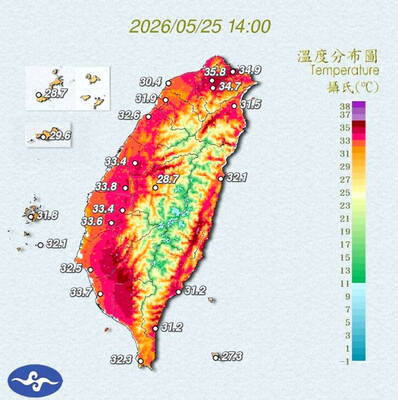
STAY COOL: The HPA recommended that people stay hydrated, use air-conditioning or fans while indoors, wear loose-fitting clothes and walk in the shade while outdoors Employers must implement measures such as installing cooling equipment, and providing drinking water and rest breaks for outdoor workers starting from Monday next week, the Taipei Department of Labor said on Sunday. Employers who fail to comply could face fines of NT$30,000 to NT$300,000 under the Occupational Safety and Health Act (職業安全衛生法), the department said. Businesses in Taipei employing fewer than 100 workers, as well as registered self-employed workers with labor insurance coverage, could receive on-site assessments and guidance from occupational safety consultants to help them apply for central government subsidies to implement or improve heat-protection measures, it said. Under the Ministry of

NATIONAL SECURITY: Authorities are working to confirm the identities of the military personnel involved and investigating possible illegal conduct and regulatory violations Authorities are probing possible national security implications after Kinmen police and immigration officers on Sunday found a Chinese woman allegedly posing as a tourist while engaging in prostitution involving more than 10 military personnel. The woman, surnamed Chen (陳), has since been deported, authorities said, adding that investigators are still working to confirm the identities of those implicated, as the records only listed code names and aliases. The case stemmed from a report received by the Kinmen District Prosecutors’ Office on Friday last week from the Jinhu Precinct of the Kinmen County Police Bureau. On Sunday, police, along with the National Immigration


 RSS
RSS