


A bipartisan group of US lawmakers is taking their concerns about China to California this week, where they plan to meet President Tsai Ing-wen (蔡英文) along with top technology and entertainment executives.
The trip — led by US Representative Mike Gallagher, a Wisconsin Republican who chairs the US House Select Committee on China — is aimed at understanding how the Chinese Communist Party (CCP) influences US social values and discourse, a person familiar with the committee’s plans said.
About half a dozen lawmakers are to begin their trip in Los Angeles on Wednesday, where they are scheduled to meet with Walt Disney Co CEO Bob Iger and other producers and screenwriters to talk about Beijing’s demands on US films in exchange for access to the Chinese market, the person said.
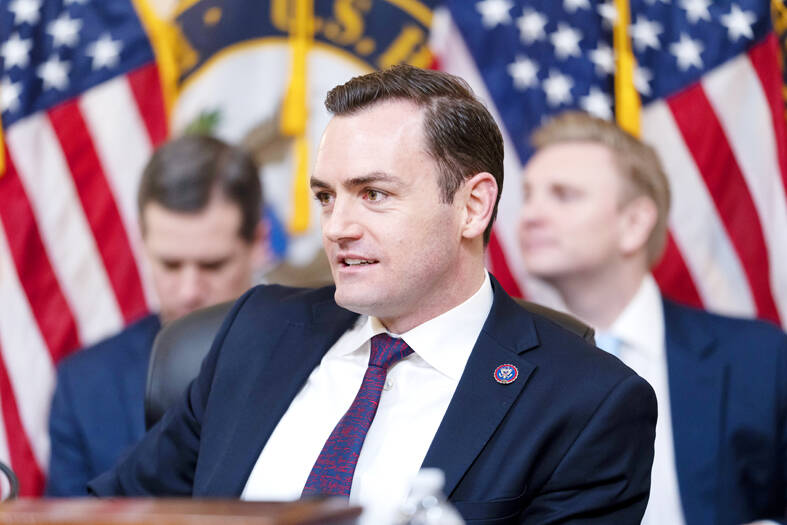
Photo: AP
The lawmakers are expected to ask how the CCP inserts its narrative — and scrubs objectionable content — not just in films shown in China, but also in global productions in a way that undermines the soft power of exporting US culture.
That stop is to include a meeting with Tsai during her stopover as she returns from an official visit to Guatemala and Belize, the person said.
Tsai is also expected to meet with US House of Representatives Speaker Kevin McCarthy, a California Republican, in his home state.
She met last week with US House of Representatives Minority Leader Hakeem Jeffries, the top House Democrat, in his home state of New York, people familiar with the event said.
Taiwan’s Presidential Office has declined to confirm Tsai’s planned meetings in advance.
The group on Thursday is to have lunch in the San Francisco Bay Area with executives from Alphabet Inc’s Google, Microsoft Corp, Palantir Technologies Inc and Apple Inc CEO Tim Cook, the person said, adding that dinner that night is to include several prominent venture capitalists, including Marc Andreessen and Vinod Khosla.
The China committee under Gallagher’s leadership has sought out forums beyond the traditional hearing room on Capitol Hill to understand all aspects of the “strategic competition” between the world’s two largest economies.
The committee’s conversations with private-sector leaders are taking place as US companies across the economy re-evaluate their exposure to China and their reliance on its consumers and supply chains.
US relations with China have been strained over China’s support for Russia, a spy balloon that flew over the US and bipartisan calls in Washington to ban the popular video-sharing app TikTok because of its Chinese parent, ByteDance Inc.
Gallagher and US Representative Raja Krishnamoorthi, the top Democrat on the China Committee, who is scheduled to be on the trip, co-sponsored one of several bills seeking to block TikTok from operating in the US.
Some industries are of particular concern, including pharmaceuticals, rare earth minerals, artificial intelligence and quantum computing, the person said.
The conversations are to focus on how the US government and the private sector need to work together to confront the threat from China, the person added.
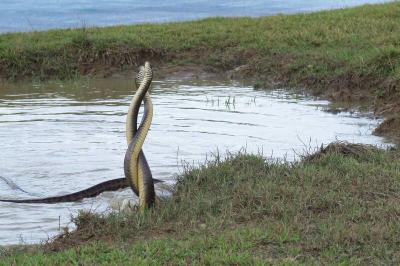
Kenting National Park service technician Yang Jien-fon (楊政峰) won a silver award in World Grand Prix Photography Awards Spring Season for his photograph of two male rat snakes intertwined in combat. Yang’s colleagues at Kenting National Park said he is a master of nature photography who has been held back by his job in civil service. The awards accept entries in all four seasons across six categories: architectural and urban photography, black-and-white and fine art photography, commercial and fashion photography, documentary and people photography, nature and experimental photography, and mobile photography. Awards are ranked according to scores and divided into platinum, gold and

More than half of the bamboo vipers captured in Tainan in the past few years were found in the city’s Sinhua District (新化), while other districts had smaller catches or none at all. Every year, Tainan captures about 6,000 snakes which have made their way into people’s homes. Of the six major venomous snakes in Taiwan, the cobra, the many-banded krait, the brown-spotted pit viper and the bamboo viper are the most frequently captured. The high concentration of bamboo vipers captured in Sinhua District is puzzling. Tainan Agriculture Bureau Forestry and Nature Conservation Division head Chu Chien-ming (朱健明) earlier this week said that the

NAMING SPAT: The foreign ministry called on Denmark to propose an acceptable solution to the erroneous nationality used for Taiwanese on residence permits Taiwan has revoked some privileges for Danish diplomatic staff over a Danish permit that lists “Taiwan” as “China,” Eric Huang (黃鈞耀), head of the Ministry of Foreign Affairs’ Department of European Affairs, told a news conference in Taipei yesterday. Reporters asked Huang whether the Danish government had responded to the ministry’s request that it correct the nationality on Danish residence permits of Taiwanese, which has been listed as “China” since 2024. Taiwan’s representative office in Denmark continues to communicate with the Danish government, and the ministry has revoked some privileges previously granted to Danish representatives in Taiwan and would continue to review

The first bluefin tuna of the season, brought to shore in Pingtung County and weighing 190kg, was yesterday auctioned for NT$10,600 (US$333.5) per kilogram, setting a record high for the local market. The auction was held at the fish market in Donggang Fishing Harbor, where the Siaoliouciou Island-registered fishing vessel Fu Yu Ching No. 2 delivered the “Pingtung First Tuna” it had caught for bidding. Bidding was intense, and the tuna was ultimately jointly purchased by a local restaurant and a local company for NT$10,600 per kilogram — NT$300 ,more than last year — for a total of NT$2.014 million. The 67-year-old skipper


 RSS
RSS