


The government should prioritize the re-entry of Chinese business travelers to boost economic activity amid packed flights from China after Beijing reopened its borders on Sunday, the Travel Quality Assurance Association (TQAA) said yesterday.
Flights to China were nearly full, primarily with business travelers, as well as Chinese spouses and students, returning for the Lunar New Year holiday, after the country lifted international travel restrictions, TQAA spokesman Ringo Lee (李奇嶽) said.
Over the past three years, China has restricted flights from Taiwan to airports in Beijing, Shanghai, Chengdu and Xiamen to contain the COVID-19 outbreak, he said.
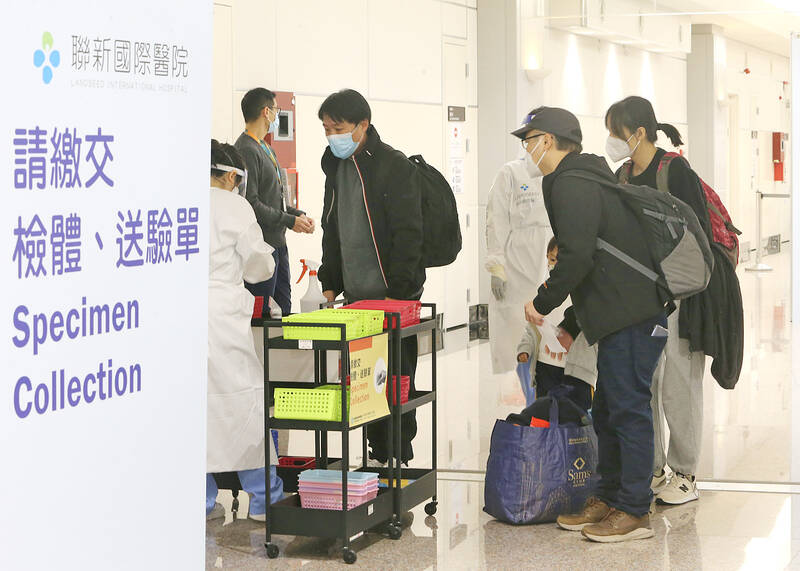
Photo: Tony Yao, Taipei Times
The number of cross-strait flights and Chinese airports that can accommodate Taiwanese flights should be increased as the current flight capacity would not meet rising demand, he said, adding that prior to the COVID-19 pandemic 4 million Taiwanese per year traveled to China.
“It is our hope that Chinese business travelers would be allowed to re-enter first, as it is important to resume economic and trade exchanges between China and Taiwan. The government should decide whether Chinese tourists should be allowed to visit after taking into account the pandemic situation there,” Lee said.
“We also hope that the ‘small three links’ connecting Kinmen and Lienchiang counties with China can resume normal operations, which would give Taiwanese businesspeople in China another way home,” he said.
Taiwanese returning from four Chinese airports and through the “small three links” must undergo saliva polymerase chain reaction (PCR) tests at their port of entry.
Travelers who test positive are asked to observe five days of home care and self-health management.
From Friday last week to Jan. 31, Taiwanese departing from China or entering via Hong Kong or Macau must obtain a PCR test report within 48 hours before boarding flights or undergo rapid antigen screening within 24 hours. Those leaving directly from Hong Kong and Macau are not subject to the testing.
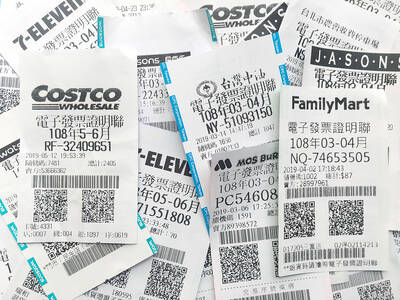
A NT$39 receipt for two bottles of tea at a FamilyMart was among the NT$10 million (US $312,969) special prize winners in the January-February uniform invoice lottery. FamilyMart said that two NT$10 million-winning receipts were issued at its stores, as well as two NT$2 million grand prizes and three NT$200,000 first prizes. The two NT$10 million receipts were issued at stores in Pingtung County and Yilan County’s Dongshan Township (冬山). One winner spent just NT$39 on two bottles of tea, while another spent NT$80 on water, tea and coffee, the company said. Meanwhile, 7-Eleven reported three NT$10 million winners — in New Taipei

Considering that most countries issue more than five denominations of banknotes, the central bank has decided to redesign all five denominations, the bank said as it prepares for the first major overhaul of the banknotes in more than 24 years. Central bank Governor Yang Chin-lung (楊金龍) is expected to report to the Legislative Yuan today on the bank’s operations and the redesign’s progress. The bank in a report sent to the legislature ahead of today’s meeting said it had commissioned a survey on the public’s preferences. Survey results showed that NT$100 and NT$1,000 banknotes are the most commonly used, while NT$200 and NT$2,000

ANNUAL EVENT: Two massive Pokemon balloons are to be set up in Daan Park, with an event zone operating from 10am to 6pm This year’s Taipei Floral Picnic is to be held at Daan Park today and tomorrow, featuring an exclusive Pokemon Go event, a themed food market, a coffee rave picnic area and stage performances, the Taipei Department of Information and Tourism said yesterday. Two massive Pokemon balloons are to be set up in the park as attractions, with an exclusive event zone operating from 10am to 6pm, it said. Participants who complete designated tasks on-site would have a chance to receive limited-edition souvenirs, it added. People could also try the newly launched game Pokemon Pokopia in the trial area, the department said. Three PokeStops are
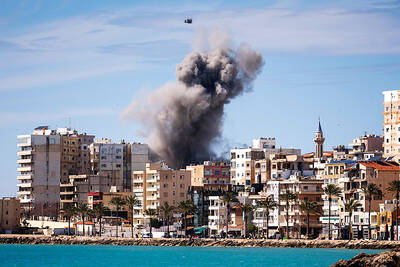
Taiwan is concerned that China could exploit the US’ war in the Middle East, with state media citing examples from the conflict to cast doubt on the efficiency of US weapons Taiwan would use to repel an invasion. Taiwanese officials said the resumption of Beijing’s large-scale air force incursions near Taiwan after an unusual decline show that China wants to take advantage of the redeployment of US forces from East Asia to the Middle East. “This is a moment for China to exercise influence,” a senior Taiwanese security official said, speaking on condition of anonymity. “What China is trying to create is a


 RSS
RSS