


The Water Resources Agency (WRA) yesterday conducted cloud seeding near a reservoir in southern Taiwan, but the operation resulted in little rainfall.
The effort aimed to boost the water levels of the Zengwen Reservoir (曾文水庫), which spans Chiayi County and Tainan, the Southern Region Water Resources Office said.
The office said that it launched the operation at 9am after detecting a cloud system approaching southern Taiwan.
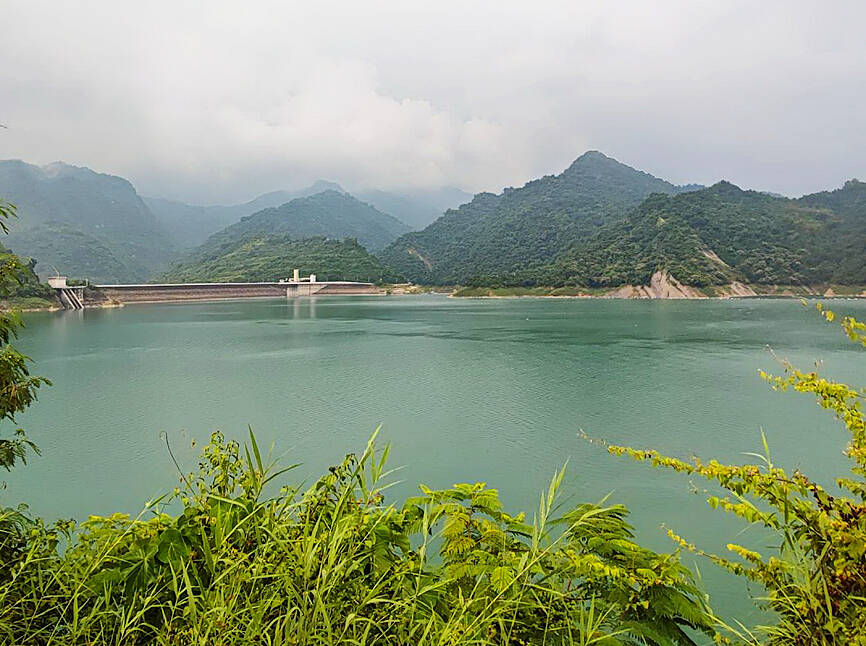
Photo: Wu Chun-feng, Taipei Times
However, from 8am to 4pm, only 0.1mm of rain fell in the reservoir’s catchment area, after 0.3mm had fallen in the previous eight hours.
Following the operation, the reservoir’s water reserves rose by 0.2 percentage points to 27.99 percent of capacity, and its usable water supply rose by 110,000m3 to 142.62 million cubic meters, WRA data showed.
As of Dec. 17, the reservoir had not received more than 80mm of rain in a single day since Aug. 7, causing its water level to decline, the office said.
To conserve water, the office has reduced water pressure in Tainan and has issued a water advisory for Chiayi, its Web site says.
The Zengwen Reservoir, which is connected to the Wushantou Reservoir (烏山頭水庫) in Tainan, normally releases water to Wushantou to produce electricity, and the water is then distributed to the greater Tainan area and the Jianan Plain.
The Wushantou Reservoir is at 59.84 percent capacity, with 47.34 million cubic meters of usable water in reserves.
The combined amount of water at the two reservoirs is the eighth-lowest since the Zengwen Reservoir entered service in 1972, office data showed.
The Zengwen Reservoir’s reserves had fallen below 5 percent of capacity during the severe water shortage that affected Taiwan in 2021.
The only other reservoir in southern Taiwan facing a serious shortage is the much smaller Baihe Reservoir (白河水庫), which was at 24.25 percent capacity as of 8am yesterday, WRA data showed.
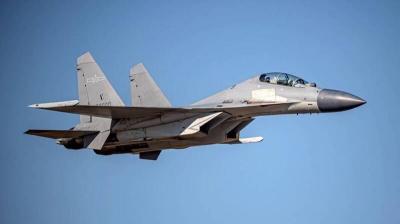
Eight Chinese naval vessels and 24 military aircraft were detected crossing the median line of the Taiwan Strait between 6am yesterday and 6am today, the Ministry of National Defense said this morning. The aircraft entered Taiwan’s northern, central, southwestern and eastern air defense identification zones, the ministry said. The armed forces responded with mission aircraft, naval vessels and shore-based missile systems to closely monitor the situation, it added. Eight naval vessels, one official ship and 36 aircraft sorties were spotted in total, the ministry said.
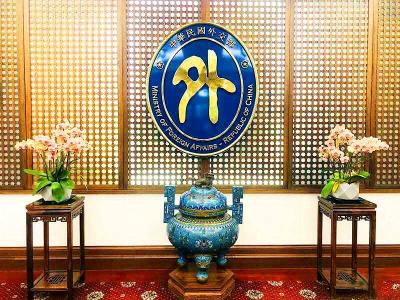
The Ministry of Foreign Affairs (MOFA) today said that if South Korea does not reply appropriately to its request to correct Taiwan’s name on its e-Arrival card system before March 31, it would take corresponding measures to alter how South Korea is labeled on the online Taiwan Arrival Card system. South Korea’s e-Arrival card system lists Taiwan as “China (Taiwan)” in the “point of departure” and “next destination” fields. The ministry said that it changed the nationality for South Koreans on Taiwan’s Alien Resident Certificates from “Korea” to “South Korea” on March 1, in a gesture of goodwill and based on the
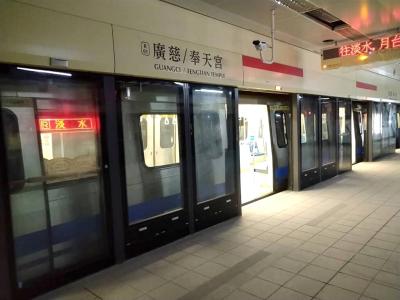
The New Taipei Metro's Sanyin Line and the eastern extension of the Taipei Metro's Tamsui-Xinyi Line (Red Line) are scheduled to begin operations in June, the National Development Council said today. The Red Line, which terminates at Xiangshan Station, would be connected by the 1.4km extension to a new eastern terminal, Guangci/Fengtian Temple Station, while the Sanyin Line would link New Taipei City's Tucheng and Yingge stations via Sanxia District (三峽). The council gave the updates at a council meeting reviewing progress on public construction projects for this year. Taiwan's annual public infrastructure budget would remain at NT$800 billion (US$25.08 billion), with NT$97.3

Taiwanese officials were shown the first of 66 F-16V fighter jets purchased by Taiwan from the United States, the Ministry of National Defense said yesterday, adding the aircraft has completed an initial flight test and is expected to be delivered later this year. A delegation led by Deputy Minister of National Defense Hsu Szu-chien (徐斯儉) visited Lockheed Martin’s F-16 C/D Block 70 (also known as F-16V) assembly line in South Carolina on March 16 to view the aircraft. The jet will undergo a final acceptance flight in the US before being delivered to Taiwan, the


 RSS
RSS