


Almost 70 percent of Taiwanese are optimistic about the COVID-19 pandemic ending or easing, an Infectious Disease Society of Taiwan (IDS) survey published on Friday showed, but about 30 percent of the respondents did not pass a quiz regarding COVID-19 prevention and response.
The IDS surveyed about 1,000 people aged 18 or older regarding their knowledge of COVID-19 and their post-pandemic outlook.
Sixty-eight percent of respondents said they were “very optimistic” or “optimistic” (9 and 58 percent respectively) about the pandemic becoming a lesser concern, IDS chairman Wang Fu-der (王復德) said.
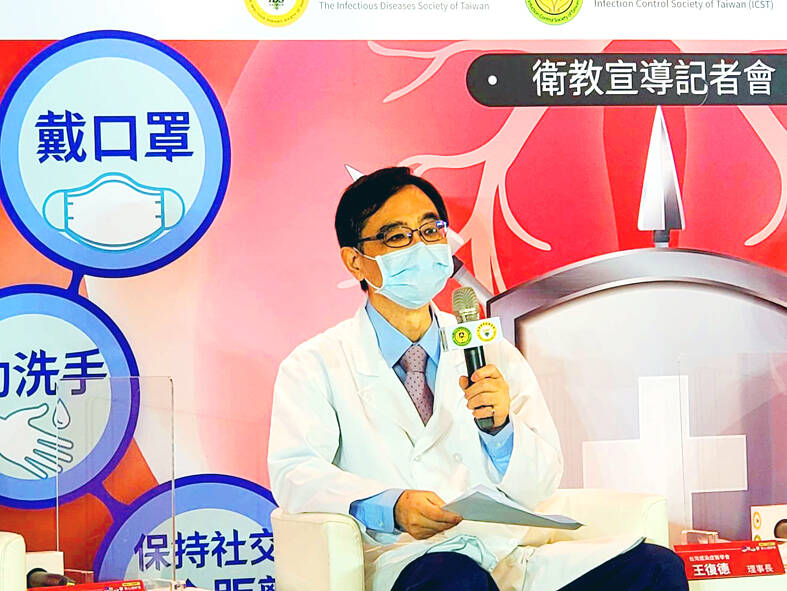
Photo: Lin Hui-chin, Taipei Times
However, in a seven-question test on knowledge of COVID-19 prevention and response, 31 percent answered three or fewer questions correctly, while the majority — 59.8 percent — answered four correctly, about 7 percent answered five correctly and none scored higher, he said.
More than 90 percent of the respondents know the symptoms of COVID-19 and what to do when testing negative or positive, Wang said.
However, many appear to lack knowledge on preventing an infection, appropriate treatment — including eligibility for anti-viral drugs — and who comprise high-risk groups for severe illness, he said.
The survey found that people who are more optimistic about the the pandemic’s progression scored lower on the quiz, which could be a concern as restrictions are eased, Wang said, adding that the association urges people to remain vigilant and take precautions as rules are lifted.
Centers for Disease Control Director-General Chou Jih-haw (周志浩) and four medical associations joined the IDS at a news conference on Friday to encourage people to follow four COVID-19 prevention rules — get vaccinated against COVID-19, conduct a rapid test when symptoms occur, take oral anti-viral drugs if eligible within five days of the start of symptoms, and maintain personal hygiene, including wearing a mask and washing hands frequently.
Daily new cases have been rising rapidly in the past few days, and the Central Epidemic Command Center (CECC) forecasts a new wave of infections, Taiwan Society of Pulmonary and Critical Care Medicine chairman Wang Hao-chien (王鶴健) said.
People aged 65 and older and those in high-risk groups with an increased risk of severe illness from infection should be especially careful, given that more than 90 percent of COVID-19-related deaths were among people with underlying health conditions, and about 70 percent were in older age groups, Wang said.
Studies have suggested that people with diabetes have a five to 10 times higher risk of developing severe illness after COVID-19 infection, Taiwanese Association of Diabetes Educators secretary-general Wang Chih-yuan (王治元) said.
Cancer patients generally have weaker immunity against infections, so they should remain vigilant when friends and family relax precautionary measures, Taiwan Oncology Society chairman James Yang (楊志新) said.
Other studies suggest that when people catch the disease and take oral anti-viral drugs as early as possible after infection, the risk of developing severe illness is significantly reduced, as well as the risk of “long COVID,” Taiwan Association of Family Medicine president Huang Hsin-chang (黃信彰) said.

FUKUOKA SITUATION: Japanese media reported that the pathogen is expected to be identified by the summer, while the CDC downplayed the idea that it was hMPV A “mysterious cold-like illness” reported in Japan’s Fukuoka Prefecture does not seem to be a new disease, but Japanese authorities have been asked about the situation, the Centers for Disease Control (CDC) said yesterday. The Fukuoka Prefectural Medical Association on Wednesday told a news conference that a “mystery cold” that has become a hot topic on social media is “highly likely to be caused by some kind of viral infection,” Japan’s KBC News reported. “Many people are experiencing symptoms starting with a sore throat, followed by a runny nose, phlegm and a severe cough,” KBC News reported, citing association officials. Health authorities are

Nvidia Corp CEO Jensen Huang (黃仁勳) arrived in Taiwan yesterday ahead of upcoming AI and technology events, saying he plans to meet with clients and Taiwan Semiconductor Manufacturing Co Chairman C.C. Wei (魏哲家) during his visit. After landing at Taipei Songshan Airport, Huang posed for photos with fans and handed out Yakult drinks to reporters and supporters waiting at the scene, saying he has “a lot to do” during the trip. Asked about reports that Nvidia’s planned headquarters site in Taipei’s Beitou Shilin Technology Park could break ground on May 27, Huang said that if the company holds an event, he would

The Ministry of Finance this afternoon announced the winning numbers for the March-April uniform invoice lottery. The winning number for the NT$10 million (US$318,060) special prize is 19531471, and the winning number for the NT$2 million grand prize is 85941329. Three numbers were drawn for the NT$200,000 first prize: 07225810, 20231230 and 83518781. Those with receipts matching the last seven digits of any of the first-prize numbers will win the NT$40,000 second prize, while those matching the last six digits will win the NT$10,000 third prize. Those whose receipts match the last five digits of the first-prize numbers can claim the NT$4,000 fourth prize,
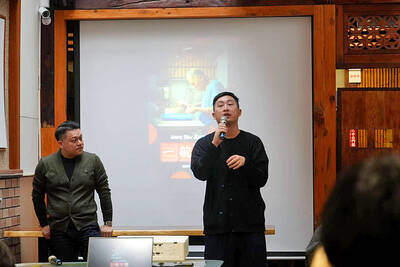
Taiwan Travelogue (臺灣漫遊錄), which earlier this week became the first Taiwanese novel to win the International Booker Prize, is to be adapted into a television series through a Taiwan-Japan coproduction, producer Chang Chen-yu (張辰漁) said yesterday. Chang, a producer at World Softest Production Film Co, wrote on Facebook that the company had been searching for projects with international appeal that retain a strong Taiwanese identity after colleagues and Japanese partners strongly recommended the novel. After reading the book, Chang said he immediately decided to pursue the screen rights. “A great story has the power to transcend time and borders, and connect countless people,”


 RSS
RSS