

A months-long investigation into a suspected sexual predator has yielded a large volume of computer files and videos of hundreds of victims aged 10 to 70, Tainan police said yesterday.
Before his arrest in August, the 41-year-old suspect, surnamed Chang (張), was working as a video editor and photographer for a commercial ad agency, police said.
Chang had since 2017 used fake names on video-chatting sites and social media apps to lure women by offering them “modeling jobs,” which turned out to be naked photo and video sessions, they said.
After receiving tip-offs, policed tracked down Chang’s IP address and monitored his online activities before conducting a raid in August and apprehending him at his residence in Taoyuan.
The investigation is ongoing, and Chang is under judicial detention as he is facing pending charges of violating personal privacy and breaches of the Child and Youth Sexual Exploitation Prevention Act (兒童及少年性剝削防制條例), along with fraud, blackmail, coercion and offenses against sexual morality (妨害風化罪), for allegedly distributing and selling sexually explicit videos online for profit.
One complaint came from woman in Tainan earlier this year, who said she was invited for a photography session with the promise of a modeling job.
During a live chat, the woman said Chang asked her to undress. Feeling that something was wrong, she reported the incident to local authorities, prompting police investigators and prosecutors to start an investigation.
Tainan police officials this past week put out a public message for other victims to come forward, saying they have only found five people who are willing to testify and present evidence against Chang.
“We ask victims to contact and help us with the investigation. We shall ensure that your name and personal information are protected, and that videos and photographs of victims will be kept out of the public eye. Your assistance is needed for justice to be served through the conviction of the offender and to help other victims,” officials said.
The case has been compared to the “Nth Room” blackmail and cybersex trafficking case in South Korea from 2018 to 2020, in which several suspects used chat sites and social media apps to record and sell sexually explicit videos online. Three main offenders were sentenced to 30 to 40 years in prison.
Investigators alleged that Chang had posed online as a woman, a female photographer or an ad agency manager. Using his knowledge at work, he would tell his prospective targets about ad agencies looking for models, offering them up to NT$3,500 per hour, asking them detailed personal information and telling them to undress when their guard was down while he recorded them.
If the woman hesitated, he would blackmail or threaten to circulate the videos to their school, family and friends, and post them on Facebook for public viewing, police said.

Two executives of drone supplier Jiin Ming Industry Co (錦明實業) have been detained and held incommunicado over the company's alleged use of prohibited China-made chips and camera lenses in drones supplied under recent military contracts, the Taoyuan District Prosecutors' Office said today. In a statement, prosecutors said they raided the offices of Jiin Ming — headquartered in Taoyuan — as well as those of its subsidiaries and its suppliers on Thursday last week. The raids followed a report that the company had breached its procurement contracts by putting the prohibited components into drones delivered to the military. During the raids, prosecutors summoned

The government would continue monitoring online rumors that a pneumonic plague outbreak has spread from Russia into China and could enhance existing quarantine measures, Premier Cho Jung-tai (卓榮泰) said today. During a legislative meeting, Democratic Progressive Party Legislator Wang Ting-yu (王定宇) said rumors were circulating that the disease had spread across several Chinese provinces. He asked Cho whether the government was prepared to prevent the disease from spreading to Taiwan, given the frequent exchanges between Taiwan and China, and how concerned the government was about the alleged outbreak. The Ministry of Health and Welfare implemented border quarantine measures after briefing the Executive Yuan
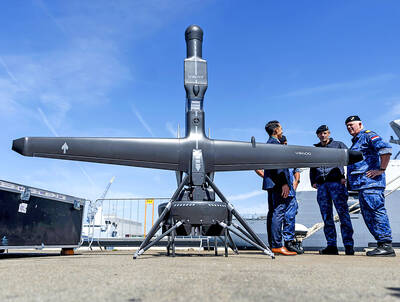
DEFENSE PROCUREMENT: Taiwan could become the largest operator of V-BAT drones outside the US once they are delivered, the Ministry of National Defense said The navy and the coast guard are acquiring 292 units of MQ-35A V-BAT vertical takeoff and landing (VTOL) surveillance drones manufactured by US-based defense technology company Shield AI, making Taiwan one of the largest buyers of the drone. The Coast Guard Administration budgeted NT$1.2 billion (US$37.1 million) to buy 12 drones, which have been delivered, Shield AI said in a report on Oct 13. The navy is planning to spend NT$36 billion under a four-year program code-named Project Yuan Xiao (遠鴞) to acquire 280 V-BAT drones, the Ministry of National Defense’s fiscal 2027 report showed. The combined procurement is expected

South Korean boy band BigBang drew 120,000 fans to three concerts at Taipei Dome from Friday through yesterday, as the band thanked them for their support over their 20-year career. The Taipei Dome concerts were part of BigBang's "2026-2027 World Tour XX: Cosmos." Friday's concert was BigBang's first performance in Taiwan in 11 years. During the encore, group leader G-Dragon (GD) shouted "I love you" in Chinese and said he was especially happy to perform in Taiwan with bandmates Taeyang and Daesung. "Taipei, I'm very grateful to you all," GD said in Chinese, asking fans to wait for the band's return. Daesung thanked


 RSS
RSS