


President Tsai Ing-wen’s (蔡英文) actions on cross-strait issues put the country at risk, the Chinese Nationalist Party (KMT) said yesterday in response to her Double Ten National Day speech.
In her address, Tsai highlighted her administration’s position that it is willing to find a “mutually agreeable arrangement” to uphold peace and stability provided there is “rationality, equality and mutual respect” with Beijing.
The KMT said in a statement that despite her willingness to work with Beijing on a mutually acceptable path to peace across the Taiwan Strait, her administration “has never taken concrete actions” to do so.
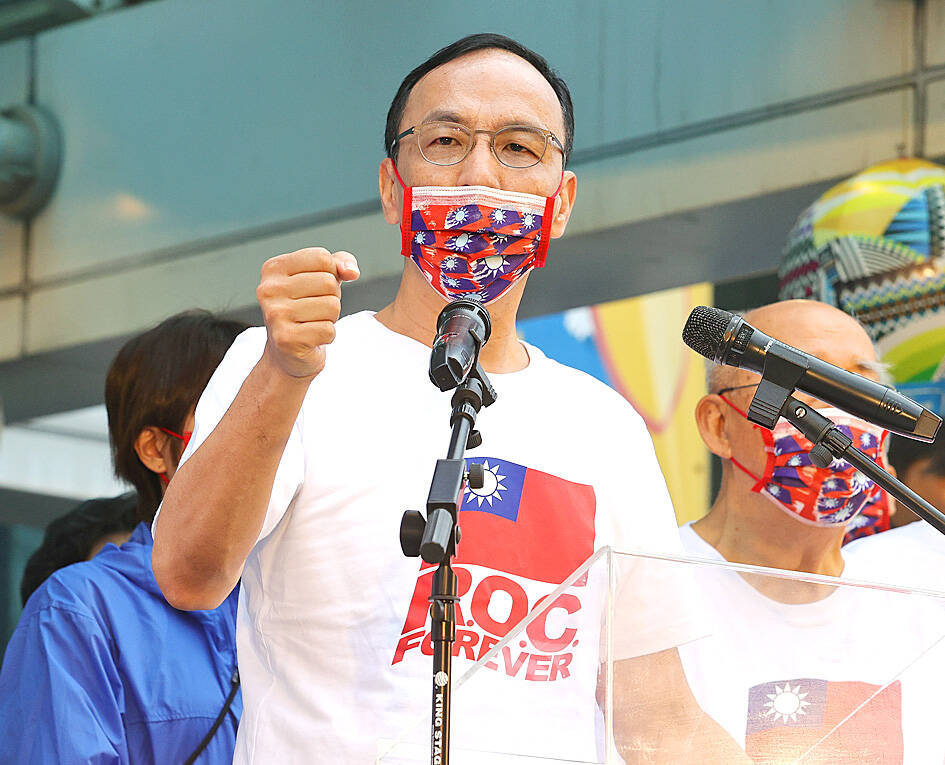
Photo: CNA
Tsai wants Taiwanese and Chinese to gradually resume normal exchanges as the two sides reopen borders after COVID-19 restrictions, while turning a blind eye to Democratic Progressive Party (DPP) lawmakers’ provocative behavior toward China, the KMT said.
Although the president emphasized her administration’s commitment to improving information transparency and identifying disinformation, the government has not disclosed documents related to COVID-19 vaccine procurement, which were classified as confidential and would remain sealed for 30 years, the KMT said.
The Presidential Office is known to be a “false information production center,” it added, calling on the Tsai administration to stop restricting freedom of speech and freedom of the press under the excuse of identifying false information.
Earlier yesterday at a flag-raising ceremony held by the KMT at its headquarters in Taipei to commemorate Double Ten National Day, KMT Chairman Eric Chu (朱立倫) reiterated that his party is determined to “build peace in the Taiwan Strait, safeguard the Republic of China [ROC] and protect the region.”
Asked if he would press Tsai at a holiday ceremony on her administration’s use of “Taiwan National Day” — which former president Ma Ying-jeou (馬英九) has opposed, preferring “ROC National Day” — Chu said that Tsai would likely only give her speech and not interact with anyone, which he said was what happened last year.
“Safeguarding the ROC is not only the stance taken by the KMT, but the shared position of all Taiwanese,” he said.
The DPP should not keep thinking about minimizing the ROC or even eliminating it, he said.
The DPP promoting a sense of impending national doom for its own political interest is “nothing new,” but the KMT has proposed a more concrete “double D” strategy of “defense and dialogue,” he said.
The proposal calls for Taiwan to build up its defense capabilities, while keeping a channel open for dialogue with Beijing for threat reduction and crisis management, he said.
Chu said that Tsai uses her Double Ten National Day speeches to promote her policies, while creating new slogans every year that would not help achieve her goals.
Taiwanese want to know “whether the ROC has become better,” he said, adding that if the value of democracy and freedom as well as the press are being controlled, “how can people live a good life?”

Fast food chain McDonald's is to raise prices by up to NT$5 on some products at its restaurants across Taiwan, starting on Wednesday next week, the company announced today. The prices of all extra value meals and sharing boxes are to increase by NT$5, while breakfast combos and creamy corn soup would go up by NT$3, the company said in a statement. The price of the main items of those meals, if ordered individually, would remain the same. Meanwhile, the price of a medium-sized lemon iced tea and hot cappuccino would rise by NT$3, extra dipping sauces for chicken nuggets would go up
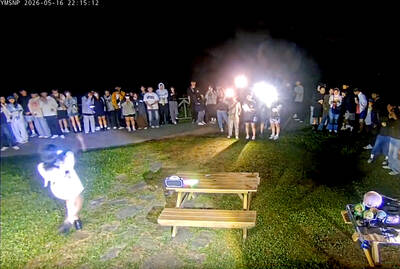
Yangmingshan National Park’s Qingtiangang (擎天崗) nature area has gone viral after a park livestream camera observed a couple in the throes of intimate congress, which was broadcast live on YouTube, drawing large late-night crowds and sparking a backlash over noise, bright lights and disruption to wildlife habitat. The area’s livestream footage appeared to show a couple engaging in sexual activity on a picnic table in the park on Friday last week, with the uncensored footage streamed publicly online. The footage quickly spread across social media, prompting a tide of visitors to travel to the site to “check in” and recreate the
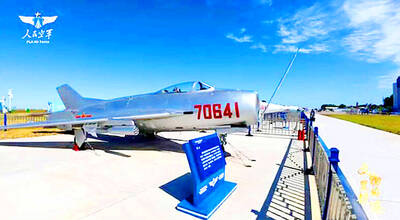
GROUNDED: A KMT lawmaker proposed eliminating drone development programs and freezing funding for counterdrone systems, despite China’s adoption of the technology China has deployed attack drones at air bases near the Taiwan Strait in a strategy aimed at overwhelming Taiwan’s air defense systems through saturation attacks, the Mainland Affairs Council (MAC) said. The council’s latest quarterly report on China said that satellite imagery and open-source intelligence indicate that the Chinese People’s Liberation Army (PLA) had converted retired J-6 fighter jets into J-6W drones, which the PLA has stationed at six air bases near Taiwan, five in China’s Fujian Province and one in Guangdong Province. The report cited J. Michael Dahm, a senior fellow at the US-based Mitchell Institute, as saying that China has

Carrefour Taiwan is to begin using a new name from the start of July, but it cannot divulge the name until then, the chairman of the supermarket chain's parent company said today. President Chain Store Co chairman Lo Chih-hsien (羅智先) was asked by reporters after a shareholders' meeting to confirm whether the company has settled on a new name for the supermarket brand. In March, the government-registered name of two Carrefour Taiwan branches was quietly changed to "Le Chia Kang" (樂家康) in Chinese, raising speculation that has been selected as the name. Lo said that because of local regulations and contractual obligations, the


 RSS
RSS