


The Sports Administration should abolish sit-ups at schools, citing concerns that the exercise can cause spinal injuries in some, New Power Party Taoyuan City councilor candidate Lu Yu-chen (呂宇晟) said yesterday.
In response, the Sports Administration said the exercise might be eliminated from physical education workouts and standardized tests later this year, adding that crunches would probably be used in its place.
Taiwanese are taught since childhood the misconception that sit-ups can train core strength, Lu said at a news conference.
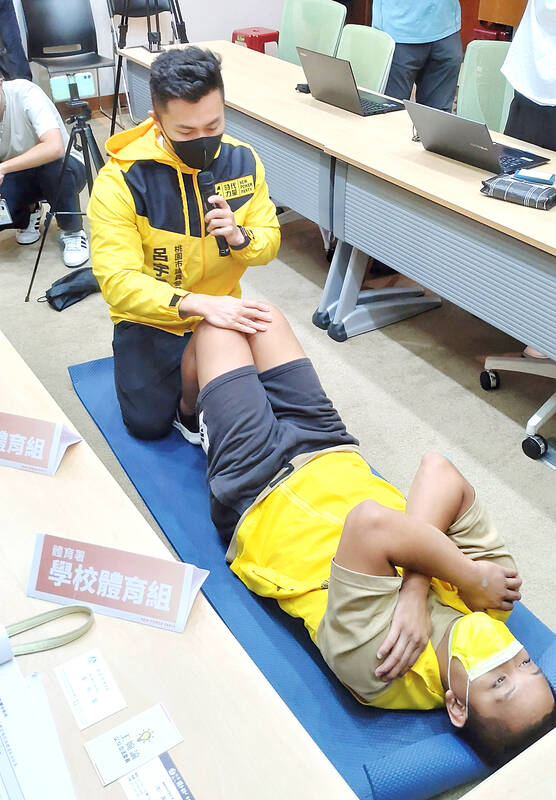
Photo: Yang Cheng-yu, Taipei Times
Lu is a personal trainer and business founder.
Fast and repeated bending of the spinal column during sit-ups carries the risk of neck and tailbone injuries, while the workout’s benefits are dubious because it can compromises core balance, he said.
School-aged children lack muscle strength and balance, so they are prone to making mistakes when doing sit-ups that can result in significant pain and increased risk of injury, he said.
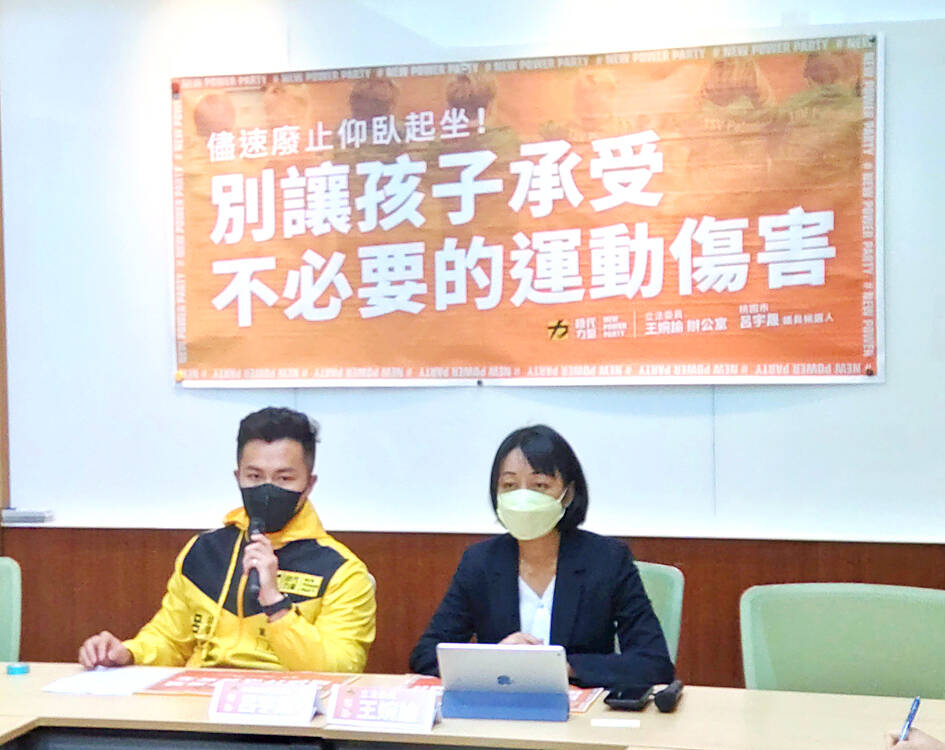
Photo: Yang Cheng-yu, Taipei Times
Studies have shown that children who do the exercise are more likely to have bruised tailbones, he said.
“Fast and repeated movements are always going to cause more injuries regardless of the thickness of the mat being used,” he said.
“If the child forgets to tuck in their chin, they can also get cervical spine damage,” he added.
“US marines dropped sit-ups from its physical fitness tests last year and replaced the exercise with planking, which the US military had been mulling since 2015,” he wrote on Facebook shortly after the conference.
The Sports Administration said in 2016 that sit-ups would be eliminated from physical education, shortly after Kaohsiung Armed Forces General Hospital said that the workout could be harmful, Legislator Claire Wang (王婉諭) said.
The agency is urged to speed up implementation of the proposed change and develop guidelines to minimize harm to children in the interim, she said.
The agency’s School Physical Education Division deputy chief Pan Wan-hsin (潘婉馨) said the agency would have begun making the change in 2020, but the plans were disrupted by the COVID-19 pandemic.
An amendment on regulations governing physical education at schools is being drafted specifically to address concerns about sit-ups and to make other changes, Pan said.
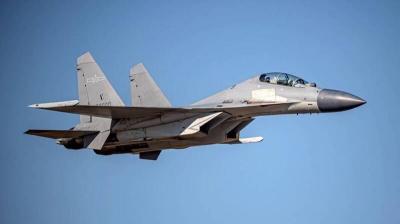
Eight Chinese naval vessels and 24 military aircraft were detected crossing the median line of the Taiwan Strait between 6am yesterday and 6am today, the Ministry of National Defense said this morning. The aircraft entered Taiwan’s northern, central, southwestern and eastern air defense identification zones, the ministry said. The armed forces responded with mission aircraft, naval vessels and shore-based missile systems to closely monitor the situation, it added. Eight naval vessels, one official ship and 36 aircraft sorties were spotted in total, the ministry said.
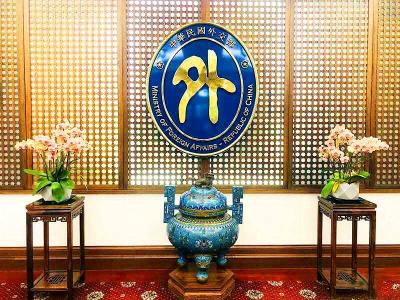
The Ministry of Foreign Affairs (MOFA) today said that if South Korea does not reply appropriately to its request to correct Taiwan’s name on its e-Arrival card system before March 31, it would take corresponding measures to alter how South Korea is labeled on the online Taiwan Arrival Card system. South Korea’s e-Arrival card system lists Taiwan as “China (Taiwan)” in the “point of departure” and “next destination” fields. The ministry said that it changed the nationality for South Koreans on Taiwan’s Alien Resident Certificates from “Korea” to “South Korea” on March 1, in a gesture of goodwill and based on the

Taiwanese officials were shown the first of 66 F-16V fighter jets purchased by Taiwan from the United States, the Ministry of National Defense said yesterday, adding the aircraft has completed an initial flight test and is expected to be delivered later this year. A delegation led by Deputy Minister of National Defense Hsu Szu-chien (徐斯儉) visited Lockheed Martin’s F-16 C/D Block 70 (also known as F-16V) assembly line in South Carolina on March 16 to view the aircraft. The jet will undergo a final acceptance flight in the US before being delivered to Taiwan, the
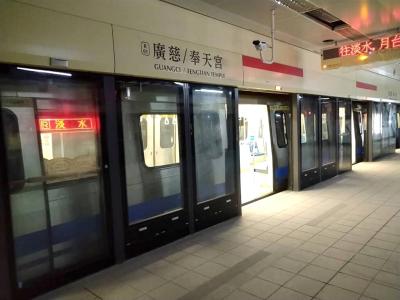
The New Taipei Metro's Sanyin Line and the eastern extension of the Taipei Metro's Tamsui-Xinyi Line (Red Line) are scheduled to begin operations in June, the National Development Council said today. The Red Line, which terminates at Xiangshan Station, would be connected by the 1.4km extension to a new eastern terminal, Guangci/Fengtian Temple Station, while the Sanyin Line would link New Taipei City's Tucheng and Yingge stations via Sanxia District (三峽). The council gave the updates at a council meeting reviewing progress on public construction projects for this year. Taiwan's annual public infrastructure budget would remain at NT$800 billion (US$25.08 billion), with NT$97.3


 RSS
RSS