


China’s military provocations around Taiwan “have caused risks to the peace and safety of not only Taiwan but also to all of East Asia,” a Japanese lawmaker yesterday wrote on Twitter.
Japan-Republic of China Diet Members’ Consultative Council Chairman Keiji Furuya made the comment prior to arriving in Taipei for a three-day visit.
In a meeting with Premier Su Tseng-chang (蘇貞昌) yesterday, Furuya, a senior member of the ruling Liberal Democratic Party, quoted late Japanese prime minister Shinzo Abe, who said that “a Taiwan emergency is a Japanese emergency, and therefore an emergency for the Japan-US alliance,” and called on like-minded democratic allies to join together in facing global and regional challenges.
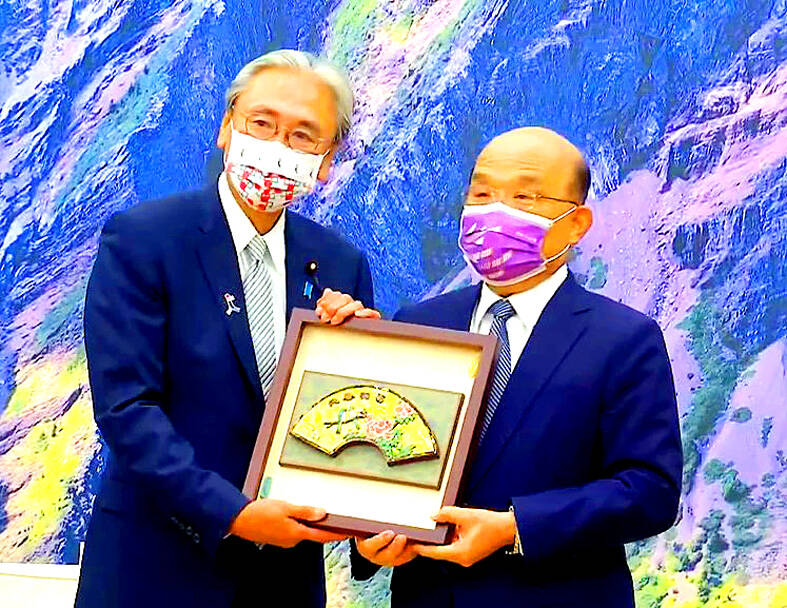
Photo copied by Lu Yi-hsuan, Taipei Times
The council, comprising more than 260 Japanese lawmakers from various political parties, supports Taiwan’s bid to join the Tokyo-led trade bloc the Comprehensive and Progressive Agreement for Trans-Pacific Partnership, he said.
Thanking Taiwan for earlier this year partially lifting an 11-year ban on food products from five Japanese prefectures that was implemented after the Fukushima Dai-ichi nuclear power plant disaster, Furuya urged Taipei to eliminate its remaining restrictions on food products implemented after the 2011 incident.
Furuya also asked about the Taiwan High Speed Rail Corp’s (THSRC) plan to purchase new trains.
THSRC started to negotiate a new purchase from a Japanese consortium in 2017, but the deal was abandoned twice in 2020 and last year, reportedly due to unreasonable pricing.
Furuya said that Japan’s Shinkansen bullet trains boast the world’s best safety, precision and technology, adding that he hopes a deal with THSRC can be closed.
Furuya and the council’s secretary-general Minoru Kihara are to meet with President Tsai Ing-wen (蔡英文) today.
The Japanese lawmakers are also likely to visit the grave of former president Lee Teng-hui (李登輝) to pay their respects to Lee, the Ministry of Foreign Affairs in Taipei said.
Additional reporting by Lu Yi-hsuan
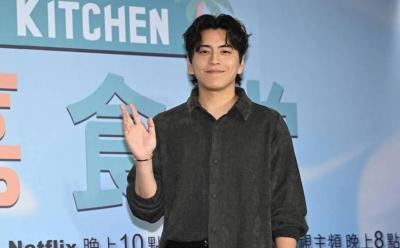
Actor Darren Wang (王大陸) was sentenced to six months in prison, commutable to a fine, by the New Taipei District Court today for contravening the Personal Data Protection Act (個人資料保護法) in a case linked to an alleged draft-dodging scheme. Wang allegedly paid NT$3.6 million (US$114,380) to an illegal group to help him evade mandatory military service through falsified medical documents, prosecutors said. He transferred the funds to Chen Chih-ming (陳志明), the alleged mastermind of a draft-evasion ring, although he lost contact with him as he was already in detention on fraud charges, they said. Chen is accused of helping a

SECURITY: Starlink owner Elon Musk has taken pro-Beijing positions, and allowing pro-China companies to control Taiwan’s critical infrastructure is risky, a legislator said Starlink was reluctant to offer services in Taiwan because of the nation’s extremely high penetration rates in 4G and 5G services, the Ministry of Digital Affairs said yesterday. The ministry made the comments at a meeting of the legislature’s Transportation Committee, which reviewed amendments to Article 36 of the Telecommunications Management Act (電信管理法). Article 36 bans foreigners from holding more than 49 percent of shares in public telecommunications networks, while shares foreigners directly and indirectly hold are also capped at 60 percent of the total, unless specified otherwise by law. The amendments, sponsored by Chinese Nationalist Party (KMT) Legislator Ko

UNREASONABLE SURVEILLANCE: A camera targeted on an road by a neighbor captured a man’s habitual unsignaled turn into home, netting him dozens of tickets The Taichung High Administrative Court has canceled all 45 tickets given to a man for failing to use a turn signal while driving, as it considered long-term surveillance of his privacy more problematic than the traffic violations. The man, surnamed Tseng (曾), lives in Changhua County and was reported 45 times within a month for failing to signal while driving when he turned into the alley where his residence is. The reports were filed by his neighbor, who set up security cameras that constantly monitored not only the alley but also the door and yard of Tseng’s house. The surveillance occurred from July
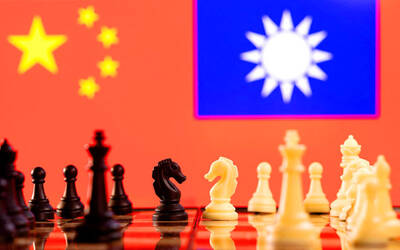
‘SAME OLD TRICK’: Even if Beijing resumes individual travel to Taiwan, it would only benefit Chinese tourism companies, the Economic Democracy Union convener said China’s 10 new “incentives” are “sugar-coated poison,” an official said yesterday, adding that Taiwanese businesses see them clearly for what they are, but that Beijing would inevitably find some local collaborators to try to drums up support. The official, speaking on condition of anonymity, made the remark ahead of a news conference the General Chamber of Commerce is to hold today. The event, titled “Industry Perspectives on China’s Recent Pro-Taiwan Policies,” is expected to include representatives from industry associations — such as those in travel, hotels, food and agriculture — to request the government cooperate with China’s new measures, people familiar with


 RSS
RSS