


The government should include digital platform accountability issues in bilateral trade negotiations with the US, the Campaign for Media Reform said yesterday.
The group made the remark in an information session on the digital intermediary service draft act organized by the National Communications Commission.
The draft act, which is based on the EU’s Digital Service Act, was proposed to tackle rising challenges brought by digital intermediary service providers, including dissemination of disinformation and illegal content.
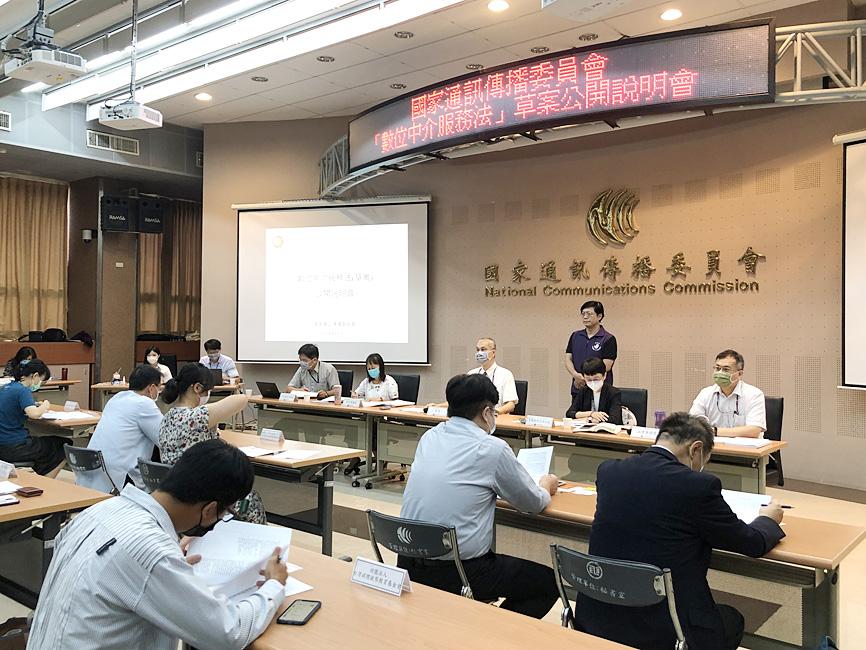
Photo: CNA
The commission plans to host three information sessions and a public hearing on the bill to hear comments from stakeholders. Yesterday’s session was attended mainly by media experts and representatives of civic groups.
Campaign for Media Reform chairwoman Lo Huei-wen (羅慧雯) said they affirm the commission’s efforts to introduce the bill, as multinational digital platforms have affected the development of news media worldwide by controlling people’s access to information and taking away a large percentage of advertising revenue.
“These platforms have also become a threat to freedom of speech and democracy by helping spread disinformation. As such, they should be asked to carry more social, legal and moral responsibilities than before,” she said.
The commission should ask multinational platforms to establish offices in Taiwan to hold them accountable for their actions, instead of only asking them to appoint local agents, she said.
However, the EU market is significantly larger than Taiwan’s, and multinational platforms might leave Taiwan if they were required to fulfill more legal obligations than they do in the EU, she said.
“We think the government should not only focus on stipulating the draft act. Recently, Taiwan and the US have begun negotiating ways to deepen bilateral trade between the two countries. The negotiations should include digital platform accountability issues,” she said.
“The US government is tackling monopolies created by digital platforms. In Taiwan, not only do we need to combine the efforts of the government and private sector, but we need to work with the US on the accountability of digital platforms,” she said.
While the draft act would ask digital platforms to disclose algorithms governing the display of content and advertisement, the commission should consider if that is an effective way to counter platforms’ massive power to censor or remove content, she said.
Taiwan Society of Convergence deputy chairman Jason Ho (何吉森) said the draft act would allow government agencies to ask platform operators to temporarily put a warning next to information deemed as disinformation or illegal content by government agencies before securing a restraining order from a court to stop its spread.
“While a warning serves as a reminder to users that they should consult other sources of information, many Internet users might see it as similar to a yellow monetization icon on a YouTube video, which is imposed for failing to meet advertiser-friendly content guidelines,” he said.
The draft act would allow the commission to spend NT$2.5 billion (US$83.35 million) on establishing a specialized agency to coordinate between multiple stakeholders.
However, a government-owned organization would be obligated to brief the Legislative Yuan on its annual budget plan, which could cause the executive and legislative branches to intervene in the operation of the agency, Ho said.
All these problems with the draft act have made it impossible to have a bottom-up approach of Internet governance, he said.
Chou Kuan-ju (周冠汝), who specializes in human rights issues in the digital age at the Taiwan Association for Human Rights, said that the EU’s Audiovisual Media Services Directive in 2018 uses warnings to flag only hate speech or violent content and suggests that the best way to handle such content is to elevate the media literacy of users.
Using warnings to flag illegal content was widely criticized by civic groups, as they would further expand the administrative authority of government agencies, Chou said.
Although digital platforms know they should remove illegal content, they could overdo it by removing a large amount of information or arraying the information in descending order to avoid fines, she said.
The association suggested that the commission remove the requirement to place warnings next to content and evaluate the bill’s possible effects on human rights.
Attorney Lin Chun-hung (林俊宏) said he found it hard to believe that the commission failed to consult with the Judicial Yuan first before stipulating that platforms be obligated to take down content within 48 hours of receiving an emergency restraining order.
District courts are overwhelmed by cases and might not have enough personnel to expedite the issuance of restraining orders, he said.

FUKUOKA SITUATION: Japanese media reported that the pathogen is expected to be identified by the summer, while the CDC downplayed the idea that it was hMPV A “mysterious cold-like illness” reported in Japan’s Fukuoka Prefecture does not seem to be a new disease, but Japanese authorities have been asked about the situation, the Centers for Disease Control (CDC) said yesterday. The Fukuoka Prefectural Medical Association on Wednesday told a news conference that a “mystery cold” that has become a hot topic on social media is “highly likely to be caused by some kind of viral infection,” Japan’s KBC News reported. “Many people are experiencing symptoms starting with a sore throat, followed by a runny nose, phlegm and a severe cough,” KBC News reported, citing association officials. Health authorities are

Nvidia Corp CEO Jensen Huang (黃仁勳) arrived in Taiwan yesterday ahead of upcoming AI and technology events, saying he plans to meet with clients and Taiwan Semiconductor Manufacturing Co Chairman C.C. Wei (魏哲家) during his visit. After landing at Taipei Songshan Airport, Huang posed for photos with fans and handed out Yakult drinks to reporters and supporters waiting at the scene, saying he has “a lot to do” during the trip. Asked about reports that Nvidia’s planned headquarters site in Taipei’s Beitou Shilin Technology Park could break ground on May 27, Huang said that if the company holds an event, he would

The Ministry of Finance this afternoon announced the winning numbers for the March-April uniform invoice lottery. The winning number for the NT$10 million (US$318,060) special prize is 19531471, and the winning number for the NT$2 million grand prize is 85941329. Three numbers were drawn for the NT$200,000 first prize: 07225810, 20231230 and 83518781. Those with receipts matching the last seven digits of any of the first-prize numbers will win the NT$40,000 second prize, while those matching the last six digits will win the NT$10,000 third prize. Those whose receipts match the last five digits of the first-prize numbers can claim the NT$4,000 fourth prize,

Taiwan Travelogue (臺灣漫遊錄), which earlier this week became the first Taiwanese novel to win the International Booker Prize, is to be adapted into a television series through a Taiwan-Japan coproduction, producer Chang Chen-yu (張辰漁) said yesterday. Chang, a producer at World Softest Production Film Co, wrote on Facebook that the company had been searching for projects with international appeal that retain a strong Taiwanese identity after colleagues and Japanese partners strongly recommended the novel. After reading the book, Chang said he immediately decided to pursue the screen rights. “A great story has the power to transcend time and borders, and connect countless people,”


 RSS
RSS