


The government might consider dropping a negative COVID-19 test result requirement for travelers from low-risk countries, but lifting the quarantine requirement for inbound travelers is still risky, the Central Epidemic Command Center (CECC) said yesterday.
The CECC on Monday said it does not plan to further loosen border controls soon.
National Taiwan University Children’s Hospital superintendent Huang Li-min (黃立民) said the “3+4” quarantine policy separates inbound travelers from family members for only three days, which is not enough to block the spread of the virus, so the government might consider changing it to a “0+7” policy.
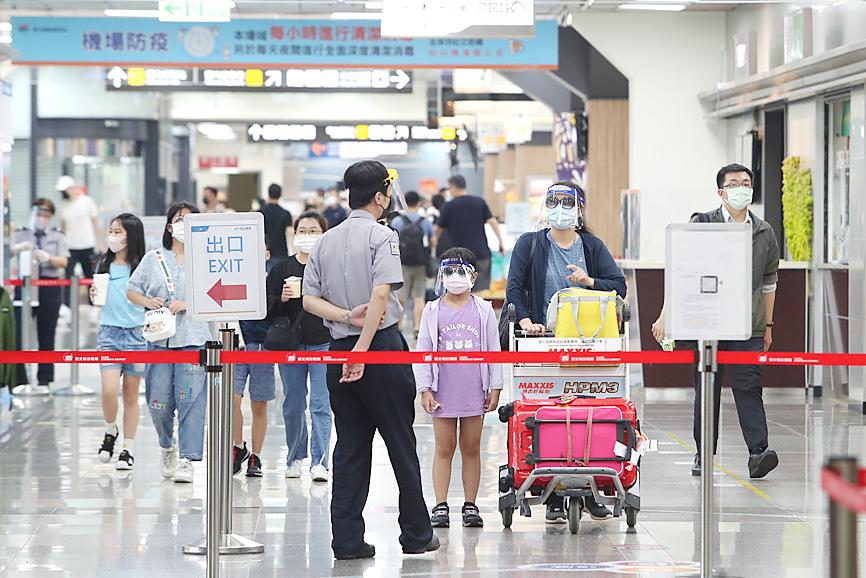
Photo: CNA
He also said that it might be more difficult for people in other countries to find places that offer polymerase chain reaction (PCR) tests, so requiring travelers to provide a negative PCR result from a test taken within 48 hours of flying to Taiwan might prove an obstacle for many people.
The government might consider requiring a negative rapid test result instead, he said.
Asked about Huang’s comments, Minister of Health and Welfare Chen Shih-chung (陳時中), who heads the CECC, yesterday said “it is less likely that we will change the test requirement to a rapid test result, but it is possible that we might remove the [negative test result] requirement for travelers from low-risk areas,” he said.
“It is still a little risky” to shorten the quarantine policy to “0+7,” as the number of new COVID-19 infections has increased by about 20 percent in European countries and the US, and cases caused by the new Omicron subvariant BA.5 of SARS-CoV-2 are being detected, so the center needs to observe the situation for a little longer.
In related news, Centers for Disease Control (CDC) Deputy Director-General Chuang Jen-hsiang (莊人祥), who is the CECC’s spokesman, said 35,914 new local cases and 103 deaths were confirmed yesterday.
Among the 3,863,991 local cases reported this year, 99.56 percent were asymptomatic or mild, 0.25 percent developed moderate illness and 0.19 percent developed severe illness, including 6,275 deaths, CECC data showed.
CDC Deputy Director-General Philip Lo (羅一鈞), deputy chief of the CECC’s medical response division, said a man in his 30s who had a mental disorder and was unvaccinated died of pneumonia and respiratory failure nine days after being diagnosed with COVID-19.
A 10-year-old boy was confirmed as having multisystem inflammatory syndrome in children (MIS-C) and was being treated in an intensive care unit, Lo said.
Eighty-four severe COVID-19 cases have been reported in children this year, including 21 deaths, he said, adding that 27 people have developed severe illness caused by MIS-C.
Chuang said a batch of 450,000 doses of the Moderna COVID-19 vaccine for children aged six months to five years old would arrive in Taiwan this morning.
Lot release testing would take about 14 days, so the vaccine is expected to be delivered to local governments on July 21 at the earliest, he said.
Some cities and counties might start administering the vaccine the same afternoon, he added.


China has reserved offshore airspace in the Yellow Sea and East China Sea from March 27 to May 6, issuing alerts usually used to warn of military exercises, although no such exercises have been announced, the Wall Street Journal (WSJ) reported yesterday. Reserving such a large area for 40 days without explanation is an “unusual step,” as military exercises normally only last a few days, the paper said. These alerts, known as Notice to Air Missions (Notams), “are intended to inform pilots and aviation authorities of temporary airspace hazards or restrictions,” the article said. The airspace reserved in the alert is

South Korea is planning to revise its controversial electronic arrival card, a step Taiwanese officials said prompted them to hold off on planned retaliatory measures, a South Korean media report said yesterday. A Yonhap News Agency report said that the South Korean Ministry of Foreign Affairs is planning to remove the “previous departure place” and “next destination” fields from its e-arrival card system. The plan, reached after interagency consultations, is under review and aims to simplify entry procedures and align the electronic form with the paper version, a South Korean ministry official said. The fields — which appeared only on the electronic form

A bipartisan group of US senators has introduced a bill to enhance cooperation with Taiwan on drone development and to reduce reliance on supply chains linked to China. The proposed Blue Skies for Taiwan Act of 2026 was introduced by Republican US senators Ted Cruz and John Curtis, and Democratic US senators Jeff Merkley and Andy Kim. The legislation seeks to ease constraints on Taiwan-US cooperation in uncrewed aerial systems (UAS), including dependence on China-sourced components, limited access to capital and regulatory barriers under US export controls, a news release issued by Cruz on Wednesday said. The bill would establish a "Blue UAS
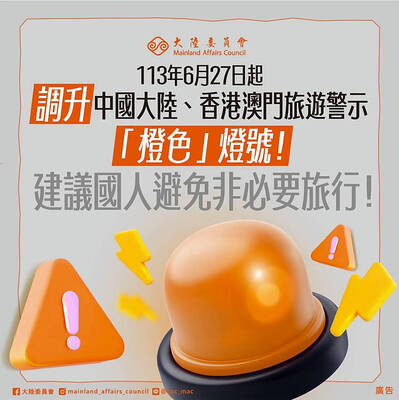
More than 6,000 Taiwanese students have participated in exchange programs in China over the past two years, despite the Mainland Affairs Council’s (MAC) “orange light” travel advisory, government records showed. The MAC’s publicly available registry showed that Taiwanese college and university students who went on exchange programs across the Strait numbered 3,592 and 2,966 people respectively. The National Immigration Agency data revealed that 2,296 and 2,551 Chinese students visited Taiwan for study in the same two years. A review of the Web sites of publicly-run universities and colleges showed that Taiwanese higher education institutions continued to recruit students for Chinese educational programs without


 RSS
RSS