


The government is on Friday to start a second round of distributing free rapid COVID-19 test kits for children aged six or younger, the Central Epidemic Command Center (CECC) said yesterday, as it reported 28,489 new local infections, 91 deaths, and 61 imported cases of the Omicron subvariants BA.4 and BA.5 of SARS-CoV-2.
Centers for Disease Control (CDC) Deputy Director-General Chuang Jen-hsiang (莊人祥), who is the CECC’s spokesperson, said that parents of children aged six or younger (born on or after Sept. 2, 2015) can obtain a pack of five test kits by bringing their children’s National Health Insurance card to contracted pharmacies or public health centers that sell rapid test kits under the government’s rationing scheme.
As COVID-19 vaccination for children aged six or younger has not started, the center on June 1 launched the first round of distribution of free test kits, and as of Sunday, more than 780,000 packs — going to more than 60 percent of eligible recipients — have been collected, the center said.

Photo: CNA
The COVID-19 rapid tests are intended for children aged two or older, so parents who pick up the kits for a child who is younger than two can use the tests on themselves, but not on the child, it said.
The CECC yesterday reported 28,580 new COVID-19 infections — 28,489 local and 91 imported cases — which is about a 28 percent reduction compared with the day before.
Of the 91 deaths, 86 were people who had underlying health conditions and 59 had not received a vaccine booster, he added.
CDC Deputy Director-General Philip Lo (羅一鈞), who is deputy head of the CECC’s medical response division, said that the genome sequencing of virus samples collected from 120 imported cases who arrived between June 10 and June 18 revealed that 61 had the BA.4 and BA.5 Omicron subvariants.
Fifty-three cases were infected with BA.5 and eight with BA.4, he said, adding that so far 107 cases of BA.5 and 19 cases of BA.4 have been detected in Taiwan, with 38 of the cases having arrived from the US, 15 from Germany and 10 from Singapore.
Genome sequencing of 443 virus samples collected from local cases last month and this month showed that all were infected with the BA.2 Omicron subvariant, indicating that the BA.4 and BA.5 subvariants have not yet been detected among local cases, he said.
Separately, after Taiwan reported its first case of monkeypox last week, CDC physician Chen Wan-ching (陳婉青) yesterday asked the public to be aware of its symptoms.
He said that the incubation period for the disease in humans ranges from five to 21 days, but is usually six to 13 days.
Common symptoms include fever, chills, sweats, headache, muscle aches, swollen lymph nodes, exhaustion and rashes, she said, adding that rashes usually appear after one to three days of having a fever, and the rashes usually begin spreading from the face to the limbs, then to other parts of the body.
The rash goes through different stages — from flat spots to bumps and blisters, which eventually form scabs — before healing, and it can take up to 14 to 21 days until the scabs fall off, she said.
Monkeypox can be caught from directly touching infected animals; touching the body fluids, skin blisters or scabs of an infected person or objects they have interacted with; and the respiratory droplets of infected people during extended face-to-face contact, she said.
People can prevent monkeypox infection while traveling to areas where it is spreading by avoiding rodents and primates, including dead animals; only eating meat that has been thoroughly cooked; and avoiding close contact with people who appear unwell and might have monkeypox, Chen said.
People who believe they have symptoms of monkeypox should seek medical attention, and inform the physician of any recent travel and contact, she said.

Yangmingshan National Park authorities yesterday urged visitors to respect public spaces and obey the law after a couple was caught on a camera livestream having sex at the park’s Qingtiangang (擎天崗) earlier in the day. The Shilin Police Precinct in Taipei said it has identified a suspect and his vehicle registration number, and would summon him for questioning. The case would be handled in accordance with public indecency charges, it added. The couple entered the park at about 11pm on Thursday and began fooling around by 1am yesterday, the police said, adding that the two were unaware of the park’s all-day live

Fast food chain McDonald's is to raise prices by up to NT$5 on some products at its restaurants across Taiwan, starting on Wednesday next week, the company announced today. The prices of all extra value meals and sharing boxes are to increase by NT$5, while breakfast combos and creamy corn soup would go up by NT$3, the company said in a statement. The price of the main items of those meals, if ordered individually, would remain the same. Meanwhile, the price of a medium-sized lemon iced tea and hot cappuccino would rise by NT$3, extra dipping sauces for chicken nuggets would go up
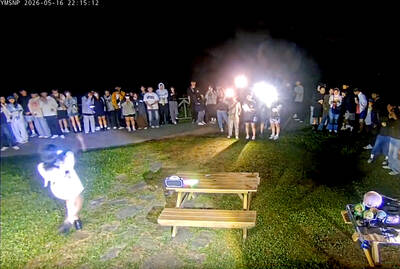
Yangmingshan National Park’s Qingtiangang (擎天崗) nature area has gone viral after a park livestream camera observed a couple in the throes of intimate congress, which was broadcast live on YouTube, drawing large late-night crowds and sparking a backlash over noise, bright lights and disruption to wildlife habitat. The area’s livestream footage appeared to show a couple engaging in sexual activity on a picnic table in the park on Friday last week, with the uncensored footage streamed publicly online. The footage quickly spread across social media, prompting a tide of visitors to travel to the site to “check in” and recreate the

Minister of Digital Affairs Lin Yi-ching (林宜敬) yesterday cited regulatory issues and national security concerns as an expert said that Taiwan is among the few Asian regions without Starlink. Lin made the remarks on Facebook after funP Innovation Group chief executive officer Nathan Chiu (邱繼弘) on Friday said Taiwan and four other countries in Asia — China, North Korea, Afghanistan and Syria — have no access to Starlink. Starlink has become available in 166 countries worldwide, including Ukraine, Malaysia, the Philippines and Vietnam, in the six years since it became commercial, he said. While China and North Korea block Starlink, Syria is not


 RSS
RSS