


Nine police officers have been listed as suspects in a bribery investigation involving car rental firms and motor vehicle offices in northern Taiwan, including one officer who allegedly received more than NT$1 million (US$33,568) in bribes from more than 100 people.
The officers allegedly received bribes from drivers who had been caught speeding and were at risk of having their licenses suspended for six months, for helping them exploit a loophole in Article 12 of the Road Traffic Management and Penalty Act (道路交通管理處罰條例).
The article states that drivers “operating a vehicle without license plates … shall be fined from NT$3,600 to NT$10,800.”
Instead of issuing a speeding ticket, the officers allegedly fined the drivers the minimum amount stated in the article and colluded with staff at local motor vehicle offices to expedite the issuance of new licenses, asking drivers for a bribe of NT$10,000 apiece.
Most bribes allegedly came from car rental firms and drivers of luxury vehicles.
New Taipei City prosecutors on Thursday coordinated searches in 29 locations, after investigating dozens of police officers in New Taipei City, Taoyuan and Hsinchu County over two years.
Prosecutors said they had been tipped off by other officers and staff at motor vehicle offices.
They questioned 79 people, 41 of whom were listed as witnesses or persons of interest, and 38 — including the officers, car rental firm staff and motor vehicle office employees — were listed as suspects, prosecutors said.
The officers under investigation are from New Taipei City’s Banciao (板橋) and Shulin (樹林) districts, Taoyuan’s Pingjhen (平鎮) and Bade (八德) districts, and Hsinchu County’s Jhubei City (竹北), they said.
Separately, Hualien County prosecutors have searched the office and residence of a deputy squad captain in Fonglin District (鳳林), who is suspected of colluding with an illegal logging operation.
Prosecutors said the officer, who heads the precinct’s criminal investigation section, allegedly helped members of the ring fell trees and collect driftwood in the Matai-an River (馬太鞍溪), including in December last year, by transporting timber in a police vehicle.
Prosecutors are questioning witnesses, and the officer and ring members are to face charges for breaching the Forestry Act (森林法), they said.
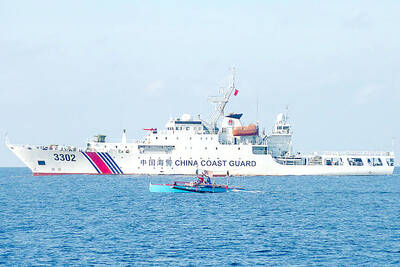
EXPANSIONIST: China deploys an average of 40 to 50 warships and coast guard vessels daily in the South China Sea, despite pledges not to militarize the region, an official said China is attempting to expand its influence across the First Island Chain and increase pressure on Japan by sending coast guard vessels into waters off of Taiwan under the pretext of maritime negotiations with Japan and the Philippines, a national security official said yesterday. China’s recent actions in the waters east of Taiwan and Japan and the Philippines’ exclusive economic zones (EEZ) are attempts to establish dominance in First Island Chain waters, said the official who declined to be named, adding that this is “expansion disguised as law enforcement.” Framing China’s actions solely as a cross-strait issue is a serious misjudgment that
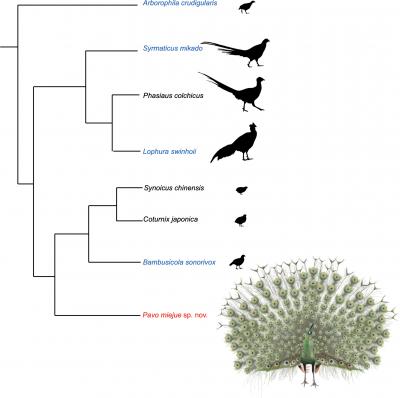
Through analyzing fossil evidence, a research team at National Taiwan University (NTU) discovered the largest endemic bird to have lived in Taiwan, naming it Pavo miejue, or extinct peafowl (滅絕孔雀). The Mikado pheasant, which is printed on the back of the NT$1,000 bank note, was previously believed to be the biggest endemic bird to Taiwan. The research team’s findings suggest that Pavo miejue lived during the Pleistocene epoch tens of thousands of years ago. It is the first endemic extinct bird species discovered and formally named in Taiwan. The study was coauthored by NTU Institute of Ecology and Evolutionary Biology professor Tsai Cheng-hsiu (蔡政修),
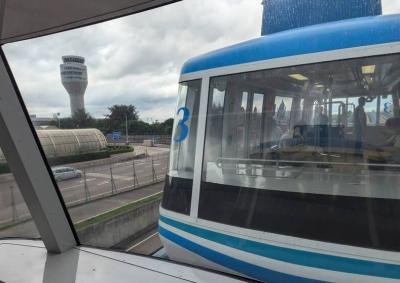
Taiwan Taoyuan International Airport is to suspend its automated Skytrain service connecting Terminal 1 and Terminal 2 starting on July 1 to facilitate connection works for the upcoming Terminal 3, the airport operator said today. Passengers and staff who need to travel between the two terminals after the suspension can instead use the Taoyuan MRT or the airport's 24-hour shuttle bus service, Taoyuan International Airport Corp said. The Taoyuan MRT Airport Line directly links the two terminals, while the shuttle buses are to operate around the clock, the company added. The Skytrain provides free transportation between the airport’s two terminals for travelers and
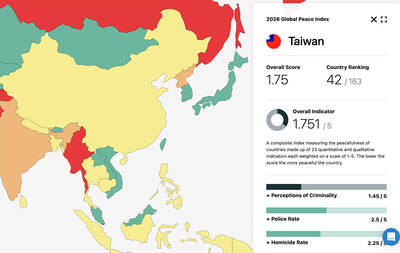
Taiwan ranked 42nd in terms of peacefulness among 163 countries, down five places from last year, according to this year’s Global Peace Index. With an overall score of 1.751, Taiwan dropped from 37th last year, the report published by the global Institute for Economics and Peace showed. The overall score measures a country’s level of peacefulness using 23 quantitative and qualitative indicators across three domains — ongoing domestic and international conflict, societal safety and security, and militarization. While Taiwan ranked 42nd worldwide, it was listed in ninth place among the 19 Asian-Pacific countries in the report, after New Zealand, Singapore, Japan, Malaysia,


 RSS
RSS