


Taipei’s annual Eid al-Fitr celebrations yesterday returned to Daan Forest Park after a two-year hiatus, with about 10,000 attendees enjoying an array of attractions, including a halal bazaar, outdoor cinema and interactive cultural exchange booths.
Festivalgoers were required to wear masks and observe social distancing amid rising COVID-19 cases nationwide.
They were also required to show proof that they had received at least two doses of an approved COVID-19 vaccine to enter venues such as the main stage, outdoor cinema and cultural experience area, organizers said, adding that attendees were also not allowed to eat or drink at the festival.
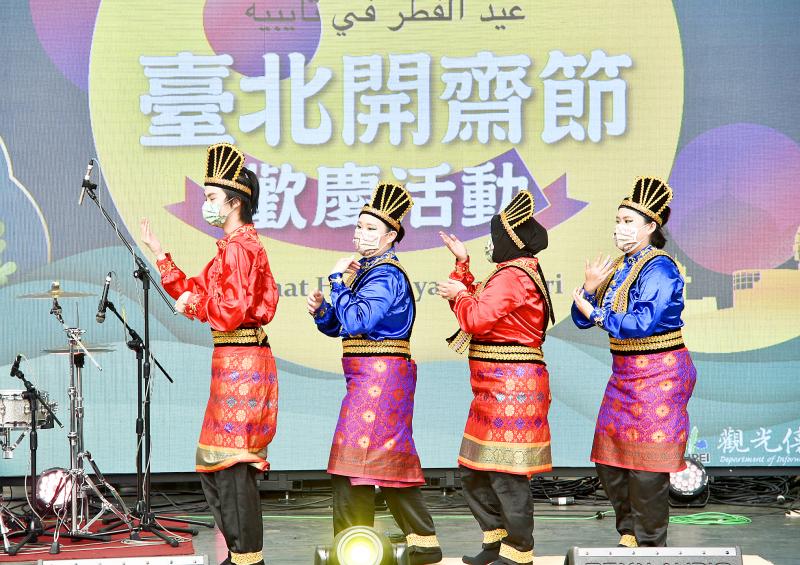
Photo: Peter Lo, Taipei Times
Indonesian festivalgoers Adi Putri, Dew and Tini said that despite high COVID-19 case numbers, their employers had still encouraged them to attend, asking only that they wear a mask and stay vigilant in avoiding close physical contact.
Ani, who is also Indonesian and said she has lived in Taiwan for eight years, said that although she had come with friends from her home country, they decided to stay out of the festival’s main venues as there was “too much hustle and bustle.”
However, she said some of her friends, many of whom work as caregivers for older people, were unable to attend because their employers had asked them not to go to events with large crowds amid the current outbreak.
Taipei Mayor Ko Wen-je (柯文哲) said in his speech at the opening of the festival that after a two-year pandemic-imposed hiatus, the city had resolved to celebrate Eid al-Fitr in Taipei this year despite the challenges.
Eid al-Fitr, also known as the Festival of Breaking the Fast, marks the end of the month-long dawn-to-dusk fasting of Ramadan.
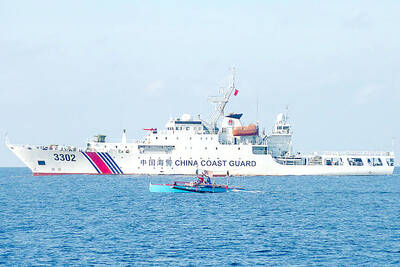
EXPANSIONIST: China deploys an average of 40 to 50 warships and coast guard vessels daily in the South China Sea, despite pledges not to militarize the region, an official said China is attempting to expand its influence across the First Island Chain and increase pressure on Japan by sending coast guard vessels into waters off of Taiwan under the pretext of maritime negotiations with Japan and the Philippines, a national security official said yesterday. China’s recent actions in the waters east of Taiwan and Japan and the Philippines’ exclusive economic zones (EEZ) are attempts to establish dominance in First Island Chain waters, said the official who declined to be named, adding that this is “expansion disguised as law enforcement.” Framing China’s actions solely as a cross-strait issue is a serious misjudgment that
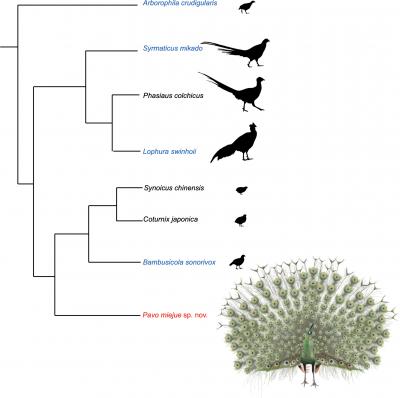
Through analyzing fossil evidence, a research team at National Taiwan University (NTU) discovered the largest endemic bird to have lived in Taiwan, naming it Pavo miejue, or extinct peafowl (滅絕孔雀). The Mikado pheasant, which is printed on the back of the NT$1,000 bank note, was previously believed to be the biggest endemic bird to Taiwan. The research team’s findings suggest that Pavo miejue lived during the Pleistocene epoch tens of thousands of years ago. It is the first endemic extinct bird species discovered and formally named in Taiwan. The study was coauthored by NTU Institute of Ecology and Evolutionary Biology professor Tsai Cheng-hsiu (蔡政修),
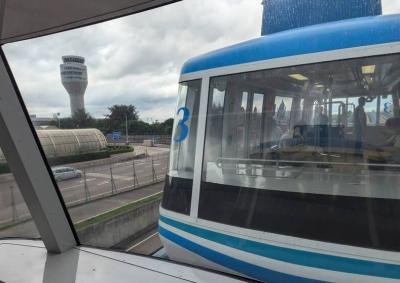
Taiwan Taoyuan International Airport is to suspend its automated Skytrain service connecting Terminal 1 and Terminal 2 starting on July 1 to facilitate connection works for the upcoming Terminal 3, the airport operator said today. Passengers and staff who need to travel between the two terminals after the suspension can instead use the Taoyuan MRT or the airport's 24-hour shuttle bus service, Taoyuan International Airport Corp said. The Taoyuan MRT Airport Line directly links the two terminals, while the shuttle buses are to operate around the clock, the company added. The Skytrain provides free transportation between the airport’s two terminals for travelers and
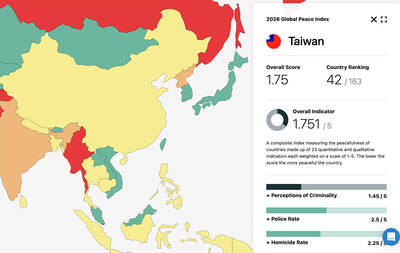
Taiwan ranked 42nd in terms of peacefulness among 163 countries, down five places from last year, according to this year’s Global Peace Index. With an overall score of 1.751, Taiwan dropped from 37th last year, the report published by the global Institute for Economics and Peace showed. The overall score measures a country’s level of peacefulness using 23 quantitative and qualitative indicators across three domains — ongoing domestic and international conflict, societal safety and security, and militarization. While Taiwan ranked 42nd worldwide, it was listed in ninth place among the 19 Asian-Pacific countries in the report, after New Zealand, Singapore, Japan, Malaysia,


 RSS
RSS