


Health experts yesterday called attention to ventilation, sanitation and COVID-19 vaccination for families with members who are quarantining at home, after the government on Friday announced that cases of the virus with no or mild symptoms would no longer have to quarantine in a dedicated facility.
Huang Chien-hsien (黃建賢), chief epidemiologist at Shinkong Wu Ho-su Memorial Hospital in Taipei, said that the dominant Omicron variant of SARS-CoV-2 is less severe than previous variants.
Huang said he supports the new policy, as tracking large numbers of asymptomatic cases is not cost-effective.
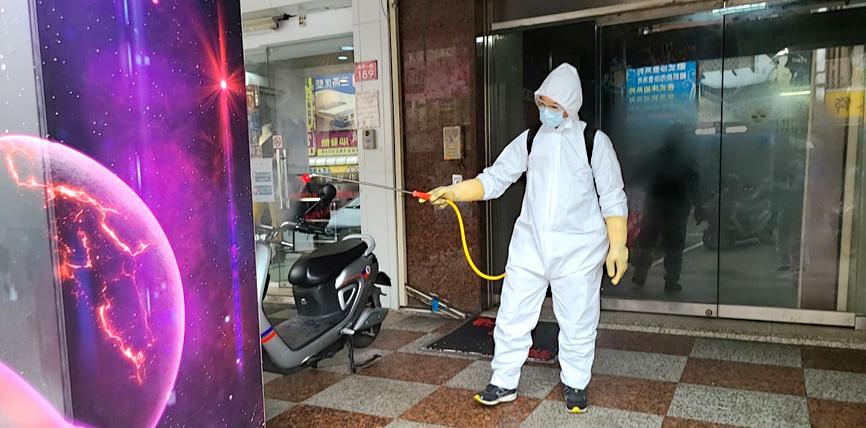
Photo courtesy of the Kaohsiung City Government
However, the policy requires people to be mindful not to put themselves in environments where they are at greater risk of being exposed to the virus, he said.
People interacting with family members quarantining at home should pay attention to ventilation and continually sanitize spaces where the infected person has been, he said, suggesting to use bleach or alcohol for cleaning.
COVID-19 is transforming into a flu or cold-like disease, and the pandemic could take six or seven months to run its course, China Medical University Hospital deputy superintendent Hwang Kao-pin (黃高彬) said.
“This should be viewed as a good development, so long as exponential growth in hospitalizations does not occur,” he said.
The Central Epidemic Command Center (CECC) has requested local health authorities to set up door-to-door vaccination campaigns to raise the vaccination rate among older residents, Hwang said.
Such campaigns could help prevent outbreaks similar to the one that killed many nursing home residents in Hong Kong, he added.
A Swedish study showed that unvaccinated people have a 60 percent chance of being infected by a home-quarantined person who has a high viral load, even if the person stays in a separate room and masking and social distancing rules are followed, said Chiu Cheng-hsun (邱政洵), deputy superintendent of Chang Gung Memorial Hospital in New Taipei City’s Linkou District (林口).
This means that the new policy poses risks of community spread, Chiu said.
The CECC now allows domestic cases who are younger than 65 and have mild or no symptoms to quarantine at home, except pregnant women and those regularly undergoing dialysis.
Home-quarantined cases must stay in a separate room from uninfected household members, and shared bathrooms and showers must be properly disinfected after each use, the guidelines released on Friday say.
Home quarantines are only allowed for households with fewer than four uninfected members.
Upon ending home quarantine, the infected person and anyone living with them must practice self-health management for seven days, with mandatory self-administered rapid tests on the third day and seventh day.
People can leave home quarantine if they test negative in a home test or a polymerase chain reaction test.
Cases who still test positive 10 or more days after their initial diagnosis may also leave home quarantine if their cycle threshold value is 30 or higher, they have not had a fever for 24 hours and their other symptoms are easing.

FUKUOKA SITUATION: Japanese media reported that the pathogen is expected to be identified by the summer, while the CDC downplayed the idea that it was hMPV A “mysterious cold-like illness” reported in Japan’s Fukuoka Prefecture does not seem to be a new disease, but Japanese authorities have been asked about the situation, the Centers for Disease Control (CDC) said yesterday. The Fukuoka Prefectural Medical Association on Wednesday told a news conference that a “mystery cold” that has become a hot topic on social media is “highly likely to be caused by some kind of viral infection,” Japan’s KBC News reported. “Many people are experiencing symptoms starting with a sore throat, followed by a runny nose, phlegm and a severe cough,” KBC News reported, citing association officials. Health authorities are

Nvidia Corp CEO Jensen Huang (黃仁勳) arrived in Taiwan yesterday ahead of upcoming AI and technology events, saying he plans to meet with clients and Taiwan Semiconductor Manufacturing Co Chairman C.C. Wei (魏哲家) during his visit. After landing at Taipei Songshan Airport, Huang posed for photos with fans and handed out Yakult drinks to reporters and supporters waiting at the scene, saying he has “a lot to do” during the trip. Asked about reports that Nvidia’s planned headquarters site in Taipei’s Beitou Shilin Technology Park could break ground on May 27, Huang said that if the company holds an event, he would

Carrefour Taiwan is to begin using a new name from the start of July, but it cannot divulge the name until then, the chairman of the supermarket chain's parent company said today. President Chain Store Co chairman Lo Chih-hsien (羅智先) was asked by reporters after a shareholders' meeting to confirm whether the company has settled on a new name for the supermarket brand. In March, the government-registered name of two Carrefour Taiwan branches was quietly changed to "Le Chia Kang" (樂家康) in Chinese, raising speculation that has been selected as the name. Lo said that because of local regulations and contractual obligations, the

The Philippines would likely be involved in any conflict over Taiwan due to its proximity to the democracy claimed by China, President Ferdinand Marcos Jr said, reiterating a stance that risks angering Beijing. “In the Philippines, we do not have a choice because Taiwan is so close to the Philippines and we have almost 200,000 Filipino nationals living and working in Taiwan,” Marcos said in an interview with Japanese media in Manila on Monday. The Philippine leader’s comments come ahead of a state visit to Japan next week, where he is to meet with Japanese Prime Minister Sanae Takaichi to discuss security


 RSS
RSS