


The Ministry of National Defense (MND) has denied that Chinese warplanes breached the airspace of the Taiwan-controlled Pratas Islands (Dongsha Islands, 東沙群島) in the disputed South China Sea.
The clarification was made late on Sunday after several media outlets reported an incursion into the territorial space of the Pratas Islands by the Chinese People’s Liberation Army (PLA) on Saturday.
The reports cited information released by a privately run Facebook page that regularly records the PLA’s incursions into Taiwan’s air defense identification zone (ADIZ).
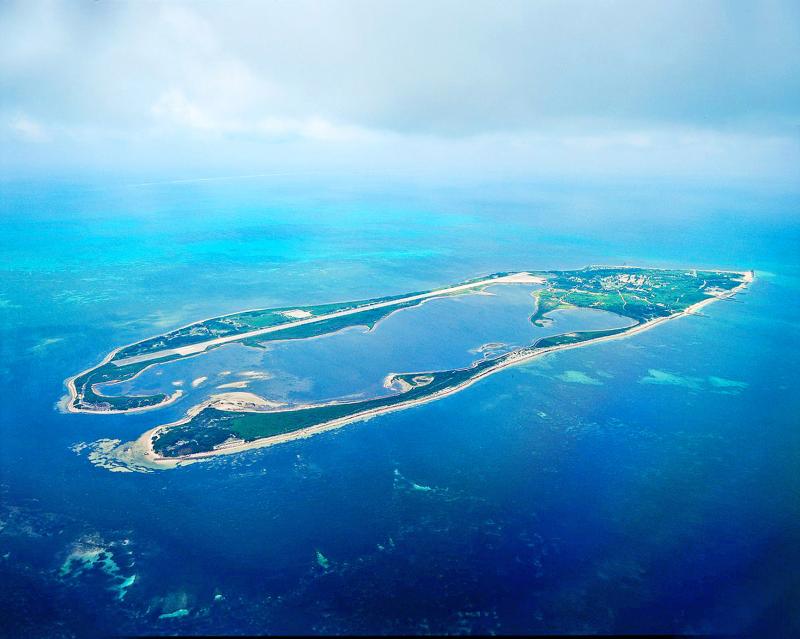
Photo provided by the Water Resources via CNA
According to an alleged transcript of a radio warning that the air force issued to the Chinese aircraft, an unnamed Taiwanese pilot told an unidentified PLA warplane: “You have entered our territorial airspace,” asking the aircraft to leave immediately.
The transcript was posted on a Facebook page titled “Taiwan’s Southwestern Airspace,” without an explanation of how the transcript was obtained.
It only said that the radio warning was issued when a number of PLA aircraft were spotted near the airspace of the Taiwan-controlled Pratas Islands.
However, the ministry dismissed the reports.
A chart of the flight routes released by the ministry showed that five PLA warplanes — three J-16 jets, one J-11 jet and one Y-8 tactical aircraft — flew into the ADIZ between Taiwan proper and the Pratas Islands on Saturday.
However, the chart showed that none of the Chinese aircraft intruded into the islands’ territorial airspace.
Without directly confirming or refuting the authenticity of the transcript on Facebook, the ministry said that “such a radio warning was issued as a ‘precautionary approach,’” without elaborating.
The ministry said that it has a “full grasp” on Chinese military maneuvers near waters and airspace surrounding Taiwan, and would take “appropriate responsive measures.”
ADIZs are areas declared by a country to allow it to identify, locate and control approaching foreign aircraft, but such zones are not considered territorial airspace.
A country’s territorial airspace extends 12 nautical miles (22km) from its coastline. Countries have the right to destroy a hostile aircraft that enters its territorial airspace without permission.
The Pratas Islands, which are almost 450km southwest of Kaohsiung, are one of two territories controlled by Taiwan in the South China Sea. The other is Itu Aba Island (Taiping Island, 太平島), which is about 1,500km southwest of Kaohsiung. Marine Corps-trained coast guard personnel are stationed on both territories.
However, the Ministry of National Defense last year said that it would temporarily post military personnel on the Pratas Islands in reaction to reports that the Chinese military was planning to conduct drills in the area.
The ministry did not elaborate on the number of troops it would deploy, their planned arrival date or how long they would stay.
Taiwan, Brunei, China, Indonesia, Malaysia, the Philippines and Vietnam all claim part of the South China Sea as their territory.

The military has spotted two Chinese warships operating in waters near Penghu County in the Taiwan Strait and sent its own naval and air forces to monitor the vessels, the Ministry of National Defense (MND) said. Beijing sends warships and warplanes into the waters and skies around Taiwan on an almost daily basis, drawing condemnation from Taipei. While the ministry offers daily updates on the locations of Chinese military aircraft, it only rarely gives details of where Chinese warships are operating, generally only when it detects aircraft carriers, as happened last week. A Chinese destroyer and a frigate entered waters to the southwest

Japanese Prime Minister Sanae Takaichi’s comment last year on Tokyo’s potential reaction to a Taiwan-China conflict has forced Beijing to rewrite its invasion plans, a retired Japanese general said. Takaichi told the Diet on Nov. 7 last year that a Chinese naval blockade or military attack on Taiwan could constitute a “survival-threatening situation” for Japan, potentially allowing Tokyo to exercise its right to collective self-defense. Former Japan Ground Self-Defense Force general Kiyofumi Ogawa said in a recent speech that the remark has been interpreted as meaning Japan could intervene in the early stages of a Taiwan Strait conflict, undermining China’s previous assumptions
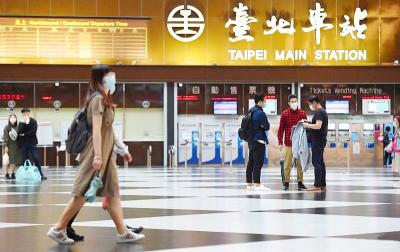
Taiwan Railways Corp (TRC) today announced that Shin Kong Mitsukoshi has been selected as the preferred bidder to operate the Taipei Railway Station shopping mall, replacing the current operator, Breeze Development Co Ltd. Among eight qualified firms that delivered presentations and were evaluated by a review committee, Shin Kong Mitsukoshi was ranked first, while Breeze was named the runner-up, the rail company said in a statement. Contract negotiations are to proceed in accordance with regulations, it said, adding that if negotiations with the top bidder fail, it could invite the second-ranked applicant to enter talks. Breeze in a statement today expressed doubts over

UNFOUNDED CONCERNS: Public concerns that allowing Indian workers to come and work in Taiwan would lead to increased sex crimes are baseless, the labor ministry said Amid public concern over the government’s plan to bring Indian workers to Taiwan, the Ministry of Labor (MOL) pointed to past intake and said that public safety remained stable. Minister of Labor Hung Sun-han (洪申翰) on April 9 told the legislature that the first group of Indian workers could arrive as early as the end of this year. Taiwan and India signed a memorandum of understanding (MOU) in February 2024 to address Taiwan’s labor shortage. The MOU was sent to the Legislative Yuan for review in mid-2024 and received cross-party backing, prompting the MOL to begin follow-up negotiations with India, Hung said. Public


 RSS
RSS