


A bill to establish a ministry of digital development is expected to pass a third reading at the legislature today, a source said on Saturday.
If the bill is passed, the Executive Yuan would assemble a task force to prepare for the new ministry, likely requiring six to seven months, the source said.
The ministry would develop the software and digital service industries, upgrade traditional industries and other enterprises, and create a globally competitive and innovative base in digital technologies, Minister Without Portfolio Kuo Yau-hwang (郭耀煌) said on March 25.
The ministry would also oversee interdepartmental coordination on cybersecurity, and foster a domestic cybersecurity technology sector, he said.
In response to a proposal by the Executive Yuan that a cybersecurity bureau and national cybersecurity research institute be established as part of the new ministry, several lawmakers across party lines had suggested that a separate agency to focus on economic and scientific applications of digital technology also be established.
The specifics of such an agency remain to be worked out by lawmakers, the source said.
“The proposed ministry has a high degree of support among lawmakers, so if a consensus can be reached on all the details, it is likely the bill will be passed,” the source said.
Other bills that the Executive Yuan is to vote on at today’s session include an amendment to the Act of Gender Equality in Employment (性別工作平等法) to raise the number of days that employees can leave work for monthly pregnancy-related medical appointments and a four-year extension to a licensing tax exemption for electric vehicles.
A bill to resolve legal issues arising from private schools exiting the market amid a declining birthrate is also on the agenda, the source said.
If the bill regarding the new ministry is not passed today, it would be rescheduled for an extraordinary session next month, the source said.
The proposed amendment to the Act of Gender Equality in Employment would increase the number of leave days from the current five to eight or 10, and lawmakers hope for a quick resolution on the bill, the source said.
The private-schools bill would determine whether the government could appropriate property belonging to private high schools, vocational schools and colleges that exit the market, the source said.
The government should allow lower-ranked private universities to leave the market and claim the properties, while improving resources in higher education and directing investment toward private universities, Lin Po-yi (林柏儀), head of organization at the Taiwan Higher Education Union, said on Jan. 20 last year.
If the Vehicle License Tax Act (使用牌照稅法) is amended today, it would extend a tax exemption for electric vehicles and benefit an estimated 11,000 new vehicle owners annually while helping the environment, the source said.

The military has spotted two Chinese warships operating in waters near Penghu County in the Taiwan Strait and sent its own naval and air forces to monitor the vessels, the Ministry of National Defense (MND) said. Beijing sends warships and warplanes into the waters and skies around Taiwan on an almost daily basis, drawing condemnation from Taipei. While the ministry offers daily updates on the locations of Chinese military aircraft, it only rarely gives details of where Chinese warships are operating, generally only when it detects aircraft carriers, as happened last week. A Chinese destroyer and a frigate entered waters to the southwest
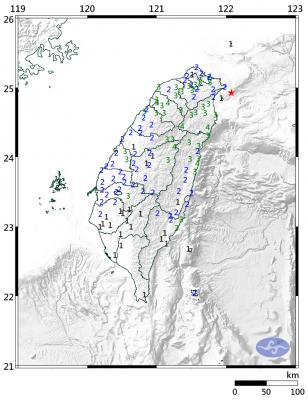
A magnitude 6.1 earthquake struck off the coast of Yilan County at 8:39pm tonight, the Central Weather Administration (CWA) said, with no immediate reports of damage or injuries. The epicenter was 38.7km east-northeast of Yilan County Hall at a focal depth of 98.3km, the CWA’s Seismological Center said. The quake’s maximum intensity, which gauges the actual physical effect of a seismic event, was a level 4 on Taiwan’s 7-tier intensity scale, the center said. That intensity level was recorded in Yilan County’s Nanao Township (南澳), Hsinchu County’s Guansi Township (關西), Nantou County’s Hehuanshan (合歡山) and Hualien County’s Yanliao (鹽寮). An intensity of 3 was

Japanese Prime Minister Sanae Takaichi’s comment last year on Tokyo’s potential reaction to a Taiwan-China conflict has forced Beijing to rewrite its invasion plans, a retired Japanese general said. Takaichi told the Diet on Nov. 7 last year that a Chinese naval blockade or military attack on Taiwan could constitute a “survival-threatening situation” for Japan, potentially allowing Tokyo to exercise its right to collective self-defense. Former Japan Ground Self-Defense Force general Kiyofumi Ogawa said in a recent speech that the remark has been interpreted as meaning Japan could intervene in the early stages of a Taiwan Strait conflict, undermining China’s previous assumptions
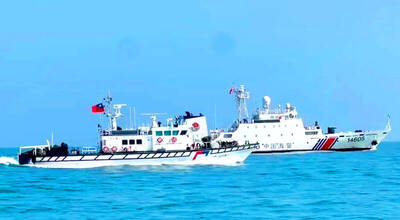
Instead of focusing solely on the threat of a full-scale military invasion, the US and its allies must prepare for a potential Chinese “quarantine” of Taiwan enforced through customs inspections, Stanford University Hoover fellow Eyck Freymann said in a Foreign Affairs article published on Wednesday. China could use various “gray zone” tactics in “reconfiguring the regional and ultimately the global economic order without a war,” said Freymann, who is also a nonresident research fellow at the US Naval War College. China might seize control of Taiwan’s links to the outside world by requiring all flights and ships entering or leaving Taiwan


 RSS
RSS