


Taichung legislative candidate Yen Kuan-heng (顏寬恒) on Monday condemned a judicial probe into allegations that he might have breached election rules by providing lavish meals during his election campaign.
Yen, the Chinese Nationalist Party’s (KMT) candidate in Taichung’s second electoral district by-election, said that public prosecutors had questioned several borough wardens and other local residents over the meals.
“This is the judiciary trying to instill fear in people who support me in the by-election,” he said.
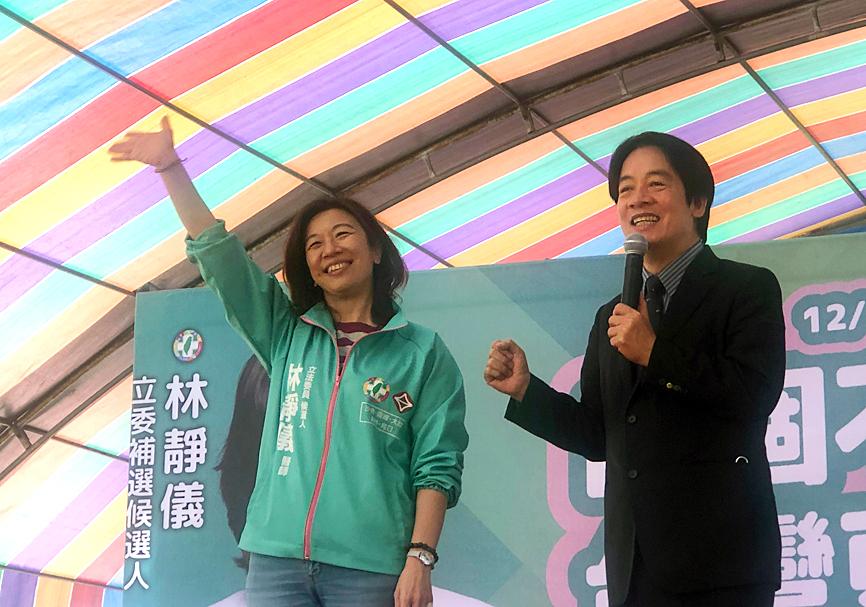
Photo: CNA
Taichung prosecutors over the weekend investigated Yen’s campaign activities, with 26 people taken in for questioning, including four borough wardens.
Yen said that organizing rallies and providing meals to supporters during election campaigns are a tradition.
“This is the usual way for candidates to canvass votes and get to know the local people. DPP [Democratic Progressive Party] politicians had done it, too, in past elections,” he said. “If the judiciary wants to focus on me, then it should pass a law prohibiting me from canvassing and organizing such events until the by-election on Jan. 9.”
Asked about Yen’s complaint, his main rival, DPP candidate Lin Ching-yi (林靜儀), said that Yen was trying to shift the focus away from him and evade the core issue of who provided funding for Yen to organize so many banquets or all-you-can-eat buffets for his campaign.
“It is clearly the judiciary’s duty to conduct an investigation, as it involves allegations of vote-buying. If these activities are legitimate, then we must ask Yen to tell the public who paid for them and how much was spent,” Lin said.
Local residents and Taichung city councilors had posted photographs and videos of the events, showing attendees partaking of free meals that included fried fish, stewed pork, roasted chicken, squid and fish balls, fried rice vermicelli, noodles, meatball soup and assorted vegetable dishes.
Taichung City Councilor Chen Shih-kai (陳世凱) said that such a meal would cost more than NT$100 to NT$200 per person, and that the Yen family had held these banquets every day for the past month, with more than 20 to 30 tables per event.
Chen said that could be constituted as “vote buying” and contravenes election rules limiting candidates to giving gifts valued at NT$30 at most.
“The Yen family has the full cooperation of local borough wardens, who made lists of neighborhood residents and organized transportation to take people to the rallies, listen to speeches by Yen and KMT members, promote Yen’s plans and promises, urge them to vote, as well as canvass family and friends to support Yen,” Chen added.
Another controversy broke out when Dadu District Agriculture Cooperative Association chairman Chao Chiu-sen (趙秋森), speaking at Yen’s rally on Saturday, said: “I have a good friend, and his son is a homosexual. He wore a bikini to attend a protest at Ketagalan Boulevard in Taipei. My friend was quite ashamed of it.”
“I told him that your son was born with such a sexual orientation, so there is nothing you can do,” Chao said.
He replied that even so, his son did not have to flaunt his sexuality with a large group of people, Chao added.
“So this is what Taiwan has become, for homosexual people to flaunt ... ostentatiously show off their sexuality in public. Why has our society become like this? We are talking about a legislative election here, and the main reason is because we have too many DPP legislators,” Chao said.
Asked about Chao’s comments, Lin told reporters: “KMT members are always inciting prejudice against people with a different sexual orientation at every election... They make false claims about some gala events or parades as if they were taking place every day.”
“The KMT is using these scare tactics to threaten people who have mainly conservative values,” she said.

The military has spotted two Chinese warships operating in waters near Penghu County in the Taiwan Strait and sent its own naval and air forces to monitor the vessels, the Ministry of National Defense (MND) said. Beijing sends warships and warplanes into the waters and skies around Taiwan on an almost daily basis, drawing condemnation from Taipei. While the ministry offers daily updates on the locations of Chinese military aircraft, it only rarely gives details of where Chinese warships are operating, generally only when it detects aircraft carriers, as happened last week. A Chinese destroyer and a frigate entered waters to the southwest
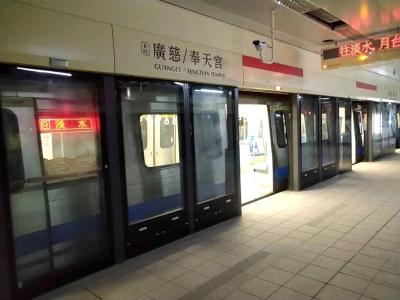
The eastern extension of the Taipei MRT Red Line could begin operations as early as late June, the Taipei Department of Rapid Transit Systems said yesterday. Taipei Rapid Transit Corp said it is considering offering one month of free rides on the new section to mark its opening. Construction progress on the 1.4km extension, which is to run from the current terminal Xiangshan Station to a new eastern terminal, Guangci/Fengtian Temple Station, was 90.6 percent complete by the end of last month, the department said in a report to the Taipei City Council's Transportation Committee. While construction began in October 2016 with an
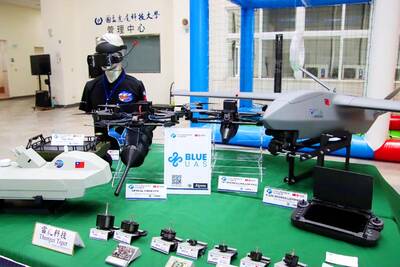
NON-RED SUPPLY: Boosting the nation’s drone industry is becoming increasingly urgent as China’s UAV dominance could become an issue in a crisis, an analyst said Taiwan’s drone exports to Europe grew 41.7-fold from 2024 to last year, with demand from Ukraine’s fight against Russian aggression the most likely driver of growth, a study showed. The Institute for Democracy, Society and Emerging Technology (DSET) in a statement on Wednesday said it found that many of Taiwan’s uncrewed aerial vehicle (UAV) sales were from Poland and the Czech Republic. These countries likely transferred the drones to Ukraine to aid it in its fight against the Russian invasion that started in 2022, it said. Despite the gains, Taiwan is not the dominant drone exporter to these markets, ranking second and fourth

Japanese Prime Minister Sanae Takaichi’s comment last year on Tokyo’s potential reaction to a Taiwan-China conflict has forced Beijing to rewrite its invasion plans, a retired Japanese general said. Takaichi told the Diet on Nov. 7 last year that a Chinese naval blockade or military attack on Taiwan could constitute a “survival-threatening situation” for Japan, potentially allowing Tokyo to exercise its right to collective self-defense. Former Japan Ground Self-Defense Force general Kiyofumi Ogawa said in a recent speech that the remark has been interpreted as meaning Japan could intervene in the early stages of a Taiwan Strait conflict, undermining China’s previous assumptions


 RSS
RSS